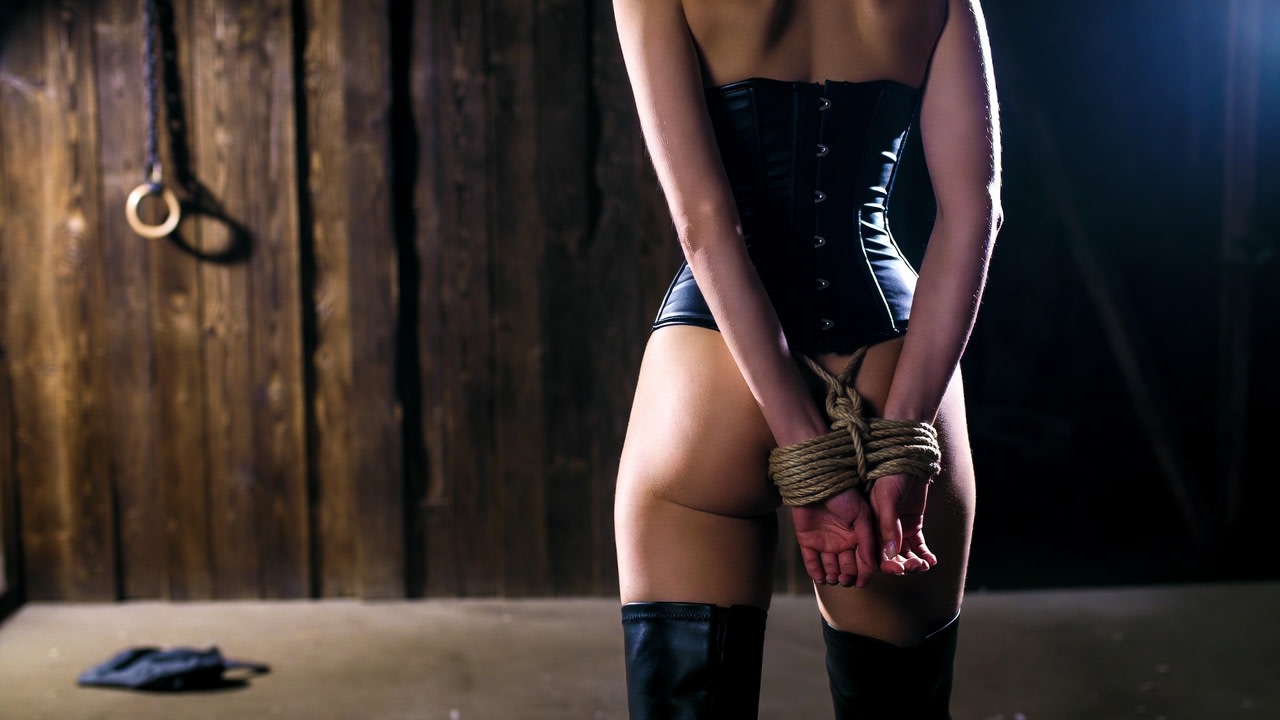
Look at what is not happening.
No implement has been lifted. No command is being spoken. No hand rests on her shoulder. There is only a woman standing in a quiet room of old wood and low amber light, her back to the door, her wrists crossed at the base of her spine and wrapped — carefully, deliberately, several turns deep — in plain natural rope. Her corset is laced. Her boots are planted. The rings on the wall hang empty. Whoever tied her has stepped away.
And she is still there.
That is the whole scene. And if you understand why that scene is enough — why it might be the most charged image in the entire vocabulary of rope — then you already understand something most people take years to learn: the simplest tie asks for the most.
The standing wrist tie: rope at its most honest
Rope bondage has its cathedrals. Elaborate chest harnesses, full-body patterns, suspensions that turn a person into architecture. They are beautiful, and they have their place.
But the wrists-behind-the-back tie is where rope tells the truth. There is nowhere for either of you to hide inside it. No decorative complexity to admire, no technical difficulty to hide behind. Just a few honest wraps, a knot placed where her fingers cannot reach it, and a decision — hers — to let her hands be taken out of the conversation.
Think about what hands are. Hands explain. Hands defend. Hands fidget, gesture, check phones, fix hair, hold doors, brace falls. Hands are how we negotiate with the world. When she crosses her wrists behind her back and offers them, she is not giving up an accessory. She is giving up her interface. What remains is her breath, her posture, her attention — and the rope, holding its one simple promise.
Why behind the back matters
Wrists bound in front is a beginning. Wrists bound behind is a statement.
In front, she can still see her hands, still bring them up, still keep them between her body and whatever comes. Behind her back, the tie opens her. Chest lifted by the corset, shoulders drawn gently rearward, the whole front of her body presented without a shield. She cannot see the knot. She can only feel it — the flat press of the wraps, the small weight of the working end against her palms — and trust that it was tied by someone who knew exactly what they were doing.
That is the quiet genius of this position: it converts anatomy into vocabulary. The body says I am not holding anything back without a single word being spoken.
The wait is the scene
Here is what the photograph knows that a hurried mind misses: the rope is not the point. The waiting is.
She has been placed facing the wall. The grain of the old boards is close enough to study. Somewhere behind her, the room continues — a floor, a doorway, footsteps that may or may not be approaching. She cannot check. Checking is exactly what has been taken from her.
So time changes texture. The first minute is ordinary. The third is not. Warmth gathers where the rope holds her; her own pulse becomes audible in her wrists. Every small sound behind her — a board settling, a breath, nothing at all — arrives with the volume turned up. Anticipation stops being an idea and becomes a physical weight, pleasant and heavy, settling low in the body.
This is what we mean when we say stillness is not passive. Standing bound and waiting is work. It is attention, gathered and offered. Any body can be tied; it takes a devoted one to stay — to keep the shoulders soft, the breath long, the mind inside the room instead of racing ahead of it. The wait is not the pause before the scene. The wait is the scene.
What she gets out of it
Ask someone who loves this position what happens in that long quiet and the answers rhyme: my thoughts finally stop. I can't do anything, so I stop trying to do everything. I feel held even when no one is touching me.
The rope does what willpower cannot. It makes the decision once, at the moment of the tie, so she doesn't have to keep making it. Surrender by the second is exhausting; surrender by the knot is restful. The wraps around her wrists are the decision, made physical, holding steady so she can stop holding anything at all.
That is why so many describe the feeling not as confinement but as relief — the same paradox that runs through everything we do here: the restraint is the freedom. Within the rope, nothing is required of her except presence. When was the last time the world asked so little and meant it?
What the one who ties carries
Now turn the scene around. Someone tied those wrists and walked away — and carried the heavier half of the exchange with them.
Because the wait only works if it is safe to wait. Her stillness is built on a hundred invisible certainties: that the rope lies flat and wide where it holds her, that her fingers stay warm and answering, that the tie releases in seconds if it must, that the person who left the room has not actually left her — that she is, in every moment of that silence, being kept.
This is the discipline on the dominant side of the knot. Not the tying itself, which any diligent student can learn, but the holding: the awareness that never wanders even when the body does, the checking that looks like a caress, the patience to let the wait do its slow, deep work without rushing to the next thing. She surrenders her hands. You surrender your distraction. That is the trade, and it is only fair.
The knot as a kept promise
A knot is a small contract written in fiber. Negotiated before, honored during, released after — and remembered long after the rope is coiled and hung back on its hook. The marks fade in an hour. The proof that someone said be still, I have you and then made it true — that stays.
This is why we say rope is less about restraint than about its keeping. Anyone can tie a wrist. Not everyone can be trusted with one.
Begin where the photograph begins
If this image stirs something in you — the crossed wrists, the patient wall, the long amber quiet — you do not need a dungeon or a suspension ring to answer it. You need what the picture contains: a rope, a room, a person you trust, and an agreement made in daylight before anything is tied.
Keep it simple. Wrists crossed, wraps flat and unhurried, snug enough to be felt with every small movement, never tight enough to bite. Check her fingers. Place her somewhere steady. And then give her the one gift this whole practice is secretly about:
Time.
Let her stand in it. Let the quiet thicken and the pulse rise and the wait ripen into something neither of you will find anywhere else. The rings on the wall can stay empty. The rest of the toybox can stay closed. One knot, well tied and well kept, asks for everything — and gives more back.
Stand still. Breathe. You are held.
— Mistress Krigar