She walks ahead of you, and she does not look back.
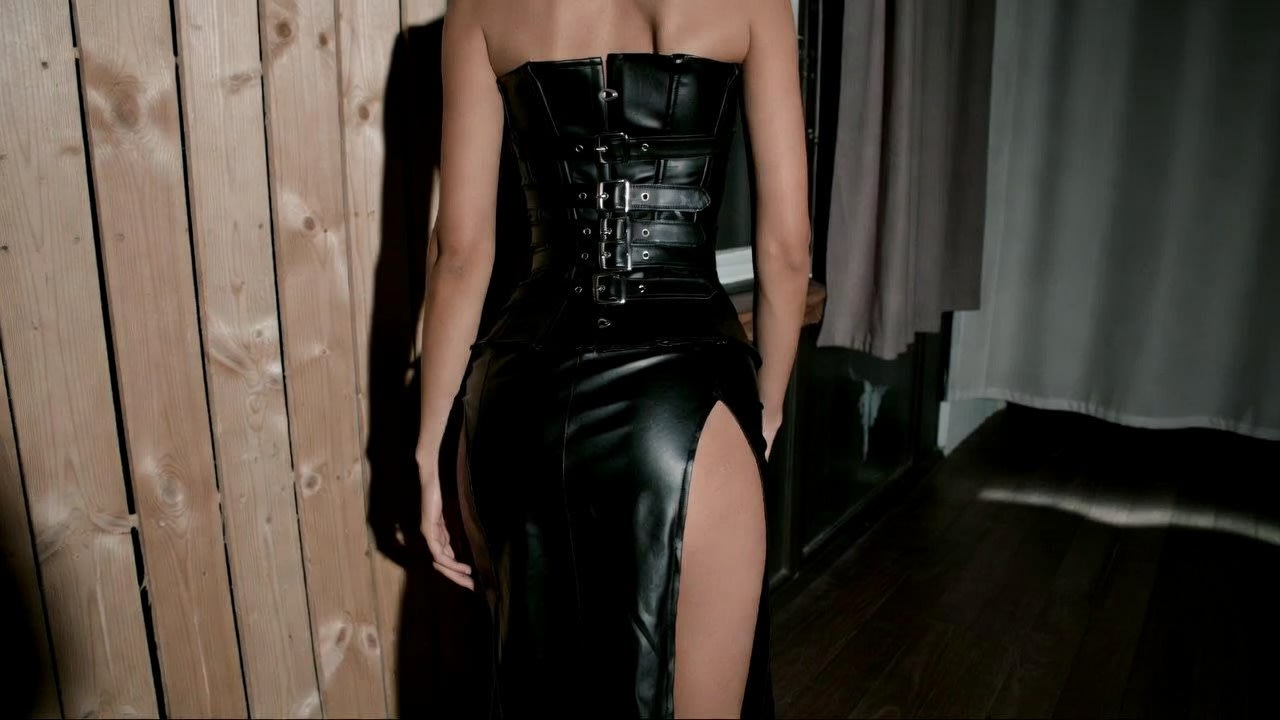
You see the room the way the cover of this piece shows it: pale wood on one side, shadow on the other, and her in the middle of it — leather laced and buckled down the spine, a long skirt cut high enough to move in, low light catching the curve of a shoulder. Her face is not offered to you. Her back is.
Most people read a turned back as dismissal. In a power exchange, it is the opposite. It is an instruction, an invitation, and a test of attention, all in one quiet gesture. Tonight I want to walk you through it. Slowly. Two steps behind me, please.
The Turned Back Is Not Absence
When a dominant turns her back on the one who serves her, nothing has been withdrawn. Her attention has simply changed shape.
Facing you, she watches you. Turned away, she listens to you. She hears whether your footsteps keep pace. She feels whether you crowd her at the doorway or hold the distance she has set. She knows, without a single glance, whether you are where you are supposed to be.
That is the first lesson of following: you are never unobserved. You are observed differently. A dominant who walks ahead of you is telling you something precise — I trust you at my back, and I expect you to be worthy of that trust. In a lifestyle built on consent and attention, there are few statements heavier than that one.
Think about what a back actually is. It is the one part of the body its owner cannot defend, cannot watch, cannot dress without effort. To show it calmly, deliberately, to another person — and to keep walking — is not carelessness. It is sovereignty.
Buckles You Cannot Reach
Look at the corset again. The buckles run down the back, stacked like rungs. She cannot see them while she wears them. Some of them she could not even close alone.
This is one of leather's oldest, quietest truths: the hardware of dominance often sits where the dominant herself cannot reach. Someone kneels behind her and works each buckle closed, one by one, from the bottom up. Someone is trusted with the tension — snug, never cruel — and with the stillness the task requires.
If you have ever been permitted to dress the woman you serve, you know it is not a chore. It is a ceremony with your hands. The leather resists a little, the way anything worth doing resists a little. The buckle finds its notch with a small metal sound that a quiet room makes almost loud. And when the last one is closed, she rolls her shoulders once, testing the hold, and what you have built together settles into place: her composure, made of hide and steel and your careful fingers.
Then she walks away from you. Of course she does. That is what the dressing was for. And every buckle you closed is now facing you as she goes — your own work, worn on her spine like a signature you were allowed to leave.
Walking Behind: A Protocol of Attention
Following is one of the oldest protocols in the dynamic, and one of the most misunderstood. Outsiders see it as smallness — trailing after someone like a shadow. Practiced properly, it is the opposite of passive. It is a discipline of complete attention.
Two steps, no more
The classic form is simple. Two steps behind, slightly to one side. Close enough to serve, far enough to see. You match her pace instead of setting your own. When she slows, you slow before you think about it. When she stops, you stop — not stumbling into her, not drifting past her. Just there.
Try it once and you will discover how much lazy walking you have done in your life. Following well demands that you read another person's body continuously: the set of her shoulders, the rhythm of her heels on the floorboards, the small hesitation that means she is about to turn. Your eyes learn her back the way a sailor learns weather.
Doorways, stairs, and the small tests
Every home is full of thresholds, and every threshold is a question. Do you reach past her for the door, unasked? Do you wait? Has she taught you what she prefers? Protocol is not a rulebook downloaded from somewhere — it is the specific grammar the two of you have written together, and doorways are where the grammar shows.
A well-trained follower does not guess. He knows, because he has paid attention, because it has been discussed in daylight, calmly, with consent laid out plainly — and because he has practiced until the knowing lives in his body instead of his worry.
The Slit in the Skirt: Revelation on Her Terms
A long leather skirt with a high slit is a small essay on power all by itself.
The skirt conceals. The slit reveals. And the crucial word is hers — the choice of what is seen, when, and for how long belongs entirely to the woman wearing it. A step opens the line of a thigh; the next step closes it. You are not taking anything in. You are being shown something, one stride at a time, on a schedule you do not control.
This is the whole architecture of desire in a power exchange, sewn into a garment. Anticipation is not a delay before the good part. Anticipation is the good part, or at least the part that makes everything after it matter. She walks, the leather parts and falls, parts and falls, and you follow, and the rhythm of it teaches you patience better than any lecture could.
Learn to love what is withheld. Not because you are denied — but because withholding is how she frames what she eventually gives, the way a dim room frames a lit doorway.
What Following Teaches
I will tell you plainly what years of this practice build in a person, because the list is worth more than any single evening.
Patience. Not the gritted-teeth kind. The settled kind, where waiting stops being a cost and becomes a place you can live comfortably.
Attention. Following trains you to notice one person completely — their pace, their mood, their smallest signals. That attention does not switch off when the leather comes off. It makes you better at every relationship you have.
Trust, in both directions. She trusts you at her back. You trust that she is leading you somewhere worth going. Neither trust is assumed; both are earned, conversation by conversation, walk by walk. This is why we talk so much about consent in this lifestyle — not as paperwork, but as the load-bearing wall of everything beautiful built on top of it.
Calm. There is a particular stillness that comes from knowing exactly where you belong in a room. Two steps behind her is not a small place. It is a precise one. Precision is restful.
Bring It Home
You do not need a manor with wooden walls and long corridors. You need one room and one agreement.
Tonight, or some night soon, let her walk ahead of you — from the kitchen to the window, from the window to the chair. Your only task: keep your distance honest and your attention complete. No phone in your pocket, no thought of what comes after. Just her back, her pace, and the sound of two people walking almost in step, one of them leading because she chooses to, one of them following for exactly the same reason.
If she wears something with buckles, close them for her. From the bottom up. Slowly. Then step back and let her turn away from you, and notice what rises in you when she does — not loss, but purpose.
She walks ahead. You follow. The room is quiet, the leather creaks softly, and everything is exactly where it belongs.
— Mistress Krigar