There is no one else in the room. That is the first thing you notice, and the last thing you forget.
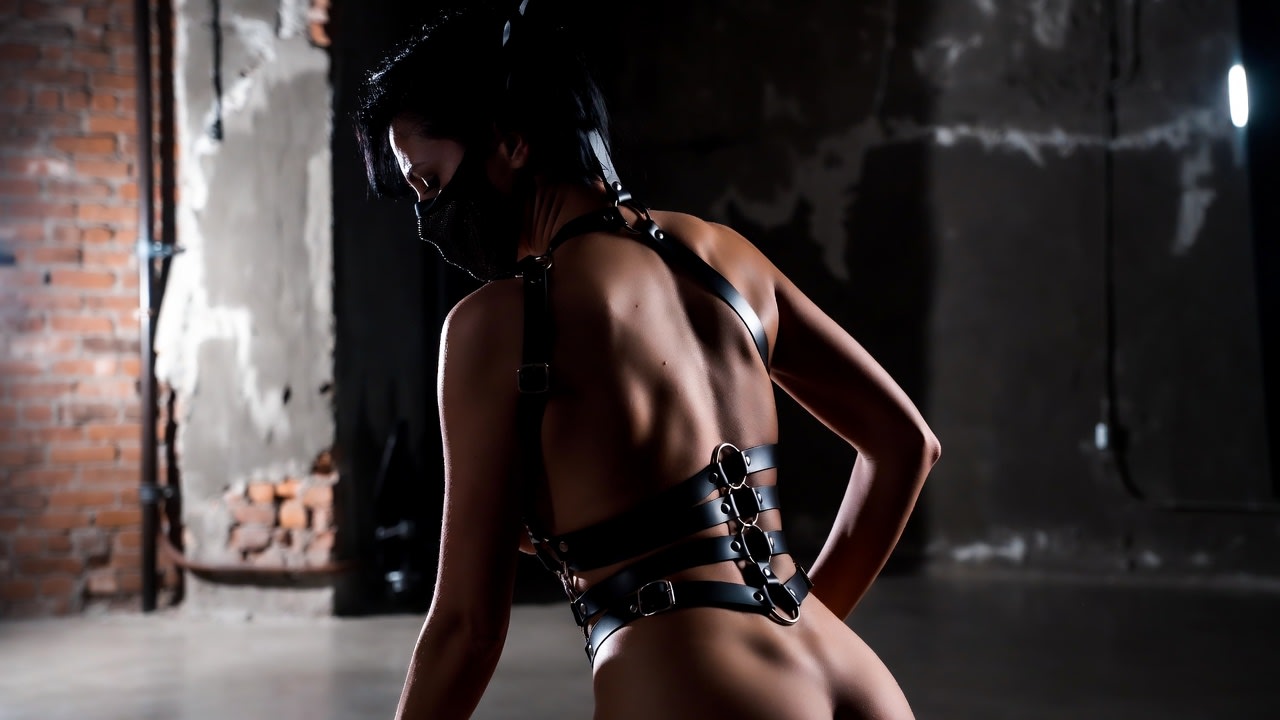
Brick on one side, raw concrete on the other. A floor polished smooth by nothing in particular. One cold light at the far wall. And in the middle of all that emptiness: a body, seen from behind, folded low. Leather straps down the spine. Rings that catch the light and hold it. No dominant standing over her. No leash. No voice giving orders.
She is practicing.
Most people think surrender needs an audience. They imagine it can only exist in the space between two people — one who commands, one who obeys. Take away the eyes, they assume, and the whole thing collapses like a scene when the lights come up.
They are wrong. And the bare room knows it.
The Room That Offers Nothing
Look at where she has chosen to kneel. Not a bedroom. Not a dungeon dressed in velvet. A raw, unfinished space — brick, mortar, concrete, dust. A room with nothing to give her.
That is precisely the point.
A finished room flatters you. It hands you atmosphere on a tray: the candles, the low red light, the music that tells your body what to feel before you have earned the feeling. There is nothing wrong with atmosphere. I use it myself, deliberately, the way I use everything.
But a bare room is honest. It reflects nothing back at you except what you brought in. If you kneel in a space like this and the surrender still rises in you — slow, warm, unmistakable — then you know it was never the candles. It was never the room at all.
It was you. It was always you.
The Harness You Buckle Yourself
There is a particular intimacy in being dressed by the one you serve. I have written about it before: the stillness, the ceremony, the hands that are not your own drawing each strap tight.
But there is another intimacy, quieter and far less discussed, in doing it alone.
Watch what it asks of you. You take the harness from its hook. You feel the weight of it — leather has a seriousness that fabric never learns. You work each buckle yourself, reaching behind your own back, pulling each strap to the tension you know is right. No one checks your work. No one corrects you.
Which means every strap is a promise you make to yourself.
This is what solo practice reveals: the harness was never only about being held by someone else. It is a frame. A structure your body learns to recognize. When you buckle it on alone, in an empty room, you are telling yourself — in the language of leather and tension — I am still this, even now, even here, even with no one to see it.
The row of rings
Down her lower back, a ladder of steel rings. Anchor points with nothing anchored to them. Some would call that incomplete. An invitation not yet answered.
I call it patience made visible.
A ring does not stop being a ring because nothing is clipped to it. It waits. It holds its shape. It stays ready. That is not emptiness — that is discipline in its purest form. The readiness itself is the practice.
Discipline Without an Audience
Here is a truth I have learned from years of training submissives, and it may sting a little: obedience that only exists when it is observed is not obedience. It is performance.
Performance has its place. Performance can be beautiful. But it is not the foundation anything lasting gets built on.
The foundation is what you do at eleven on an ordinary evening, in an ordinary room, when no one has asked anything of you. It is the posture you take when there is no one to praise it. The ritual you keep when skipping it would cost you nothing — nothing except the person you are trying to become.
Athletes understand this without romance. No one runs the race for you, and no one runs the training either. The race is the visible part, the small tip of something enormous and private. Every serious discipline on this earth is built in the unwatched hours.
Why would surrender be any different?
What the Solitary Hour Teaches
Posture
Begin with the body, because the body is the honest one. Alone, you learn what your posture actually is — not the version you produce under a gaze, but the true one. Kneel. Fold forward. Feel where the harness pulls and where it rests. Hold the position one breath longer than comfortable. Then one more.
The body keeps what it repeats. When someone worthy finally does stand behind you, your spine will already know the shape of respect. You will not be improvising. You will be remembering.
Stillness
Stillness alone is harder than stillness observed. There is no one to disappoint but yourself, and the self is so easily forgiven. The itch, the shift, the glance at the phone — no one would know.
You would know.
So the solitary hour becomes a negotiation between who you are and who you claim to be. Five minutes of true stillness in an empty room is worth an evening of elegant posing under someone's eyes. It is the difference between a photograph of strength and strength.
Ritual
And then there is the ritual itself — the sequence, kept the same way each time. The harness in the same order. The same corner of the room. The same slow descent. Ritual is how the body marks a border: on this side, the ordinary day; on that side, the practice.
Kept alone, a ritual stops being something you do and becomes something you are. That is the whole aim of training. Not obedience as an event. Obedience as a nature.
The Turned Back
Notice, finally, what the image does not show you: her face.
She has her back to us. To the camera, to the room, to anyone who might be standing at the door. And a turned back, in this life, is never nothing. Between strangers it is dismissal. Between lovers it can be an argument. But in surrender, the turned back is a declaration of a different kind:
I am not performing for you. I am not monitoring your reaction. I am doing my work.
There is a freedom in that which the watched hours never quite provide. Unobserved, she does not have to be graceful. She does not have to arrange her face into devotion. She can simply be devoted — inelegantly, privately, completely. The practice belongs to her alone, which is exactly what makes it worth offering to someone else later.
Because that is the paradox at the center of this: the submissive who can surrender alone is the only one with something real to give. Everything else is borrowed light.
Begin Where She Begins
You do not need the industrial room. You do not need the harness, though you may find, as many do, that the body listens better with a frame around it. You need a door you can close, a few minutes you refuse to give to anything else, and the willingness to be watched by no one and accountable anyway.
Choose one small practice. Keep it daily. Keep it when it is inconvenient, which is the only kind of keeping that counts. Let it be modest — a posture held, a line written in a journal, a ritual of dressing done slowly and properly instead of quickly and carelessly.
Then notice, after a week, after a month, what has changed. Not in the room. In you.
The bare room is not a punishment. It is a mirror with nothing to hide behind. Stand in it — kneel in it — and find out who you are when nobody is holding the leash.
I think you already know. I think that is why you read this far.
Good. Now go practice.
— Mistress Krigar