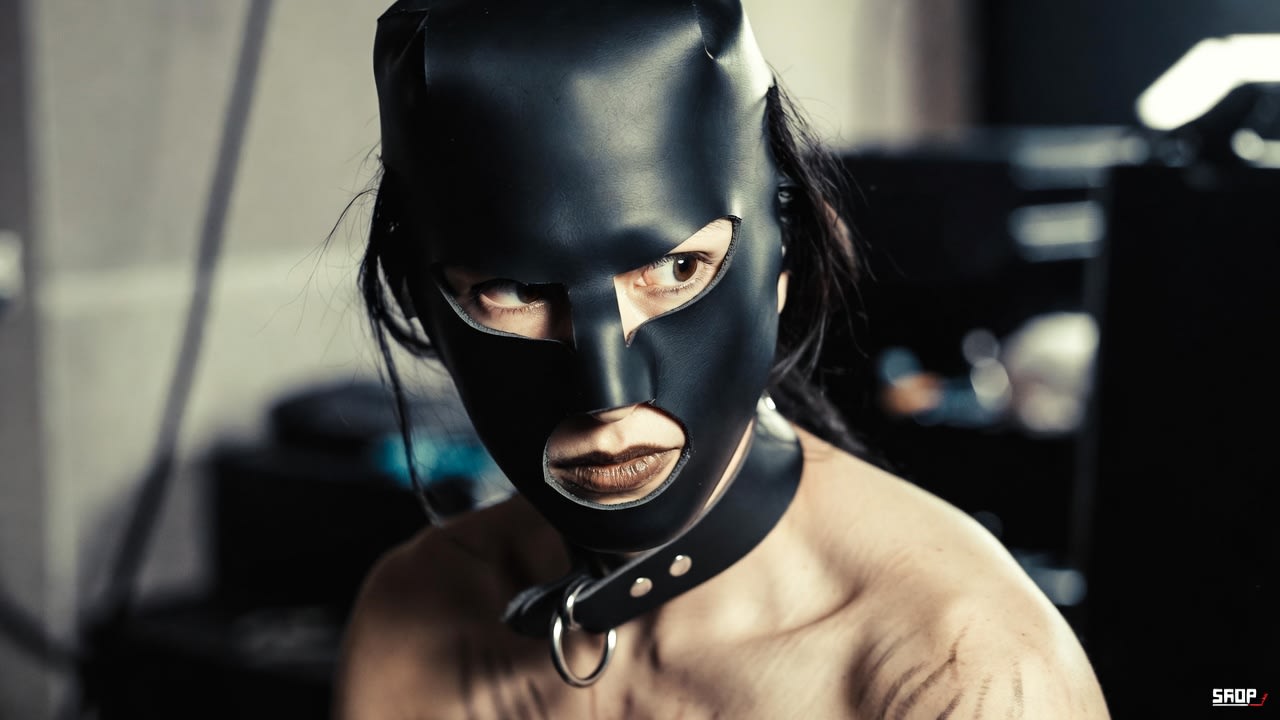
The hood goes on and the room changes. Not because anything in the room has moved — the same lamp, the same shadows, the same quiet hum of a space that has seen this before. What changes is you. The leather closes over your hair, your cheekbones, the small tells of your face that you have spent a lifetime arranging for other people. And then, through two clean openings, your eyes.
Everyone talks about what the hood takes. Almost no one talks about what it leaves.
This is a post about the part of you that stays visible when everything else is given up. The gaze that remains. If you have ever looked at a photograph of a hooded submissive and felt the eyes land on you like a hand on the back of your neck — you already know where we are going.
The First Thing the Hood Takes
Your face is a negotiation. It has been since you were small. You learned to soften it for some people and firm it for others, to smile at the right moments, to hold your expression like a second job you never applied for. Most people carry this labor so constantly they no longer feel its weight.
The hood ends the negotiation. Leather does not smile. Leather does not reassure, apologize, or perform. When it settles over your features, every one of those small daily masks — and we wear so many more masks than the ones made of leather — becomes irrelevant at once.
Submissives often describe the first minute in a hood as loud. That is the sound of a lifetime of facial management going silent. What is left underneath is not emptiness. It is you, undecorated. Many people meet themselves properly for the first time in the dark warmth of a hood, which is a strange place for a first meeting, and exactly the right one.
The Last Thing It Leaves
But look again at that image. The hood in this photograph does not blind. The eyes are open, and they are not pleading, and they are not empty. They are level.
This is the paradox that makes the open-eyed hood one of the most intense pieces of equipment in the wardrobe: it removes every way of being seen except the most honest one.
You cannot arch an eyebrow. You cannot offer a disarming smile. You cannot do anything with your jaw, your mouth, your carefully composed expression. All of your social armor is under the leather. What you have left is the gaze itself — and a gaze, stripped of the face around it, does not know how to lie.
When a Dominant meets those eyes, she is not reading a face. She is reading a state. Arousal, fear, defiance, devotion, the moment surrender actually lands — it is all there, unframed, with nothing around it to soften the signal. Submissives who think the hood will let them hide learn this quickly. The hood does not hide you. It aims you.
Being witnessed, not watched
There is a difference between being watched and being witnessed. Watched is passive; it happens to you on every street and in every meeting. Witnessed is rarer. Witnessed means someone is looking at the truth of you, with attention, on purpose.
The hood manufactures witness. By deleting everything decorative, it forces both people into the one channel that cannot perform. Many couples in a power exchange dynamic report that their most intimate moments were not the elaborate scenes but a held gaze — thirty seconds of eye contact through leather that said more than an hour of talk.
Anonymity Is Not Hiding
New submissives often reach for the hood for the wrong reason, and it is a sympathetic wrong reason: they want to disappear. Shame is loud in the beginning. The fantasy is that the leather will make the wanting anonymous, deniable, someone else's.
It does the opposite, and this is its gift.
Under the hood there is no one else to be. The identity you present at work, at family dinners, in the harsh light of your own bathroom mirror — none of it fits through those eye openings. What looks out is the want itself, undiluted. The hood does not let you escape yourself. It removes everywhere else to stand.
This is why anonymity, in a trusting dynamic, is clarifying rather than concealing. The submissive who says I could finally ask for what I wanted once my face was covered is not describing cowardice. They are describing the removal of an audience. The face performs for audiences. The eyes do not know how.
The Collar Beneath
In this image, below the hood, a leather collar. A steel O-ring resting in the hollow of the throat. It matters that both are present, because they do different work.
The hood changes who you are. The collar declares whose you are. One dissolves; the other anchors. A hood without a collar can drift toward the impersonal — a body, a shape, an anyone. The collar corrects that. It says: this particular surrender is claimed. You are not anonymous to her. You are anonymous to everything that is not her, which is precisely the point.
The O-ring is the practical poetry of it. A ring exists to be taken hold of. Even resting untouched at the throat, it carries the promise of the hand that could arrive. Submissives describe the weight of an unused ring as a presence in itself — the dynamic, sitting quietly against the skin, all day if she wishes.
The Unceremonious Room
Notice, finally, where this photograph happens. Not a dungeon with theatrical red light. Not silk and candles. A plain room, workshop shadows, ordinary clutter going soft in the background.
This is worth a moment, because it tells the truth about lived power exchange better than any staged set. Surrender that only exists in ceremonial spaces is a costume. Surrender that survives an ordinary room — that can kneel among cables and shelving and the unglamorous furniture of a real life — has become something sturdier. A practice. A fact about you rather than an event you attend.
The hood is portable ceremony. It brings the ritual with it, wherever the room happens to be. When the leather closes, the room becomes the right room. That is a kind of freedom the elaborate dungeon never quite delivers: the knowledge that your dynamic does not depend on scenery.
Wearing the Hood Well
Intensity earns care. A few standards I hold, and you should too.
Negotiate before the leather. Agree on duration, signals, and what the hood means tonight before it goes on. A hooded submissive with restricted speech needs a non-verbal safeword — a dropped object, a tapped rhythm, a raised hand. Decide it while both faces are still bare.
Breath is never a compromise. Open-mouth, open-nose designs for anyone new. Nothing that fights the airway. The surrender should be psychological, never respiratory.
Check in with the eyes. The channel the hood leaves open is the channel you use. A Dominant who takes a submissive's face away accepts the duty of reading what remains. Look often. You will see more than you expect — that is the entire architecture of the thing.
Come out slowly. Removing a hood is a small rebirth and it deserves gentleness. Dim light, a steady hand, time for the face to remember its work. Aftercare begins before the leather is fully off.
The Gaze That Remains
Strip away the performance and the person does not vanish. This is the quiet lesson of the hood, and it may be the quiet lesson of submission itself. You are not your arranged face. You are not your practiced expressions. When all of it is taken — willingly, carefully, by someone who has earned the taking — something is still there, looking out, steady in the leather.
That remainder is what a Dominant actually wants. Not the mask. Not even the leather one. The eyes behind it, honest at last, holding her gaze because there is finally nothing in the way.
The hood cannot take that. Nothing can. It can only reveal it — which is why, long after the buckles are undone and the face has returned to its daily work, the ones who have worn it well remember the hood not as the place they disappeared, but as the place they were finally seen.
Structure, ritual, and daily practice are how surrender becomes real. If you are ready to train yours, SubSurrender is where the work begins.