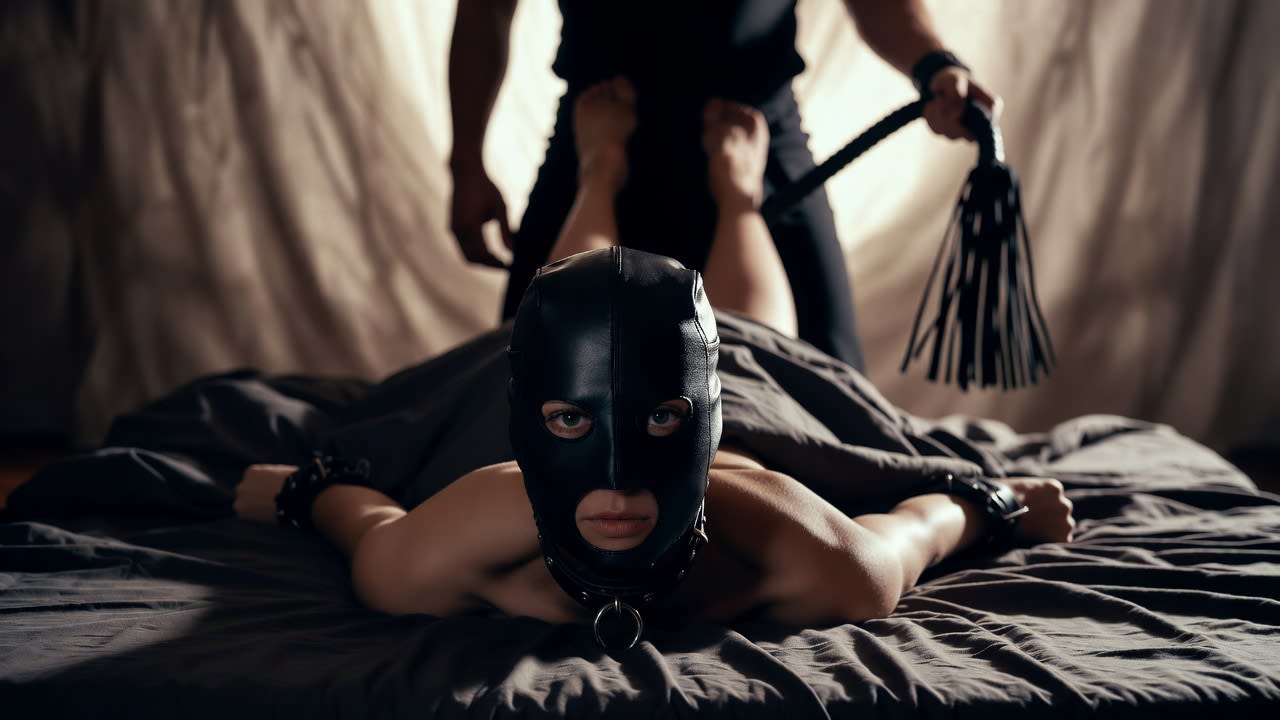
Under the Leather: How Losing Your Face Sharpens Every Other Sense
There is a particular hush that arrives the moment the hood goes on. Not silence exactly — you can still hear the room, the soft give of the bedding, the breath of the one standing over you. But the world goes quieter in a way that has nothing to do with sound. The face disappears, and with it the constant, exhausting work of being a person who is seen. What is left is skin, breath, and the long, electric stretch of waiting.
This is the paradox of the leather hood. It takes something away — your face, your expression, the small social armor you wear without noticing — and in exchange it hands you the whole rest of your body, sharpened and awake.
The face is the loudest part of you
Think about how much you ask your face to do. It performs. It reassures. It manages the impression you make on everyone in the room, second by second, whether you want it to or not. Even alone, even in the dark, most people keep a faint hold on that composure.
The hood ends that. Drawn down over the head, snug against the jaw, it closes the most expressive part of you behind a smooth wall of leather. There is nothing left to arrange. No one is reading you. And the strange gift in that is relief — the deep, unfamiliar relief of being unwatched while still being entirely attended to.
I have watched it happen many times. The shoulders drop first. Then the breath changes, slows, lengthens. The body that was holding itself together begins, instead, to hold itself open. This is the beginning of sensory surrender, and it begins precisely where the face used to be.
Sensory deprivation is not absence — it is redirection
People hear "sensory deprivation" and imagine nothing. Emptiness. A switching-off. It is the opposite. When you close one channel, the others do not go quiet; they lean in. Cover the eyes and the skin starts to listen. Cover the face and every nerve below it begins to report for duty.
This is the quiet engineering of the hood. By narrowing the world, it concentrates it. A single touch arrives with the weight of three. The drift of warm air across the back of the thighs becomes an event. The leather against your cheek, your own breath returning to you warm inside the mask — these are not deprivations. They are the new center of everything.
The body, laid out and offered
There is a reason the most affecting image of surrender is not a struggle but a stillness. The body lying prone, face down and hooded, arms drawn out, wrists held in studded cuffs — this is not a person being overcome. This is a person who has decided. The decision was made before the hood ever came down. Everything after is the slow, deilig unfolding of that single yes.
To be offered like this — flat, open, unhurried — is to give up the smallest, most reflexive controls. The instinct to cover. The instinct to brace. The instinct to look up and check. The hood makes the last one impossible, and in doing so it removes the temptation to manage what is coming. You cannot watch for it. You can only wait for it.
And waiting, as anyone who has truly surrendered knows, is the whole thing.
The flogger that hasn't fallen yet
Above the laid-out body, the dominant stands holding the flogger. It is not moving. The falls hang loose and heavy, and the room holds its breath with it. This is the most charged moment in the entire exchange — not the first contact, but the long second before it.
Anticipation is its own sensation. Behind the hood, with sight gone and the face stilled, anticipation becomes almost unbearable in the best possible way. You do not know where the first fall will land. You do not know when. The not-knowing is not cruelty; it is the gift. It hands the moment its full weight. It makes you present in a way that ordinary life almost never permits.
When the flogger does finally move, it lands on a body that has been listening for it with every nerve it owns. That is why the hood matters. It is not decoration. It is preparation. It turns the skin into something that can receive.
Why the dominant covers the face
From the standing side of the scene, the hood does something else entirely. It removes the running commentary. No flicker of the eyes asking was that too much, no reflexive smile smoothing the moment over. The submissive is freed from performing reassurance, and the dominant is freed to read the truer signals — the breath, the set of the spine, the way the hands open or close in their cuffs.
Power exchange becomes cleaner when the face is gone. Quieter. More honest. Both people are listening to the body instead of the mask of manners we all wear. There is great tenderness in this, even when there is also a flogger in the room. Especially then.
Trust is the only thing holding the hood on
None of this works without trust, and the hood makes that plain. To let someone cover your face — to give up sight, expression, and the ability to see what is coming — is one of the most concentrated acts of trust two people can share. You are saying: I will not watch your hands, because I do not need to. I know them.
That trust is built, never assumed. It is built in the conversations before, in the agreed words and the agreed limits, in the slow accumulation of times the dominant has proven worth surrendering to. The hood is not the beginning of trust. It is the proof of it, worn on the body.
And it must be a trust that runs both ways. The one who holds the flogger holds something far more delicate than leather: a person who has made themselves blind and open on purpose. To be given that is an honor, and it is treated like one. Care is not the opposite of dominance. Care is what makes dominance worth surrendering to.
What the hood gives back
People sometimes assume that to disappear behind leather is to become less. It is the reverse. Stripped of the face and its endless management, the submissive becomes more — more present, more sensitive, more fully inside the body than waking life usually allows. The hood does not erase you. It distills you.
This is the deeper logic of sensory surrender. We spend our days scattered across a hundred small demands, our attention thin and divided. The hood gathers all of that back into a single point: this body, this breath, this moment, this waiting. There is a kind of luxury in it that has nothing to do with comfort. It is the luxury of being entirely, undividedly here.
A few quiet words on doing it well
If the leather hood calls to you, approach it the way you would approach anything worth doing properly — slowly, and with respect for the body. Choose a hood that breathes and never obstructs the airway; the mouth and nose are not yours to compromise. Agree on a signal that works without speech, since the voice is often the first thing the hood quiets. Begin with short wearings and learn how this particular surrender feels before you ask more of it. And come back afterward, gently, with warmth and water and a hand on the spine, because every surrender deserves a soft return.
Done with care, the hood is not a way of hiding. It is a way of arriving — face given up, every other sense awake, the whole body laid open and listening for the first fall.
That is the secret under the leather. You lose the smallest part of yourself and, in the dark behind it, you find the rest.
— Mistress Krigar