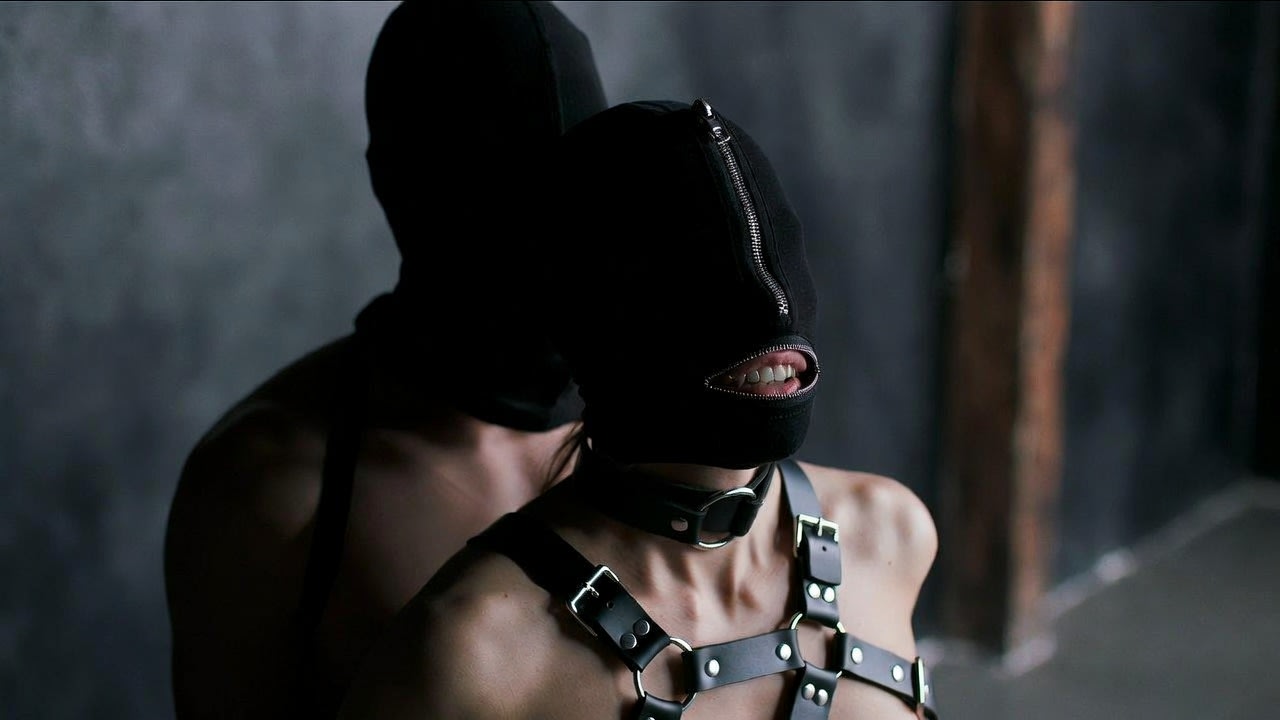
Look at the cover image for a moment before you read on. Two figures against a dark wall. Black hoods. A zip where a mouth should be, drawn open just enough to show teeth — not a scream, not quite a smile. A harness buckled over bare shoulders. One body resting against the other, close, unhurried. You cannot see a single face, and yet the picture is full of expression. That is the paradox this piece is about.
The hood is one of the oldest tools in the leather wardrobe and one of the least understood. To someone standing outside the lifestyle, it can look severe, even frightening: a person erased. To the person inside it, the experience is often the opposite. Ask a submissive who loves the hood what it feels like and you will hear words like quiet, weightless, finally. Not erased. Revealed.
The Face Is a Full-Time Job
Consider how much work your face does in an ordinary day. It performs politeness at colleagues. It arranges itself into competence in meetings. It smiles on schedule, softens on demand, holds back what would be inconvenient to show. By evening, most people have spent hours managing a surface they barely think about — and are exhausted by it without knowing why.
The hood ends that shift. Zipped in, there is no expression to manage, no eye contact to negotiate, no audience to read. For many submissives, this is the first true rest they have had all week. The performance stops because the stage is gone. What remains is breath, warmth, the press of leather, and the presence of the one who put it on them.
This is why I say the hood does not hide the submissive. It hides everything that was in the way.
Anonymity as a Gift, Not a Disguise
There is a common misreading of anonymity in kink — as if covering the face must mean shame, secrecy, something to apologise for. Sometimes discretion is simply practical; we live in a world that does not always deserve our openness. But inside the scene itself, anonymity does something far more interesting than protect an identity. It dissolves one.
Under the hood, you are not your job title, your reputation, your history, or your carefully curated self. You are a body that breathes, a mind that listens, a will that has chosen to yield. Strip the name away and what is left is remarkably honest: wanting, trusting, waiting. Many people meet themselves for the first time in the dark of a hood, precisely because there is no one else left to be.
Two Hoods, One Stillness
In the image, both figures are hooded. That detail matters. Hood play is not only a Dominant-covers-submissive arrangement; sometimes two submissives are placed together in stillness, learning the discipline of simply being near another surrendered body. Notice the posture: one behind the other, shoulder to shoulder blade, heads inclined. With no faces to perform for each other, closeness becomes something felt rather than displayed. Skin registers warmth. Breath finds a shared rhythm. Nothing needs to be said, and so, for once, nothing is.
What the Zip Teaches
The zip-mouth hood deserves its own meditation. A closed hood says: your words are not needed now. An opened zip says: speak — because I have allowed it. That small metal seam turns something as ordinary as talking into something granted, and therefore precious.
Submissives often discover that when speech becomes a privilege rather than a default, they choose their words differently. The chatter falls away. What passes through the opened zip tends to be true: a safeword if it is needed, a whispered thank you, a sound that no polite room would ever be allowed to hear. The hood does not silence a person. It curates them.
Trust, Made Visible
Let us be precise about what is actually happening when someone accepts a hood. They are surrendering sight — the sense we lean on most to feel safe. They are surrendering their face — the tool we use to influence others. They are accepting that for the next stretch of time, their safety lives in someone else's attention.
That is not a small thing, and it must never be treated as one. This is why hood play sits firmly in the territory of earned trust. It is not a first-date instrument. It belongs between people who have built a vocabulary together: negotiated limits, established signals, proven reliability in smaller surrenders before attempting this larger one.
The Practical Foundation
Because I care about how this is done, not only how it feels, the essentials belong in writing. Negotiate before anything touches the head — claustrophobia, panic history, breathing concerns, how long, how much. Agree on non-verbal signals; a hooded submissive may not be able to speak clearly, so a dropped object, a hand tap, or a hum pattern must carry the weight a safeword normally does. The airway is sacred: nostrils or mouth zip clear, always, and the Dominant's attention never wanders from the rhythm of that breath. Check in more than you think you need to. And plan the exit — a hood should come off slowly, with dim light and a steady hand, because the return to the world is part of the scene, not an afterthought.
A Dominant who handles the hood casually has told you everything you need to know about them. Walk away. The ones worth kneeling for treat that zip like the ceremony it is.
The Dominant's Side of the Dark
It is often assumed the hood is entirely for the submissive's journey. Not so. For the Dominant, a hooded submissive is a lesson in reading the body instead of the face. Deprived of expressions, you learn to hear consent and distress in older languages: the pace of breath, the set of shoulders, the small tremor in a thigh, stillness that is peaceful versus stillness that is braced.
This sharpens a Dominant the way darkness sharpens hearing. I would go as far as to say that no one fully learns to read a submissive until they have cared for one whose face they cannot see. The hood makes the Dominant more attentive, not less — and attentiveness, as my readers know by now, is the truest form of dominance there is.
Aftercare: Coming Back to the Light
The moments after a hood comes off are tender in a way few other scenes produce. The submissive surfaces like a diver — eyes adjusting, self reassembling, name returning. Do not rush this. Water, warmth, a quiet voice, a hand that stays. Some laugh. Some cry without sadness. Some simply lie there, blinking at the ceiling, reluctant to put the face back on just yet.
Honour that reluctance. It is the truest review a scene can receive: the wish to remain, a little longer, in the place where nothing was demanded of the surface.
Begin in Stillness
If the image above stirs something in you — the dark fabric, the opened zip, the calm of two bodies that owe the world no expression — trust that stirring, and move toward it slowly. Talk about it with someone who has earned your honesty. Negotiate it properly. Let the first time be short, warm, and unhurried.
The hood will still be there when you are ready. The dark is patient. So am I.
— Mistress Krigar