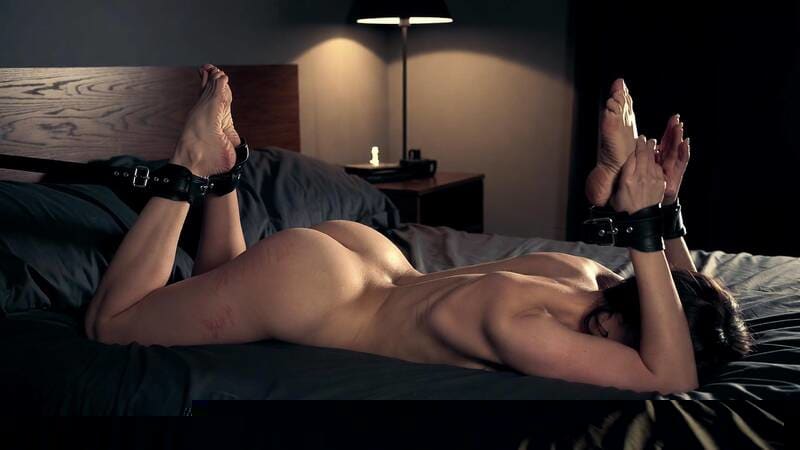
The lamp is on. The candle is lit, low and steady on the nightstand. Nothing about this room is rushed. And in the middle of that unhurried light, she lies on her stomach with her back bared, ankles cuffed, wrists cuffed, both drawn up and back until they meet, a shape that folds her spine into a bow and turns her face toward the pillow, away from the door, away from whoever is standing behind her. She cannot see what happens next. That is not incidental to this scene. It is the scene.
The Vulnerability of a Turned Back
Most of what we call trust in this world is trust you can verify. You watch a hand approach and you decide, in real time, whether to flinch. You read a face and calibrate. Eye contact is the oldest safety mechanism a body has, it lets you track intention as it forms. Take it away, turn someone face-down with their hands drawn behind them, and you have removed that mechanism entirely. She is not choosing, moment to moment, to allow what is happening. She chose once, before the cuffs closed, and now the choosing is finished. What is left is something quieter and harder: staying inside a decision she can no longer revise by watching.
This is why a bound back reads so differently than a bound front. Facing your Dominant, however restrained, you are still in dialogue. Facing away, you are in surrender's purer form, not performance, not negotiation, just the fact of the body left in the position it was given, breathing, waiting, trusting the room around it more than its own eyes.
What the Hands and Ankles Are Actually Saying
Look at the shape itself. Ankles lifted, drawn up and back; wrists brought to meet them. The spine has no choice but to arch. This is not a position the body finds accidentally, it is built, joint by joint, by someone else's hands, and once built it holds itself. There is no slack to fidget with, no shift that undoes the geometry. She did not tie herself into this. She was tied into it, and that distinction matters more than it sounds like it should.
Being arranged by another person's hands is a different submission than restraining yourself. When you bind your own wrists, you are still, in some sense, the author of your own containment, your hands did the last thing they did before stillness. When someone else does it to you, authorship transfers entirely. The body becomes a thing that is being shaped, not a thing shaping itself. For many submissives this is the whole point of the exercise: not the rope or the leather cuffs themselves, but the moment control of your own posture is handed to someone standing behind you, out of sight, with nothing to stop them but their own restraint and care.
The Difference Between Restriction and Exposure
People new to bondage tend to focus on the restriction, what can't move, what's held fast. But watch this photograph a little longer and you'll notice the restriction is only half the story. The other half is exposure. Ankles drawn up and back does not just immobilize the legs; it opens the whole line of the body to the room. The back, unguarded. The spine, visible in every vertebra. There is no way to curl inward and protect the soft places when the position itself insists on an arch. Bondage like this does not just take away movement. It takes away the ability to hide, and asks the body to be looked at exactly as it is, unposed, unable to angle itself into something more flattering or more defended.
This is the quieter cruelty and the quieter gift of well-built restraint. It removes vanity along with mobility. What's left, once the shame-reflex has nowhere to go, is just a body, breathing, offered.
Why the Candle Matters
Notice the light in this room. Not overhead, not clinical, a bedside lamp, warm and low, and a candle burning steadily on the nightstand nearby. This is not the lighting of urgency. Nobody lights a candle when they are in a hurry. The slowness of the light tells you something about the pace of everything else: this is not a scene built on speed or shock. It is built on time. Time to arrange the cuffs correctly. Time to check that the position is sustainable, not just striking. Time, afterward, to simply let her lie there, held, unseeing, and let the stillness do its work on her nervous system before anything else happens at all.
Good bondage is slow bondage, even when the shapes it makes look severe. The severity of the position and the gentleness of the pace are not in conflict, they are the same discipline, worn two different ways. A Dominant who rushes the tying has usually rushed the aftercare too, and rushed aftercare is where the real harm in this practice tends to live. The candle, small as it is, is doing quiet correctional work in this image: it is telling you nobody here is in a hurry.
The Discipline of Not Filling the Silence
When a submissive cannot see you, the temptation as a Dominant is to narrate, to fill the blindness with a running commentary of reassurance, because your own discomfort with her not-knowing is louder than her actual need. Resist that instinct. Silence, held well, is not abandonment. It is a different kind of presence: the presence of someone who trusts the arrangement they've made enough not to keep checking it out loud. Words can undercut a scene as easily as they can steady one. Sometimes the kindest thing a Dominant can offer a bound, turned-away body is simply to stay close, stay quiet, and let her feel, rather than hear, that she has not been left.
This is a harder skill than it sounds. It asks the Dominant to sit inside their own uncertainty, to trust their knots and their read of her without constant verbal confirmation that everything is fine. The unseeing trust runs in both directions. She trusts the room she cannot see. You trust the stillness you're not narrating.
What This Teaches Outside the Bedroom
Every submissive who has been bound this way, face down, turned away, arranged rather than arranging, comes back to ordinary life having practiced something most people never rehearse: staying inside a decision after the ability to monitor it has been removed. You cannot watch every variable in your life either. You commit to a partner, a job, a path, and then most of what happens is out of view, decided by forces you can't track in real time. The nervous system that has practiced trusting a held position without visual confirmation carries something useful back out into the world, a working knowledge that not-seeing is not the same as not-being-held.
That is the gift underneath the aesthetic. The photograph is striking because the position is dramatic, yes. But the real content of the scene is smaller and steadier than drama: a body that has decided, once, clearly, to let itself be arranged, and is now simply staying there, breathing, unhurried, trusting the warmth of the room it cannot see.
Closing
Surrender is easy to romanticize and hard to practice. It is easy when you can watch it happen to you. It is a different, deeper discipline when your face is turned to the pillow and your only evidence that you are safe is the fact that you agreed to this, once, before the light went low and the cuffs closed. That is the trust this image is actually about. Not the rope. Not the arch of the spine. The unseeing part, and the staying, anyway.
- Mistress Krigar