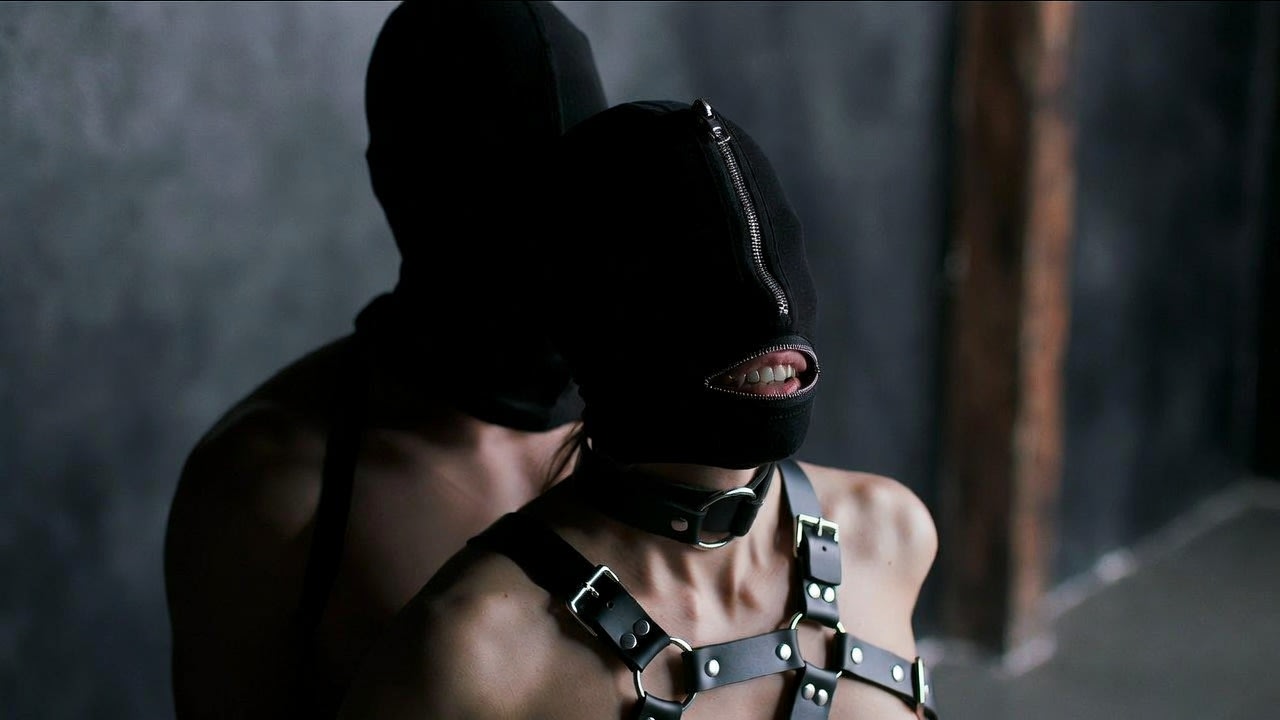
There is a particular quiet that arrives when the hood goes on.
Not silence — silence is the absence of sound. This is something fuller. The world narrows to the inside of black fabric, to the warmth of your own breath returning to your face, to the small mechanical sound of a zipper being drawn down by a hand that is not yours. Everything closes. And then one thing, deliberately, is left open.
The mouth.
I want to talk about that single opening. Not the hood as concealment — others have written about anonymity, about the hush of the senses, about disappearing inside leather. This is narrower than that. This is about the zip at the mouth, and what it means to be sealed everywhere except the one place where you breathe, taste, and speak. Because that opening is not an oversight. It is a decision. And the decision is mine.
Sealed, Except for One Thing
Look at what a zippered hood actually does. It takes the face — the most public, most performing part of a person — and it puts it away. No expression to manage. No eyes to read you with. No need to arrange yourself into anything for anyone. The hood does that work for you, and it is a relief most people do not expect.
But the zipper changes the grammar of it.
A sealed hood says: nothing comes in, nothing goes out. A zippered one says: something may come in, something may go out — when it is allowed. The teeth of the zip sit closed against your lips like a held breath. And when a hand finds the pull and draws it down, slowly, the cool air arrives at your mouth before anything else does. You feel the opening before you understand it.
That is the whole architecture of surrender in one small motion. You did not open. You were opened.
The Mouth Is Where You Negotiate With the World
Think about everything the mouth does. It speaks. It argues. It explains, apologises, jokes, deflects, asks for things, talks its way out of things. The mouth is where most of us live when we are trying to stay in control.
So when the rest of the face is gone and only the mouth remains, something interesting happens. All of that machinery has nowhere to hide. You cannot raise an eyebrow. You cannot give a look. You are reduced to breath and to whatever words you are permitted, and suddenly both of those feel enormous.
This is why the zippered mouth is more intimate than a fully sealed hood, not less. A closed hood lets you vanish. A zippered one keeps you present at the exact point where presence is hardest to fake. You are still here. You are still breathing where I can hear it. You can still say the word — your word, the one that stops everything — and that means your stillness is a choice you keep making, breath after breath.
Breath becomes the conversation
When you cannot see and cannot show your face, breathing becomes the language. I can hear the difference between calm and almost-calm. I can hear the catch when the zip moves. I can hear you settle.
I pay attention to that. A good dominant is not loud. A good dominant listens. The zip at the mouth gives me something to listen to, and it gives you something to surrender with that requires no performance at all. You do not have to be brave or composed. You only have to breathe, and let me hear it.
Voice Is a Privilege, Not a Default
Here is the part people misunderstand about silence in power exchange. It is not about taking your voice away as punishment. It is about returning it to its proper weight.
In ordinary life, words are cheap. We spend them constantly, carelessly, to fill the air. Inside the hood, with the mouth as the only door, words become expensive again. When the zip is closed, you are quiet not because you are forbidden but because the moment does not require you. When the zip is open and I ask you something, your answer matters. It is the only thing you can offer, and so it arrives clean, unhurried, true.
That is the gift hidden in the restraint. People expect to feel diminished. Most feel the opposite. They feel concentrated — distilled down to breath and the few words that are actually worth saying.
And the safeword lives here too, always. The opening is never only mine. It is the channel that keeps you safe. The mouth that I decide to open is also the mouth that can end the scene in a single syllable. Control and consent are not opposites in this. They are the same zipper, run in two directions.
The Harness Below: Held While You Let Go
The hood rarely arrives alone. Below it, the body is laced into leather — a harness across the chest, buckles catching the low light, straps that frame rather than bind. There is a reason these two things travel together.
The hood quiets the mind. The harness holds the body. Together they say the same thing from two directions: you are contained, you are accounted for, you do not have to hold yourself up right now. The leather does the holding. The straps are a structure you can lean your whole weight against, the way you might lean into an honest embrace and trust it not to move.
This is the warmth inside what looks, from the outside, like something severe. From across the room it reads as hardness — black fabric, metal teeth, buckled leather. From the inside it is closer to being swaddled. Held still. Held safe. Free, for once, of the exhausting work of managing your own face and your own words and your own composure.
That contrast is the heart of it. The aesthetic is dark and disciplined. The experience is tender. Both are true at once, and the people who understand this lifestyle live comfortably in that "both."
Why People Crave the Zip
Let me be plain about the appeal, because there is no shame in wanting it.
Most of us spend the day being seen. Performing competence. Choosing our words. Holding the line. It is tiring in a way we rarely name. The zippered hood offers an inversion so complete that the body reads it as rest. Someone else decides what you see (nothing), what you say (only what is asked), even when you may freely breathe the open air. The decisions stop being yours. And when the decisions stop, the noise stops.
This is not weakness. It takes a particular strength to be sealed in the dark and stay soft inside it. To trust the hands at the zipper. To let your breath be heard. To wait to be opened rather than opening yourself.
That is surrender in its cleanest form — not collapse, not absence, but a deliberate handing-over to someone who has earned the right to hold the pull.
How to Approach It, If It Calls to You
If the zip at the mouth has been living in the back of your mind, a few quiet truths before you reach for it.
Begin with trust, not with gear. The hood is the easy part to buy. The hard part — the part that makes it good — is the person whose hand is on the zipper. Know them. Talk first, plainly, about what the closed zip means and what the open one does. Agree on the signal that ends everything, and agree that it is honoured instantly, every time, no exceptions.
Go slowly the first time. Closed for a moment. Opened. Closed again. Learn the rhythm of your own breath inside the dark before you ask for more of it. There is no prize for rushing. The whole point is that nothing here is rushed.
And keep it shame-free. Wanting to be sealed and quieted is not a flaw to confess. It is a need like any other, and it deserves to be met with care, attention, and a steady hand.
The Last Word, Before the Zip Closes
The zippered hood is a small thing that says a large one. It says: you are not in charge of the opening, and that is the relief, not the cost. It says: your breath is being listened to. It says: when you are given words, use them, because they are the only ones that count now.
Everything else goes dark and quiet and held. One small opening remains, at the mouth, where you breathe and wait.
I will decide when to draw it down. You only have to trust the hand that does.
— Mistress Krigar