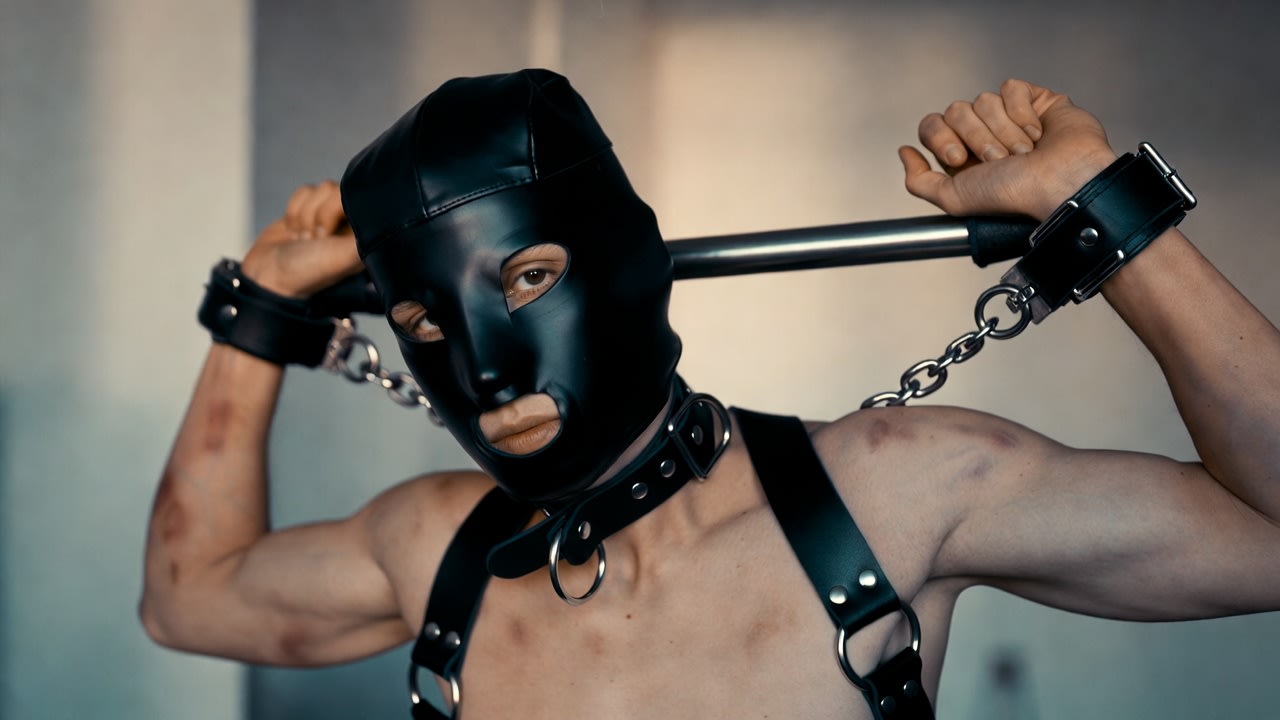
Most restraint is something done to you. Rope finds you. Cuffs close around you. A chain runs from your body to a wall, a cross, a bed frame — to something that is not you. You can lean against that kind of restraint. You can hang from it, fight it a little, let it prove itself. The structure holds, and you are held.
The yoke is different.
The yoke is the bar behind your shoulders, resting across the back of your neck like a decision you have already made. Your arms come up. Your wrists meet the cuffs at either end. The chain draws them close, and then there is nothing left in the room holding you — nothing but you. You are not tied to the wall. You are not tied to the floor. You are tied to yourself, and you are the one who has to carry it.
That is what this piece is about: the strange, demanding, deeply beautiful discipline of bearing your own surrender.
What the Yoke Actually Asks
Look at the shape of it. Arms raised, elbows bent, wrists cuffed to a bar that sits behind the head. It is an old shape — older than leather, older than steel. The yoke has always meant the same thing: you carry the weight of your work on your own body, and you keep walking.
In a scene, that meaning sharpens into something intimate. Nobody is holding the bar up for you. If your arms tire, you feel it. If you shift, the chain reminds you where your wrists belong. The restraint is real, but the engine of it is your own obedience. You could lower your arms. The cuffs would still be there, the chain would still be there — but the shape, the offering, the presented line of your body from raised wrists to bared chest — that shape only exists because you keep making it, second after second.
The yoke asks one question, quietly, on repeat: are you still choosing this?
And the answer, given not in words but in held muscle and steady breath, is the whole point.
Restraint You Carry Is Restraint You Confess
There is an honesty in the yoke that fixed bondage lets you avoid.
When you are tied to a cross, you can tell yourself a comfortable story: I had no choice. The rope decided. It is a sweet story, and sometimes it is exactly the story a submissive needs. Being overpowered by structure has its own deep release.
But the yoke takes that story away from you, gently, the way I would take anything from you — with intention. Carrying your own restraint means you cannot pretend it is happening to you. Every minute the bar stays up is a minute you said yes again. The surrender is not implied. It is demonstrated. Continuously. Visibly. With effort.
That is why the yoke feels so exposing, even under a hood, even with the face covered. The leather hides your expression. The bar reveals your will. Anyone watching can see precisely how much you mean it, written in the tremor of your arms and the stillness you fight to keep.
You cannot fake the yoke. That is why I like it.
The Hood, the Bar, and What Remains
Put the hood on that same body — leather closed over the face, only the eyes and mouth left open — and something interesting happens. Almost everything about the person disappears. Name, history, profession, the face they wear at work. What remains is very short list: breath, eyes, and the shape they are holding.
That list is enough. It might be the truest version of them that exists.
The eyes through a hood are never casual. They cannot be. With everything else covered, the gaze has to do all the speaking, and what it usually says — steady, a little defiant, wholly present — is I am still here. I am still in this. Look at what I am carrying for you.
The collar sits below, with its ring waiting. The harness crosses the chest, buckled flat, going nowhere. Those are the fixed points, the constants. The yoke above them is the variable — the living, effortful, minute-by-minute proof. Together they make a sentence: owned, structured, and still choosing it.
Endurance Is a Language
Somewhere around the fourth or fifth minute, the yoke stops being a position and starts being a conversation.
The shoulders begin to speak first. Then the forearms. The body sends up its small honest reports — this is heavy, this is long, we could stop — and the submissive answers each one the same way: by not stopping. Not with drama. Not with gritted heroics. Just by continuing, breath by breath, to hold the shape they were given.
This is what I mean when I say endurance is a language. It is how a body says devotion without using the word. Words are cheap in a scene; anyone can say I would do anything for you. The yoke lets you say it in a currency that cannot be counterfeited — time, weight, and stillness.
And for the one who watches — for the one the shape is held for — there is nothing passive about receiving it. Watching someone carry weight they could put down, and choosing not to, because you asked: that lands somewhere deeper than any dramatic gesture. It is the quietest gift in the room and the heaviest.
The Difference Between Suffering and Offering
Let me be precise here, because this is where the yoke is misunderstood.
The point is not pain. The point is not to grind someone down until they break. A yoke held in misery, past honest limits, teaches nothing and builds nothing — it only spends trust that took months to earn. That is not dominance. That is carelessness wearing dominance's clothes.
The point is the offering. The weight should be real enough to mean something and bearable enough to be given gladly. A good scene with the yoke ends with the submissive tired, proud, and lit from inside — not hollowed out. The line between those two outcomes is drawn before the cuffs ever close: in negotiation, in safewords, in the shared understanding that the bar comes down the moment the choosing stops.
Consent is not the paperwork of a scene. It is the scene. The yoke only works because both people know, at every second, that it could end — and it doesn't.
Why Carrying Is Harder Than Being Held
New submissives often imagine that the deepest surrender is total helplessness — the full tie, the immobilized body, nothing left to do. And there is depth there, truly.
But ask anyone who has worn the yoke: being held is rest. Carrying is work.
When the structure holds you, your will can go quiet. When you are the structure, your will is on duty the entire time. There is no moment of the yoke where you get to stop deciding. It is surrender performed as a continuous act rather than a single event — less like falling, more like kneeling on purpose, again and again, sixty times a minute.
That is why the yoke tends to find people further along the path. It takes a certain settledness. A beginner wants the restraint to be stronger than they are, and should have that. But there comes a point in a submissive's development where the sweeter thing — the more advanced thing — is restraint that is exactly as strong as their own devotion, and no stronger. The yoke measures that devotion precisely. It is an instrument of measurement as much as an instrument of restraint.
The Marks of Carrying
A body that trains carries its history for a while. The faint shadow where the bar rested. The print of a cuff's edge. These fade, as they should, and while they last they are private — a quiet record between the two people who made them, kept under sleeves and collars in the ordinary world.
I will not romanticize marks beyond what they are. They are not trophies and they are not proof of love; the proof was the carrying itself. But there is a specific tenderness in the days after a heavy scene — a body that aches slightly in the shape of what it offered, a reminder arriving every time the arms lift. Most people move through their week untouched by anything they chose. A submissive who has worn the yoke moves through theirs accompanied.
Setting the Bar Down
Every yoke ends the same way, and the ending matters as much as the holding.
The chain is unclipped. The cuffs open. The bar is lifted away — and someone else should lift it; that is not a detail, it is the closing of the circle. The arms come down slowly, aching, and for a moment they feel like they belong to someone else. This is where aftercare begins: shoulders rubbed back to life, water, warmth, a voice saying you carried it well.
Because that is the truth at the bottom of all of this. The yoke is never really about the bar. The bar is just honest weight. What is actually being carried — what was always being carried — is trust. Yours, mine, ours. The bar simply gives it a shape the body can hold and the eye can see.
Carry it well. Set it down when it is time. Be proud of the ache.
— Mistress Krigar