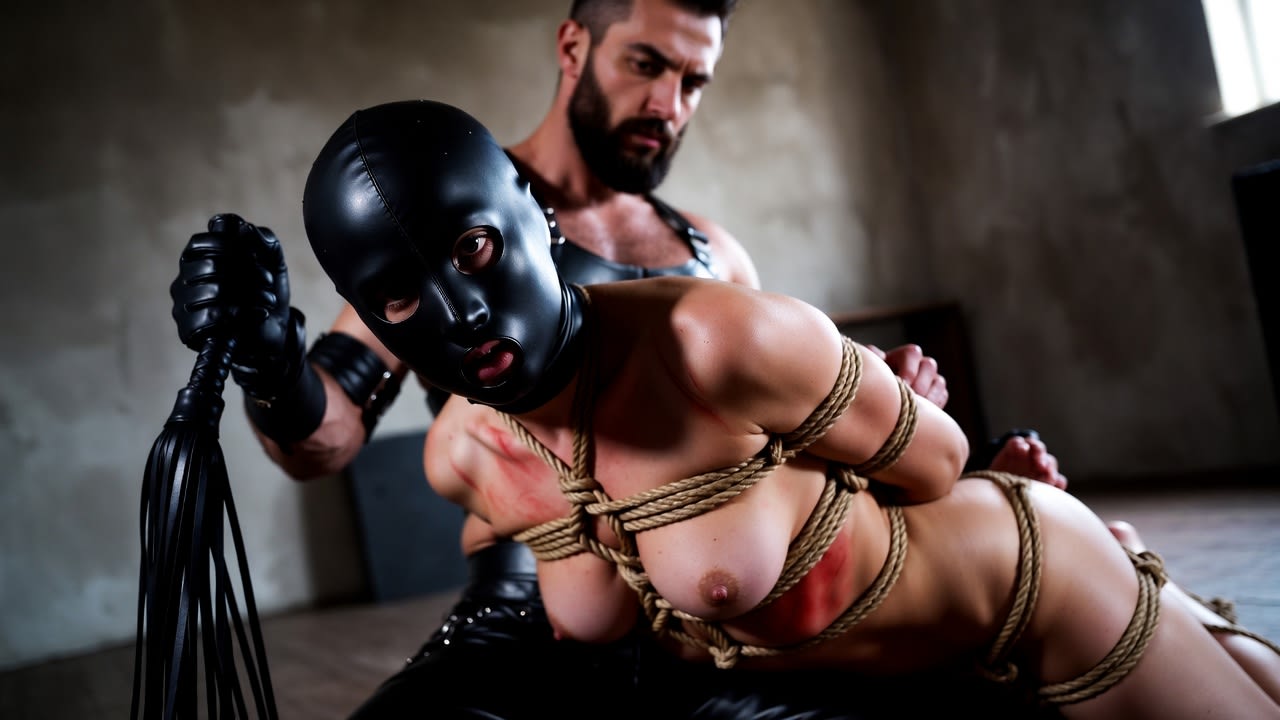
The Weight of the Flogger: On Being Bound, Held, and the Breath Before It Falls
There is a moment before anything happens. The rope is already on you. The hood has already closed the room down to the sound of your own breath. And somewhere above you, held loose in a gloved hand, is the flogger — not yet moving, not yet fallen, simply present. That pause is where the real work lives. Not in the strike. In the waiting for it.
People imagine that impact play is about the impact. They think the flogger is the point. It is not. The flogger is the punctuation at the end of a long, deliberate sentence that begins with rope and ends with your surrender. Tonight I want to walk you through that sentence slowly, the way I would walk you through it in person — one length of rope, one breath, one held moment at a time.
The rope comes first
Before I raise anything, I bind. This is not decoration. Rope is the first conversation we have without words. When I wrap a line across your chest and draw it snug, I am asking a question, and your body answers before your mouth can. Do you tense, or do you soften into it? Do you fight the turn of the wrist, or do you let me place you where I want you placed?
Shibari — the art of tying — is often mistaken for restraint alone. Restraint is only its surface. Underneath, rope is a way of being held so completely that you no longer have to hold yourself. Each wrap takes a small decision out of your hands. Where to put your arms. How to sit. Whether to reach for the thing you want. One by one, I take these from you, and one by one, you feel lighter for their leaving.
Why we begin with binding
I bind first because I want you already surrendered before the flogger ever enters the story. A body that is free can flinch away, can brace, can manage the sensation and stay in control of it. A body wrapped in rope cannot. It can only receive. That is the entire point. The rope removes your options so that the only thing left to you is trust — trust that the hand which tied you knows exactly what it is doing, and knows precisely how far to take you.
And there is a particular kind of beauty in a body made still by rope. The line of the shoulder held back. The breath moving under the cords. You become, for a while, something arranged. Something chosen. That is not a small thing to give, and I never treat it as one.
The hood, and the mercy of the dark
Then comes the hood. Leather, close, quiet. The moment it settles, the world narrows. You cannot see my hand. You cannot see the flogger. You cannot read the tell of my shoulder to know when the next fall is coming.
This frightens people at first, and then it frees them. Sensory deprivation is not cruelty — it is mercy of a strange and specific kind. When I take your sight, I take your vigilance with it. You stop scanning. You stop bracing for the thing you can see approaching. All that watchfulness you carry through every ordinary day simply has nowhere to go, and it sets itself down.
Inside the dark of the hood, sensation sharpens. Every touch arrives louder because it arrives unannounced. The drag of leather tails resting against your skin before I lift them. The warmth of a palm laid flat over your sternum. My voice, closer than you expected. You have no eyes now. So you learn, quickly, to listen with your whole body.
The flogger, held, not yet fallen
Now — the flogger. And here is the secret the impatient never learn: I hold it far longer than I use it.
A good flogger is a heavy, honest thing. Falls of leather gathered at a handle, weighted to swing true. In the hand it feels like intention made physical. But the instrument that does the most work is not the leather. It is the waiting. I let you feel the tails trail across your back. I let them rest. I let the silence stretch until you can hear your own pulse in it. And in that stretched silence, your whole nervous system leans toward the strike that has not come.
Anticipation is the real instrument
Anticipation is sharper than any lash. When you cannot see and cannot move, a single second of stillness becomes enormous. Your mind fills the dark with possibility. Will it be soft? Will it be slow? Now, or after another breath? I could answer you. I choose not to. I let you hang there in the not-knowing, because the not-knowing is where you finally, fully let go.
This is the discipline of a patient hand. Any fool can swing hard. It takes something else entirely to hold the swing back — to read the breath, to feel the exact moment the body stops resisting and starts asking. I do not strike when I am ready. I strike when you are ready, even when you do not yet know that you are.
What it means to be held
Look closely at what is actually happening in a scene like this and you will see it is not a picture of force. It is a picture of holding. One body wrapped in rope and cradled against another. A hand at the back of the neck. Weight taken. Nothing about it is careless.
Submission is often misread as weakness, as something done to a person. It is the opposite. To be bound, hooded, and laid open before a flogger, and to stay — to breathe, to trust, to remain — is one of the strongest things a person can do. You are not being overpowered. You are choosing, deliberately, to set down your power and hand it to someone who has earned the holding of it. That choice is yours in every second. The rope does not make it for you.
And my part of that exchange is sacred. When you give me your stillness, you give me responsibility. I hold the flogger, yes. But I also hold you — your safety, your limits, the word that stops everything the instant you say it. Power exchange only works when both hands are honest. Mine always are.
The first fall — and the surrender that answers it
When it finally comes, the first true stroke is almost a relief. The tension that has been building through the rope, through the dark, through the long held pause, breaks open like weather. The sting is real, but it is not the story. The story is what happens in you a half-second after: the exhale, the drop of the shoulders, the sudden quiet in a mind that has been loud for far too long.
This is what the lifestyle is truly about, underneath all its leather and rope. Not pain. Release. A place to put down the weight you carry everywhere else. For a little while, bound and hooded and held, you are responsible for nothing. You do not have to decide. You do not have to perform. You only have to be here, and breathe, and let the next thing arrive.
After: the rope loosens, the room returns
Every descent needs a return. When the flogger is set down, the work is not finished — it is only changing shape. I loosen the rope slowly, line by line, the way I laid it. I lift the hood and let your eyes find the light again at their own pace. I keep my hands on you while the room comes back, because coming back is its own tender, disorienting thing, and no one should do it alone.
This is the part the beginners forget and the devoted never do. Aftercare is not an afterthought. It is the closing of the circle. The same trust that let you fall is the trust that carries you home. Water. Warmth. A quiet voice telling you that you did well, and meaning it.
A closing word
So the next time you see an image like this one — the rope, the hood, the flogger held and waiting — do not look at it and think only of the strike. Look at the pause. Look at the holding. Look at the enormous, deliberate trust it takes to be laid open like that and to stay.
That is the whole art. The rope that quiets you. The dark that frees you. The patient hand that waits until you are ready, and the surrender, deep and deliberate and entirely your own, that finally answers it. Deilig, in the truest sense of the word — something you sink into on purpose, and come out of more yourself than before.
Take your time getting there. The best things always ask for patience. I have plenty of it. The question, as ever, is whether you are ready to hand me yours.
— Mistress Krigar