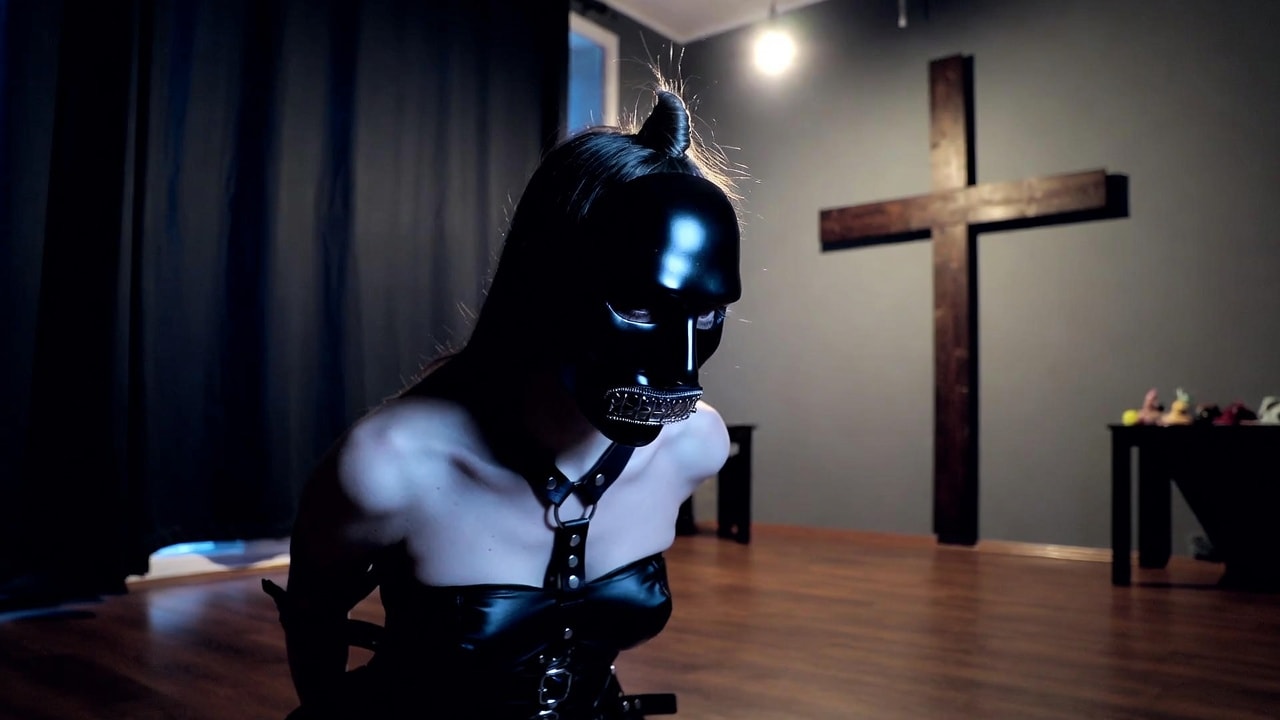
The room is almost dark. One lamp, low. A plain wooden cross on the wall, curtains drawn against the evening, and in the middle of the floor: her. Kneeling. Harnessed in leather. Her face closed behind a black muzzle mask, the metal grille over her mouth catching what little light there is.
She is not going to speak. That is the point. She chose this — the mask, the kneel, the hour of quiet — and in choosing it, she said more than most people manage in a year of talking.
This is a piece about silence. About the muzzle as a vow rather than a punishment. About why ritual — the same room, the same gestures, the same stillness — is what turns submission from a mood into a practice. Sit with me. We are going to take our time.
A Room That Asks for Reverence
Every serious practice has its architecture. Meditation has the cushion. Music has the concert hall, where you lower your voice before anyone tells you to. And power exchange, done with intention, has the room.
Look at the space around her. Nothing loud. Dark walls, bare floor, a single point of light. The room is not decorated; it is prepared. There is a difference. Decoration says look at me. Preparation says something is going to happen here, and it matters.
When a space is prepared this way, it does half the work before a single word of protocol is spoken. The body reads the room. Shoulders drop. Breath slows. The submissive who steps into a prepared space begins to surrender at the threshold, because everything in the room agrees on what the room is for.
You do not need a dungeon for this. A corner of a bedroom, cleared and lit with intention, is a sanctuary if you both treat it as one. What makes a space sacred is not the furniture. It is the agreement.
The Muzzle: A Vow, Not a Gag
People who stand outside this life see a muzzle mask and think it takes something away. Speech. Identity. The face itself. They are not entirely wrong — and they are missing everything.
Yes, the mask covers. But watch what happens underneath it. The wearer stops managing her expression. She stops performing pleasantness, stops arranging her face into the shapes the world expects. Behind the leather there is no audience to please. There is only the role, the breath, and the person she answers to.
And the grille over the mouth — that is the vow. Not silence forced on her, but silence offered up. There is a reason so many traditions treat the vow of silence as an act of devotion. When you give up your voice for an hour, you find out how much of your noise was armor. What is left when the armor comes off is quieter, softer, and far more honest.
What silence gives back
Silence sharpens everything it touches. When the mouth is closed, the ears open. She hears the floorboards under my step. The small sound of leather settling. Her own heartbeat, which has been there all along, ignored.
Silence also changes the dynamic between us. A submissive who cannot speak must be read — and a dominant who cannot rely on words must learn to read. Breath, posture, the tension in a shoulder, the angle of a bowed head. The muzzle does not end the conversation. It moves the conversation somewhere deeper, where lying is harder and attention is everything.
This is why the quietest scenes demand the most preparation. Before the mask goes on, we talk — properly. Signals are agreed. A hand sign for pause, an object to drop, a clear way to end everything instantly. Silence in a scene is only beautiful when the way out of it is loud, simple, and always available. That is not bureaucracy. That is the floor the whole cathedral stands on.
Why Ritual Deepens Surrender
Now, the kneel. Look at how she holds it. Spine long, hands settled, head slightly bowed. This is not collapse. This is form — and form is what separates ritual from habit.
Anyone can kneel once, in a rush of feeling. That is a gesture. Ritual is what happens when the gesture repeats: the same evening each week, the same order of preparation, the same words at the beginning and the end. Repetition is not boring. Repetition is how meaning accumulates. The fiftieth time she kneels in that spot carries the weight of the forty-nine times before it.
The psychology here is simple and old. The mind relaxes inside structure. When the sequence is known — enter, undress, harness, mask, kneel, wait — there are no decisions left to make, and decision-making is where anxiety lives. Strip the decisions away and what remains is presence. Many submissives describe the state that follows as the quietest their head ever gets. Not empty. Clear.
For the dominant, ritual is a discipline of its own. It asks me to be consistent. To arrive on time, prepared, deliberate. To honor the form even on the evenings I am tired. Her surrender is a gift; ritual is how I show that I know its price.
Building a ritual of your own
If you want to bring this into your own dynamic, start smaller than you think. One anchor is enough. A particular way of entering the room. A collar fastened with the same three words each time. Five minutes of kneeling in silence before anything else happens.
Choose an element and repeat it until it stops being a thing you do and becomes a place you go. Then, slowly, add. The order matters more than the content. A modest ritual kept faithfully will take you deeper than an elaborate one performed twice and abandoned.
And talk afterward. Every time. What worked, what wandered, what the silence held. Ritual without reflection turns hollow; reflection is how it stays alive.
Trust Is the Architecture
Everything in that photograph — the mask, the harness, the stillness, the prepared room — rests on one invisible thing: trust that has been earned and is continuously kept.
She kneels with her voice set aside because she knows, in her body and not just her mind, that her limits were heard, her signals will be honored, and the person she has given this hour to takes the weight of it seriously. Take away that knowledge and the same image becomes something else entirely. Trust is what makes surrender an act of strength rather than a loss.
So build the trust the way you build the ritual: consistently, unhurried, in the light. Negotiate before. Check in after. Let her see that the structure holds even when she tests it — especially when she tests it. Devotion grows in exactly one soil, and that soil is safety.
The Hour Ends. The Quiet Stays.
At some point the lamp is turned up. The mask comes off, buckle by buckle, and I take my time with it, because the way a scene is ended teaches the body whether it was cherished. Her face comes back to the light a little different than it went in. Softer around the eyes. Unarmored.
That is what the vow of silence buys. Not an hour of theater — a residue of quiet that follows her out of the room and into the week. The world will fill her ears again soon enough. But she knows the way back now. The room is there. The form is kept. The kneel is waiting.
Silence is not the absence of an answer. Sometimes it is the answer.
— Mistress Krigar