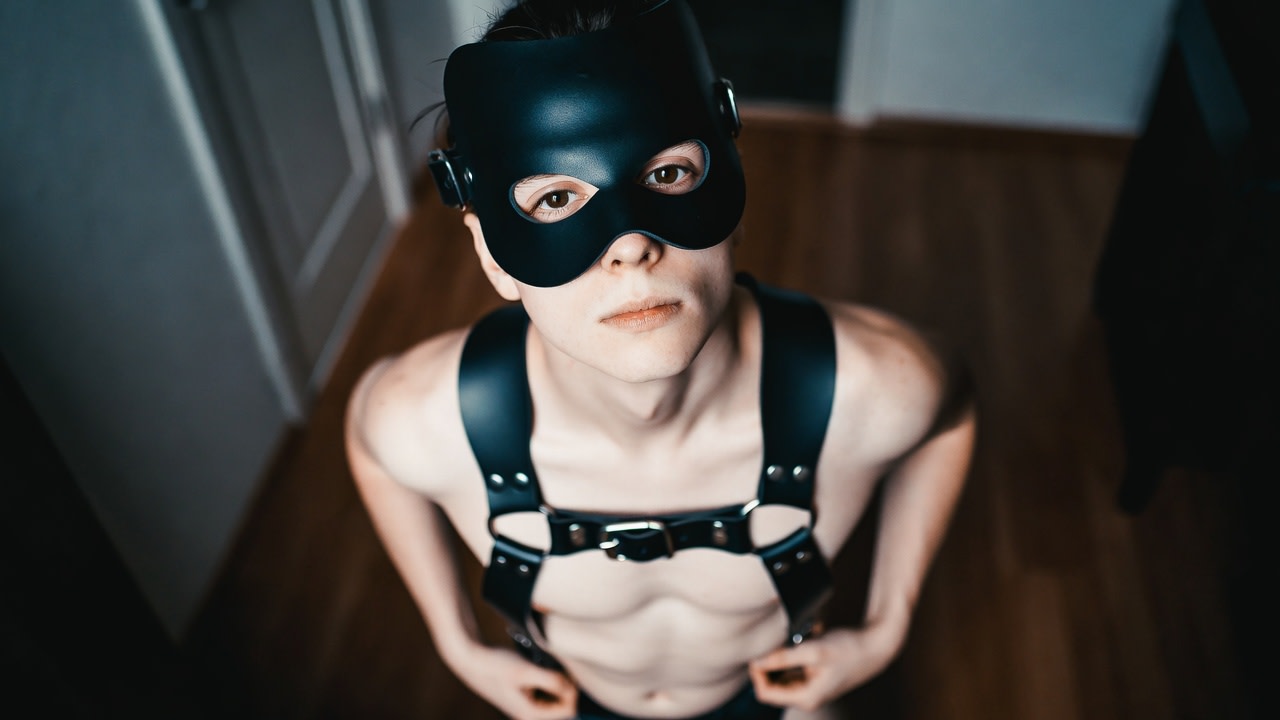
The Upturned Face: The Mask, the Kneel, and the Quiet Power of Looking Up
There is a moment, before anything is said, when someone kneels and lifts their eyes. The chin rises. The gaze climbs. It finds the person standing above and holds there — steady, unhurried, offered. In that small tilt of the head, everything is already decided.
You have seen the shape of it. A leather mask laid across the upper face. A harness buckled over bare skin, the cool line of metal resting where the heart beats loudest. And the eyes, open and calm, looking up. People assume an image like this is about concealment. It is not. It is about being seen — completely, deliberately, on purpose.
The mask does not hide you. It aims the light.
The most common mistake is to think of the mask as a wall. A place to vanish. And yes, leather across the brow and cheekbones does take something. It quiets the ordinary face — the one that answers messages, stands politely in queues, keeps its expression sensible all day long.
But when you take one thing away, you hand another thing over. The mask narrows a person down to the eyes and the mouth. It makes the gaze louder. With the rest of the face stilled, what remains has nowhere left to hide. That is the paradox at the centre of every mask worth wearing: it is not a disguise. It is a spotlight.
Why the anonymity is a kind of freedom
There is a reason so many people breathe out the moment the mask goes on. The daytime self is a heavy thing to carry. It has a name, a role, a long list of people it is supposed to impress. Set that down for an hour and something honest steps forward in its place.
Submission is difficult under a full, unguarded face because the daytime self keeps interrupting — worrying about how it looks, whether it is doing this correctly, who might be watching. The mask closes that door. Behind it, you are not performing for the world. You are answering to one person only. And with the crowd shut out, surrender stops feeling like exposure and starts feeling like relief.
Looking up is not smallness. It is a decision.
We are taught to read a lowered body as defeat. Kneeling, the tilt of the head, the eyes raised toward someone taller — the ordinary world calls this losing. It is not. In power exchange, kneeling is one of the most deliberate things a person can do, and lifting the gaze afterward is the most deliberate part of all.
Anyone can drop their eyes. That is easy. That is what shy people do, what frightened people do, what people do when they would rather not be here. To kneel and then look up — to keep the eyes open and pointed at the one who holds the moment — is a different act entirely. It says: I am not hiding from this. I chose it. I am watching it happen to me and I am staying.
That upturned face is not empty. Read it closely and it is full — attention, trust, a quiet dare, a request without words. It gives away the whole hand and loses nothing, because nothing here was taken. It was offered.
The harness: buckled on, worn, never concealed
Look at what sits against the skin. Not clothing in any practical sense. Straps that cover almost nothing and announce everything. A harness does not keep you warm or decent. It frames. It draws a line down the sternum, cuts across the chest, and says: attention belongs here, and here, and here.
To be buckled into leather is to agree to be marked as available — not to everyone, but to the one whose hands did the buckling. There is a slow ceremony in it. The strap drawn snug. The metal set into the keeper with a small, final click. Each fastening is a sentence in a language spoken entirely through touch and pressure, and the body learns to read it fluently. By the time the last buckle closes, the mind has already gone quiet. The gear did half the work of arriving.
The weight that steadies you
People expect restraint and framing to feel like a cage. More often it feels like ballast. The harness gives the body edges. It reminds you, with every breath that presses against the leather, exactly where you are and exactly who put you there. For a mind that spends its ordinary hours spinning, that steady pressure is not confinement. It is anchor.
The view from above
Now consider the other side of the gaze — the one looking down. The high angle is not an accident of the photograph. It is the whole point. This is the Dominant's line of sight: the kneeling shape below, the mask turned up, the eyes waiting.
To be looked at from above is to be studied. Nothing about you is rushing past. You are held in someone's full field of vision, examined without hurry, seen the way few people are ever willing to be seen. It can feel like too much. It is meant to. That is the exchange — you give up the comfort of being ordinary and overlooked, and in return you are made the single most important thing in the room.
And the one above is not simply taking. A gaze like that is a form of care, if it is done well. It notices the tension in the shoulders. It reads the breath. It watches for the moment the daytime self finally lets go and something softer surfaces. Real dominance is not indifference from a height. It is attention from a height — steady, warm, and completely unwilling to look away.
What the upward gaze is really asking
Strip away the leather and the posture and one question remains, the same one under all of it: Will you keep looking at me?
That is what the raised face wants to know. Not whether it is beautiful. Whether it will be met. Submission offered into an empty room is a lonely thing. Submission offered into a steady, present gaze is a conversation — the deepest one two people can have without a single word, made of nothing but attention flowing one way and trust flowing back the other.
So the sub lifts the eyes and asks. And the answer that matters is not spoken either. It is simply that the gaze above does not flinch, does not drift, does not leave. It stays. And staying, in this room, is everything.
Trust is the architecture holding it all up
None of this stands without one thing beneath it. Not the mask, not the harness, not the kneel. Take away trust and the leather is only costume and the posture is only theatre. With trust, the same objects become a language, and the same gestures become surrender in its truest form — freely given, fully meant, safe enough to mean it.
That trust is built slowly and in the light long before the mask ever goes on. It is made of conversations about limits, about words that stop everything at once, about what is wanted and what is never to be touched. The intensity you see in the image is only possible because of the ordinary, careful talking that came before it. Power exchange is not the absence of safety. It is safety made so solid that two people can finally let go on top of it.
Lift your eyes
So here is what the picture is truly saying, beneath the mask and the metal and the low warm light. It is not about domination as a costume. It is about the courage of the upturned face — the person who kneels, and then, instead of hiding, chooses to look up and be seen.
If you have felt the pull of that — the wish to set the daytime self down for a while, to be framed, to be watched with real attention, to hand over the gaze and trust that it will be met — you are not strange, and you are not alone. You are describing one of the oldest and most human hungers there is: to be fully seen by someone you trust, and kept.
Kneel if you like. Wear the mask if it frees you. But whatever else you do, lift your eyes. The whole of it lives in that one small, brave tilt of the head.
SubSurrender is an adults-only space for exploring desire, power exchange, and surrender with intention. Everything here begins and ends with consent, communication, and care. — Mistress Krigar