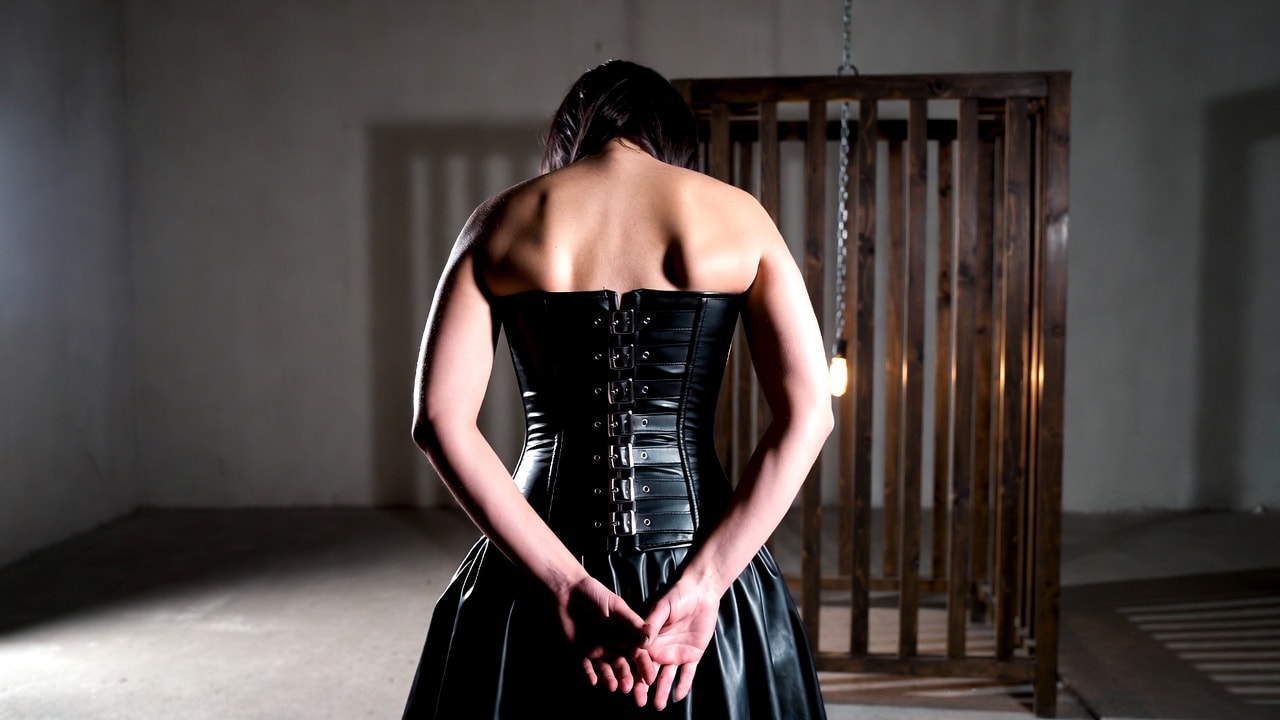
The room is nearly empty. Concrete underfoot, bare walls, one warm bulb hanging on its chain. In front of her: the cage, wooden and patient, its door standing open. She has not entered it. She stands before it in a black leather corset dress, spine straight, and folds her hands behind her back — one wrist resting in the other, the way you hold something you intend to give away.
Nothing in this picture is happening. That is exactly why you cannot look away.
We talk endlessly about surrender as an event — the kneel, the collar closing, the cuffs, the click. We talk far less about the threshold: the strange, charged strip of floor between the life where you decide everything and the space where you have asked to decide nothing. But the threshold is where surrender actually lives. Everything after it is only follow-through.
The Threshold Is a Question, Not a Doorway
An open cage asks something a closed one never can. A closed door is a fact. An open one is a question, and it addresses you directly: will you?
Notice what the picture does not contain. No hand on her shoulder. No leash pulling her forward. No voice counting down. Whoever holds authority in this room has done the most confident thing a dominant can do — arranged the space, opened the door, and stepped back. The cage does not reach for her. It waits.
This is the quiet heart of consensual power exchange. Control that must drag its subject across the threshold is not control; it is force wearing control's clothes. Real authority sets the question down gently and lets it sit in the room, under one warm light, for as long as it takes. The submissive who crosses does so on her own feet. That is what makes the crossing worth anything.
Hands Behind the Back: The First Surrender Is Self-Imposed
Look at her hands. No rope binds them. No cuffs. She has clasped them behind her own back, at the small of her spine, below the ladder of buckles running down the corset. She has bound herself — loosely, symbolically, completely.
This gesture is older than any of our equipment. Hands folded behind the back is the body saying: I will not defend myself, I will not reach for anything, I will not use these unless you return them to me. It is a vow made in posture. And because nothing enforces it, it must be renewed every second she holds it. A knot holds you whether or not you believe in it. A clasped pair of hands holds only as long as the belief does.
Why chosen stillness outranks imposed stillness
There is a reason experienced players speak of stillness with such reverence. Anyone can be held still. Choosing to be still — remaining in position with nothing but your own word keeping you there — is discipline of a different order. It engages the will rather than bypassing it. Ten minutes of chosen stillness before an open cage can go deeper than an hour of elaborate restraint, because every one of those minutes is signed for, personally, again and again.
This is also why the threshold moment builds trust so quickly in a dynamic. The dominant watches a person hold a vow with no enforcement, and learns exactly what that person's word is worth. The submissive holds it, feels it hold, and learns the same thing about herself. Both of them walk away knowing something real.
The Cage Before You Enter It
The cage in this room is wood, not steel. Warm-toned, hand-built, the kind of structure that looks less like a punishment and more like furniture for a very particular kind of peace. That softness matters. What the cage offers — what all structure in a power exchange offers — is not humiliation but simplification. Inside it, the world shrinks to something survivable. No inbox. No performance. No thousand small decisions. Just slats, light, breath, and the knowledge that someone else is keeping watch.
But none of that is available at the threshold, and this is the point so many people miss. At the threshold, the cage is still all meaning and no comfort. Standing before it, she is holding both truths at once: everything she gives up by stepping in, and everything she receives. The threshold is where the exchange is actually weighed. That weighing — sober, unhurried, wide awake — is what separates surrender from collapse.
Anticipation is not the delay of the experience. It is the experience.
The bulb burns beside the cage like a small ceremony. Nothing about this room says hurry. And the body, standing in that unhurried light, does what bodies do at thresholds: the pulse lifts, the skin wakes, attention sharpens to a fine point. Anticipation is often described as the time before the scene starts. Wrong. By the time she is standing here, hands folded, breath slow, the scene has been running for some time. The wait is not the price of the experience. On the right night, it is the richest part of it.
What the Dominant Owes the Threshold
If you hold the power in a dynamic, the threshold is yours to protect. It is tempting to shorten it — to fill the silence, to guide with a hand, to rescue your submissive from the discomfort of her own decision. Resist that. The gift you give by waiting is the certainty, afterward, that she chose. Not agreed. Not went along. Chose, with her whole standing body, in her own time.
Practically, that means building thresholds into your rituals on purpose. A pause at the door of the room. A required minute of stillness in position before anything begins. A rule that she enters the space herself, unassisted, or not at all. These small architectures of hesitation are not delays in your control — they are demonstrations of it. Anyone can command a body. The threshold commands a decision.
What the Submissive Finds There
And if you are the one standing before the cage: know that the trembling, doubting, electric feeling of the threshold is not a failure of submission. It is submission, in its most honest form. The ones who feel nothing at the door have usually stopped noticing what they are giving. You noticed. You stood there, weighed it, held your own wrists, and stayed.
Some nights you will cross. Some nights you will stand at the threshold and find that the answer is no — and a dynamic worth being in will honor that no without a flicker of punishment, because a no that costs you nothing to say is the only thing that makes your yes mean everything.
Practice the Threshold
Like every part of this life, the threshold rewards training. Practice stillness in small doses: two quiet minutes standing in position, hands clasped behind your back, before your evening ritual. Practice the weighing: before any scene, name to yourself — or in your journal — one thing you are giving and one thing you are receiving. Practice the honest no, so that your yes stays clean.
Structure, streaks, and small daily disciplines are how the threshold stops being a wall and becomes a doorway you know how to stand in. That standing — spine long, hands folded, breath even, the open door asking its one soft question — is a skill. It can be built like any other.
The Door Is Open
She has not moved yet. The bulb hums. The wood waits without impatience, the way only well-made things wait. Whatever she decides, she has already done the hardest and most beautiful part: she came to the threshold, put her own hands behind her back, and let the question be asked.
Stand there as long as you need. The cage is not going anywhere. Neither is the part of you that already knows the answer.
— Mistress Krigar