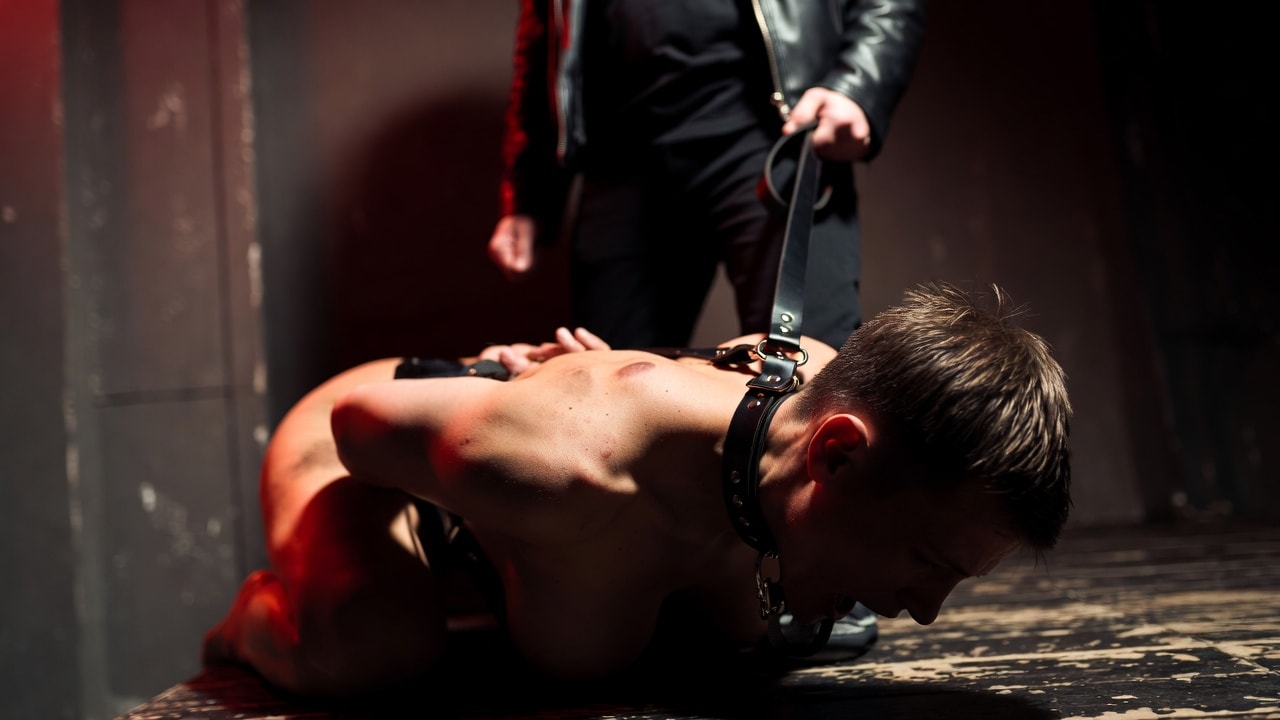
There are two kinds of leash. One hangs loose in a lazy curve, a formality, a piece of punctuation. The other is pulled straight — a dark line drawn taut from her fist to your collar, humming with intention. The first says: I have you. The second says: I am using you now.
Look at the scene. A bare wooden floor, scarred and honest. Red light pooling in the corners like something warm that refuses to cool. A man folded low — not kneeling so much as poured onto the boards, forehead bowed toward the grain, spine curved into a hill of surrender. And above him, unhurried, a figure in leather with the lead wrapped once around a steady hand. The leash does not sag. It rises from the collar in one clean, tensioned line.
That line is the entire conversation. This is what it says.
The Difference Between Held and Pulled
Much has been written — here, and everywhere the lifestyle is written about — on the slack leash: control so complete it needs no reminder. That is a beautiful, mature stage of a dynamic. But it is not where the leash begins, and it is not where the leash does its deepest teaching.
The taut lead is different. Tension is information. When the line goes tight, two nervous systems are suddenly wired together. She feels every shift of your weight travel up the leather into her wrist. You feel the smallest articulation of her hand arrive at your throat before your mind has finished noticing it. A taut leash is not a wall between you. It is a bridge — narrow, precise, and absolutely honest.
You cannot lie on a taut leash. Hesitation telegraphs. Resistance telegraphs. So does willingness. That is why the pull feels so exposing, and why it is so prized by those who understand it: for as long as the line is tight, you are known.
Why the Pull Goes Down, Not Away
Here is the paradox in the image, and it deserves a moment of stillness. The leash rises — her hand is high, the line ascends from the collar like a bell rope. And yet the body it commands goes down. Chest to the boards. Face low. Small.
A leash on an unwilling creature produces strain in the opposite direction: pulling away, choking against the collar, fighting the geometry. A leash on a surrendered one produces this — descent. The pull is upward; the obedience is downward; and the space between those two directions is where trust lives. He is not being dragged to the floor. He is answering the tension the way water answers a riverbed: by taking the shape offered.
Going low at the end of a lifted lead is a sentence spoken back to her: you do not need to force me down. Your intention is enough. I will do the descending myself.
The Floor Is Not a Punishment
Hardwood is an underrated teacher. It does not flatter the knees. It presses back, plank by plank, and keeps the body honest about its own weight. On a cushion, a kneel can drift into daydream. On bare boards, every minute is chosen again.
This is why the low position — the deep fold, chest down, arms drawn back — reads so differently from a simple kneel. A kneel is a posture. This is an offering. The back becomes the highest point of you, presented like a landscape. The neck, ringed in leather, is the only part of you she is holding, and the only part she needs.
And the red light matters more than décor. Red is the color a room turns when it stops pretending to be ordinary. It flattens time. In red light there is no morning, no inbox, no calendar — only the floor, the line, and the slow sound of your own breathing coming back to you off the boards.
What She Is Doing Up There
It would be easy to read the standing figure as passive — she holds a strap, nothing more. That reading misses everything.
Holding a taut lead well is work. It is attention made physical. Her stance is set so the tension stays constant; her wrist absorbs and returns every tremor; her eyes are on the body below her, reading it the way a sailor reads water. Too much pull and the collar bites, the moment curdles. Too little and the line goes dead, the conversation drops. She is holding the tension at exactly the weight where he can lean into it — where the leash becomes something he can rest against.
That is the secret nobody tells you about the pulled leash: done well, it is load-bearing. The submissive at the end of it is not merely restrained. He is supported. The same line that commands him down is also, quietly, holding him together.
Tension as Tenderness
In power exchange, tenderness rarely looks like softness. It looks like precision. The exact height of her hand. The exact degree of pull that says stay without saying suffer. A taut leash maintained with care is one of the most tender things that can pass between two people, precisely because it would be so easy to do carelessly — and she doesn't.
Submissives often describe the strange calm that arrives on a tight lead: the mind stops scanning. There is nothing to decide. Direction is no longer your department. The tension answers the oldest anxious question — where should I be? — continuously, at the throat: here. Exactly here.
Earning the Line: Trust Before Tension
None of this is a first-night ritual. A taut lead on an unfamiliar collar is just pressure; on a negotiated, familiar one, it is language. The difference is everything that happened before the clasp clicked shut.
The conversation happens first, in plain words, upright, eye to eye: what the collar means, what the pull may ask, what it never will. Limits are not the opposite of this scene — they are its foundation. The leash is only as honest as the agreement it hangs from. A safeword does not slacken the line; it is the reason the line can be trusted tight.
And afterward — because there is always an afterward — the collar comes off, the floor gives him back, and the hand that held the lead becomes simply a hand again: bringing water, resting on the back of the neck it commanded, staying. Aftercare is not the end of the scene. It is the proof of it.
The Shape You Make Is the Answer
Return once more to the image, because it will not leave you alone. The line rises. The body descends. Between them, a whole philosophy of surrender drawn in one stroke of black leather.
Anyone can be pulled. That takes only force. But to feel the leash go taut and pour yourself downward — to answer tension with softness, command with descent, her lifted hand with your lowered head — that is not weakness, and it never was. It is the most articulate thing a body can say without a single word.
The leash is drawn tight. The floor is waiting. And the line between her hand and your collar is asking the only question that matters: will you follow it down?
You already know your answer. That is why you are here.
— Mistress Krigar