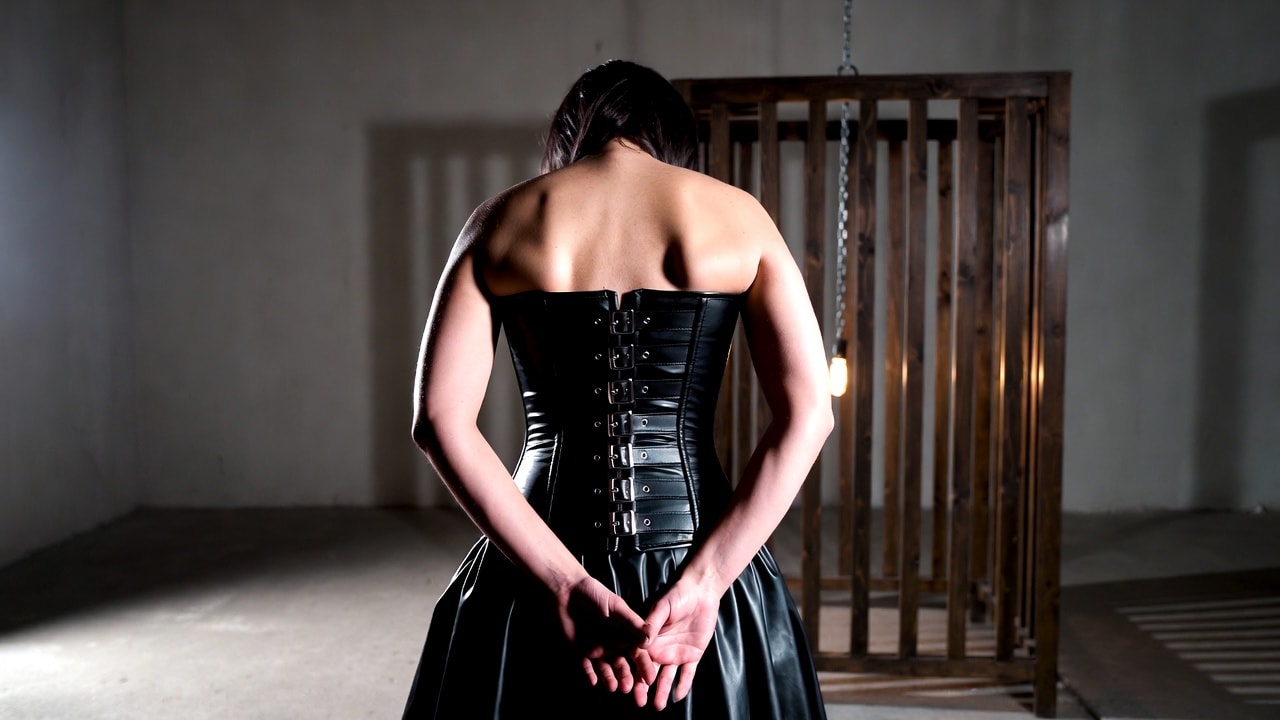
Look at her for a moment before you read another word. She is standing in a bare room, laced into leather, her back to you. The cage waits in the corner. The chain hangs still. And her hands — the most capable, most defended part of her — are folded quietly at the base of her spine, one resting inside the other.
Nobody is holding them there. That is the whole point.
We talk a great deal about restraint that is done to a body: rope, cuffs, the closed door. This is something else. This is restraint a person lays on herself and then keeps, breath after breath, because she was asked. It looks like nothing. It is one of the deepest things a submissive can offer.
The Most Useful Thing You Own
Your hands are how you manage the world. They reach, they fix, they cover, they correct. When something feels uncertain, the hands move first — they smooth a sleeve, check a phone, reach for the nearest small task. They are your fastest instinct and your favourite armour.
So consider what it means to fold them away.
To clasp your hands behind your back is to set down the tool you reach for without thinking. You cannot fidget. You cannot tidy yourself. You cannot manage the moment, soften it, hurry it along, or quietly take control of it through some small busy gesture. You are left with only what you are: standing, breathing, present, and seen.
That is why this position unsettles people far more than they expect. It is not the body that strains. It is the habit of self-protection, suddenly with nowhere to go.
What the Position Actually Is
In many dynamics it has a plain name — present, parade rest, the waiting stance. The shape is simple. Feet settled. Shoulders open rather than hunched. Chin level. Hands gathered low behind the back, loosely held, no tension gripping the knuckles white.
Notice what the shape does to the body. With the hands drawn back, the chest opens. The spine lengthens. Nothing is hidden and nothing is braced. The posture itself is an offering: here I am, undefended, on purpose.
It is not a slouch and it is not a performance. Done well, it is almost boring to look at and extraordinary to inhabit. The stillness is the content.
Why It Is Harder Than It Looks
People assume difficulty lives in the dramatic positions — the long kneel, the strict bind, the held strain. Often the hardest thing in the room is the quiet one.
Stand with your hands behind your back for three unbroken minutes and you will meet every restless thing inside you. The itch to adjust. The urge to fill the silence with a word. The small panic of having nothing to do with yourself while another person simply watches. There is no task to hide behind. There is only the discipline of staying.
And that is the training. Not the position of the arms — the settling of the mind beneath it. You are learning to be looked at without flinching toward usefulness. You are learning that you do not have to earn the moment by doing something. You only have to remain in it.
The Trust Hidden in the Gesture
Here is what the photograph cannot quite show you, and what matters most.
When you put your hands behind your back, you give up your first line of defence. The hands that would catch you, push away, cover, or steady — you have voluntarily stood them down. In that posture you are saying something without words to the person you have given yourself to: I trust you with the part of me that protects me.
That is the exchange. Not obedience for its own sake. Trust, made physical. The submissive lowers her guard not because she is forced to, but because she has decided this person has earned it. And the one who receives that gesture carries a real weight: someone has set down their defences in front of you. The correct response is never carelessness. It is attention. It is care worthy of what was given.
Power exchange is often misread as taking. At its best it is nothing of the kind. It is one person offering, deliberately, and another holding what was offered as if it were precious. Because it is.
The Stillness Is Not Emptiness
From the outside, a person standing with her hands behind her back appears to be doing nothing at all. Inside, something quite full is happening.
The restless mind slows. The breath drops lower and steadies. The endless low hum of self-management — do I look right, should I move, what next — goes quiet, because there is nothing to manage and nowhere to go. What remains is a kind of clarity that is difficult to reach any other way. Some call it the beginning of subspace. I think of it more simply as arriving. You stop performing yourself and finally just are, here, in this room, in this skin, under this gaze.
This is the indulgence at the centre of it. Not spectacle. Surrender of the small, exhausting work of running yourself. For a little while, you do not have to decide anything. You only have to stand, and breathe, and be kept. There is a deep luxury in that — deilig, the Norwegians would say — a permission most people never give themselves.
How to Begin
You do not need a dungeon, a corset, or a single piece of leather to start. You need a few feet of floor and someone you trust, or simply your own quiet intention to practise.
Start short. One minute. Stand with your feet settled and your hands loosely clasped behind your back. Let the shoulders fall. Breathe slowly and do not correct anything. When the urge comes to move, to fix, to fill the silence — and it will come — notice it, and let it pass without obeying it. That noticing is the whole exercise.
If you practise with a partner, agree on the simple things first. How long. How to stop — a word, a touch, a look — available at any moment, no explanation owed. Surrender only means anything when it is freely given and freely revocable. A position held under genuine pressure is not devotion; it is just strain. The freedom to end it is what makes staying meaningful.
Extend the time slowly, week by week, only as far as it stays good. This is a practice, not a test. You are not proving endurance. You are building the quiet muscle of staying present while undefended — and that grows the way trust grows, gradually and on its own schedule.
For the One Who Watches
If you are the one who asks for this position, understand what you are receiving. A person has folded away their defences at your request. Do not let the moment go cheap. Watch them. Stay present yourself. Notice the breath, the small tremor, the settling. Speak when it serves them and stay silent when silence serves them better. End it cleanly and warmly. The gift is only as meaningful as the care you meet it with.
When the Hands Come Back
Every surrender has an ending, and the ending matters as much as the act.
When the hands are released — when she is told, gently, that she may move again — something has shifted. The defences come back, but they come back chosen. She picked up her own protection again, on the other side of having freely set it down, and that is its own quiet power. Nothing was taken from her. She gave, and then she returned to herself, fuller for it.
That is the truth the image holds. Not bondage. Not force. A woman in a bare room, hands folded behind her back because she decided to keep them there — undefended on purpose, trusting on purpose, still on purpose.
The cage in the corner was never the point. The freedom was always in the choosing.
— Mistress Krigar