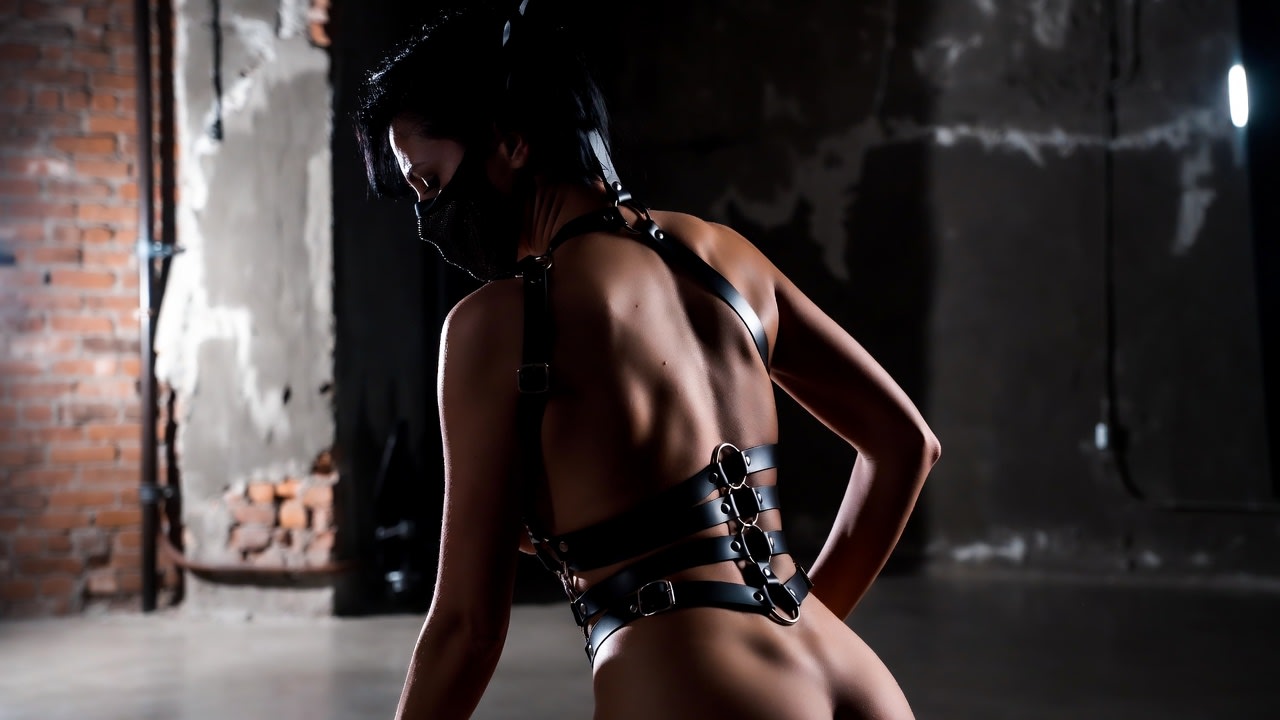
She is turned away from you. That is the first thing. Not a face, not an invitation — a back. A spine traced in black leather, straps laced from shoulder to waist like the rigging of something built to hold weather. The light comes from one side and refuses to apologise for it. Concrete behind her. Brick, raw and unbothered. And down the centre of her, ring after ring after ring, the harness does what a harness is for: it holds.
Look a moment longer. You will notice she is not straining against any of it. She is standing inside the leather the way you stand inside a decision you have already made.
A Harness Is Not a Costume
People who have never worn one assume the leather harness is decoration — a flourish, a bit of theatre pulled on for a photograph and pulled off again the moment the room empties. They are wrong, and pleasantly so.
A harness is an instrument. It does not hide the body; it organises it. Straps cross the chest and frame what is already there. A band settles at the ribs and reminds you, with every breath, exactly where your edges are. The buckles are not metaphors. They close. And in closing, they hand you a feeling that almost nothing else in an ordinary day will give you: the feeling of being held in place by something patient and deliberate.
That is the quiet trick of leather. It is firm without being cruel. It keeps its shape so that you can briefly stop keeping yours.
The Lacing Up the Spine
The most beautiful part of the harness in front of us is the part she cannot see. The lacing runs up the spine — rings stacked like vertebrae, leather threaded through them, drawn snug and then snugger by someone standing behind her with steady hands.
There is a reason we lace people from behind. You cannot do it to yourself, not properly. Someone has to stand at your back, take the slack, and decide how tight is tight enough. You give them the centre line of your body and you let them set the tension. This is not a small thing. The spine is where we armour ourselves — we straighten it to face the world, we stiffen it when we are afraid. To let it be laced is to let it be tended.
Submission, at its best, looks exactly like this. Not collapse. Not absence. A spine still strong, still upright — but no longer doing all the work alone.
What the Straps Ask of You
The harness asks for stillness, and stillness is harder than it sounds.
Most of us spend our days in motion we did not choose — reacting, deciding, carrying, fixing. The body forgets it is allowed to simply be worn into shape and left there. When the leather goes on and the buckles close, the message travels up through the skin before the mind catches up: you do not have to hold yourself together right now. The straps have it.
Tension you can feel
There is a specific pleasure in pressure that has a reason. The band at the ribs, the strap across the shoulder, the snug line down the back — none of it hurts, but all of it is present. It is the difference between a hand resting on you and a hand simply nearby. The harness rests on you everywhere at once. You stop being able to ignore your own body, and for a great many people that is the most luxurious thing imaginable.
A frame for attention
Leather also tells the other person where to look. It draws the eye along the lines of you and slows it down. To be framed like this — deliberately, with intent — is to be paid attention to in a way most lives are starved of. The harness is, in the end, a way of saying here, look at this part of me, I have made it ready for you.
The Back Knows First
Notice that she is facing away. There is enormous trust folded into a turned back.
To stand with your spine to someone is to hand them the part of you that cannot watch them. You cannot see their face, their hands, what they reach for next. You can only feel the leather draw tighter and trust that the tightening is care and not carelessness. In our world we call this surrender, and people outside it always mishear the word — they think it means giving up. It does not. It means giving over. Handing the reins to someone who has earned them, and then having the nerve to keep your back turned.
That nerve is not weakness. Watch her shoulders. There is no fear in them. There is the particular ease of someone who has chosen the hands at her back and would choose them again.
Buckled In, and Somehow Free
Here is the paradox the leather understands and most people do not. The more precisely you are held, the freer you become.
When the structure is firm, the mind can finally put down the thousand small negotiations it runs all day — where are my limits, am I doing this right, what happens next. The harness answers the first question with every strap. Your edges are here, and here, and here. The dominant standing behind you answers the rest. And into the space those answers clear, something unhooks. Call it subspace, call it stillness, call it the deep exhale you have been postponing for years. It arrives because the leather and the trust have, between them, made it safe to arrive.
Freedom, it turns out, is not the absence of structure. It is the right structure, worn by the right person, fastened by someone you trust.
How to Wear It Like You Mean It
If the image has done its work and you are wondering how this feels from the inside, a few quiet truths before you buckle anything.
Fit is everything. Leather should be snug, never strangling. You want to feel held, not held hostage. Two fingers should slide under any strap. If a buckle bites or a band cuts your breath short, loosen it — discomfort that you grit through is not devotion, it is just discomfort.
Let someone else do the lacing. The spine harness is a two-person ritual on purpose. Stand still, breathe out, and let the hands at your back set the tension. Tell them when it is right. The handover is half the point.
Decide the words before the straps. Agree on what tighter means, what enough means, what stop means — and trust that saying any of them will be honoured instantly. The leather only feels safe because the language around it is solid. A harness without a safeword is just a costume after all.
Go slowly the first time. Put it on in a quiet room. Stand in front of a mirror, or turn your back to someone you trust and let them look. Notice what the pressure does to your breathing, your shoulders, the noise in your head. You are not performing. You are learning what your own body does when it is finally allowed to be held.
The Quiet After
When the buckles open again — and they will — there is a moment most people are not warned about. The leather lifts away and the body feels suddenly, almost unbearably, light. The skin remembers the lines for a while, faint pressure ghosts where the straps were. Stay in that moment. Let yourself be unlaced as carefully as you were laced. Warmth, water, a hand on the back of your neck. The harness held you; now let someone hold you without it.
That is the whole arc, really. To be framed, fastened, held, and then released into care. The leather is only the most beautiful excuse to do something we are all quietly starving for — to hand the centre of ourselves to someone steady, and to trust the hands that draw it close.
She is still turned away from you in the photograph. She always will be. But now you know what her stillness is made of. Not submission as surrender of self. Submission as the deep, deliberate luxury of being held exactly in place — and choosing it, ring by ring, all the way up the spine.