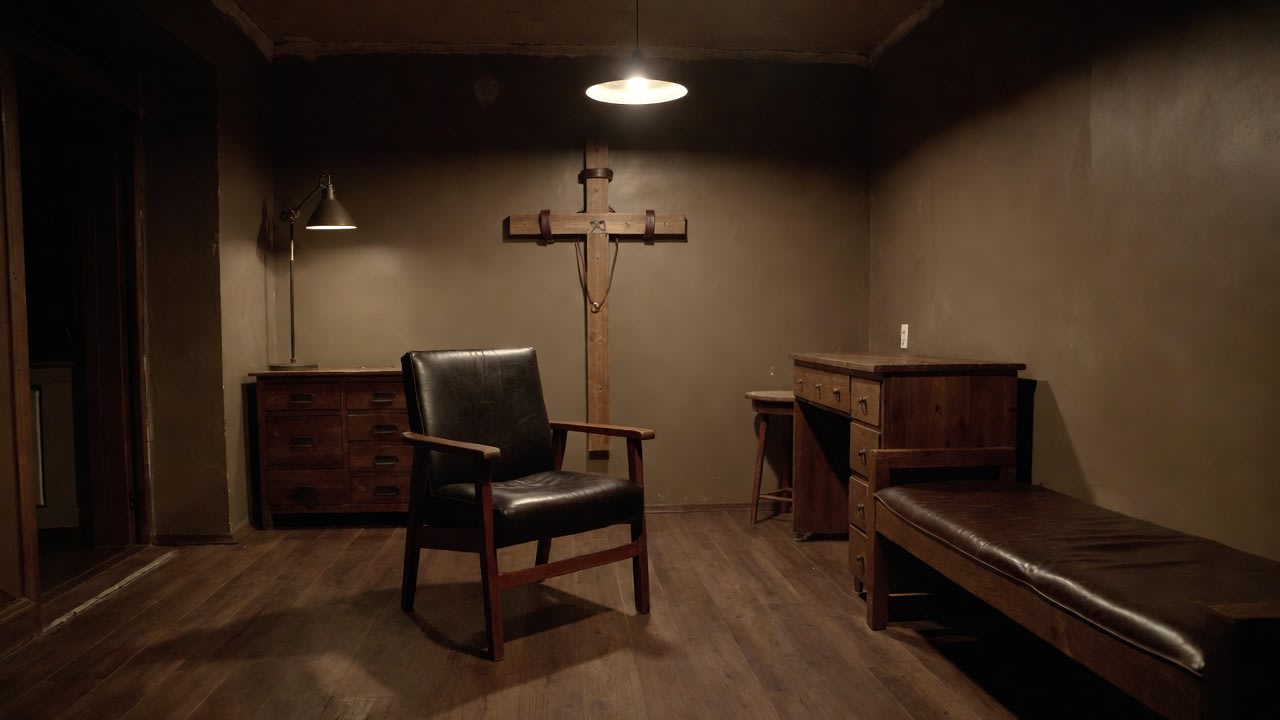
There is a room, and it is empty. A single lamp burns low over the floorboards. A wooden cross rests against the wall, straps hanging slack. A leather chair sits at an angle, as if someone only just rose from it. A bench waits along the wall, its surface polished by use and care. Nothing moves. Nothing needs to.
Most people, shown this photograph, would see furniture. You see something else. You feel the pull low in your stomach, the way the air in such a room seems heavier than air elsewhere. That feeling has a name. It is anticipation — and it is the subject of tonight's lesson.
The room is the first command
Before a word is spoken, before a collar is lifted from its hook, the room has already begun the scene. This is something the inexperienced miss and the devoted understand in their bones: a playroom does not wait passively. It instructs.
The chair says: someone will sit here, unhurried, and watch. The bench says: someone will be arranged here, deliberately, and stay. The cross says nothing at all — it does not have to. Its silence is the loudest thing in the room.
When a submissive steps across that threshold, half of the surrender has already happened. The room told them what it is for, and they entered anyway. Willingly. Knowingly. That step is a sentence written in the body: I have read what this space intends, and I consent to it. No contract is more honest.
Why emptiness is the most charged state
A scene in motion is loud with sensation. Skin, breath, the creak of leather, instruction and response. It fills the senses so completely that the mind has no room left for anything else. That is its gift.
But the empty room offers a different gift, and a rarer one. Emptiness is potential. It is every scene that has happened there and every scene that has not happened yet, held in suspension. The imagination — that most disobedient of organs — rushes in to furnish it. Whose wrists have those straps held? Whose will they hold next? Standing alone in a prepared playroom, a person conducts a scene entirely in the mind, and the body responds as if it were real. Pulse first. Reason later.
This is why anticipation is not the absence of the scene. It is the first act of the scene. A Dominant who understands this never rushes the doorway. Let them stand in it. Let them look. The room is doing your work for you.
The lamp knows what it is doing
Notice the light. Not darkness — darkness hides, and hiding is for the ashamed. Not brightness either — brightness examines, and examination belongs to hospitals. A low, warm lamp does something more precise: it selects. It warms the wood, deepens the leather, and leaves the corners soft. It says: what happens here is intentional, and intentional things deserve intentional light.
If you are building a space of your own, begin there. One honest lamp will teach a room more about atmosphere than any amount of equipment.
Preparation is devotion made visible
Look again at the photograph. The floor is clean. The leather is kept. The straps are not tangled; they hang as they were left, which means they were left with attention. This matters more than any of the objects themselves.
A well-kept playroom is a love letter written in maintenance. It says: what we do here is worth doing properly. The care taken with the room is a promise about the care that will be taken with the person in it. A submissive reads this instantly, even if they could not put it into words. Order calms the nervous system. Cleanliness signals competence. Competence permits surrender.
The reverse is also true, and I will say it plainly: a chaotic space makes a chaotic scene. Dust on the bench is a small betrayal. If the room is neglected, some quiet part of the submissive's mind will ask — reasonably — what else is neglected. Aftercare? Limits? Attention itself? Trust is built in the details precisely because the details are where laziness hides.
The furniture of stillness
Consider what this room actually contains. Not much. A chair, a bench, a cross, a chest of drawers, a lamp. This restraint is not poverty. It is confidence.
The chair is the seat of authority — and notice that authority, here, sits. It does not loom or pace. It observes, at its own pace, in its own comfort. Power that is certain of itself can afford to be still.
The bench is the counterpart: the place of placement. To be arranged on a bench and told to stay is one of the simplest and deepest exercises in submission, because it asks for the one thing modern life has made nearly impossible — remaining where you are put, doing nothing, being watched, and letting that be enough.
And the cross. It stands against the wall like a piece of quiet architecture, straps at rest. It represents the fullest expression of what this room is for: the moment a person gives their weight, their posture, their movement — all of it — into hands they trust. Empty, it is a question. You already know what the question is.
Ritual: how a room becomes a threshold
Spaces gain power through repetition. A bedroom is only a bedroom until the tenth scene, the fiftieth kneeling, the hundredth time the lamp was lit with intention — and then it is something else. The nervous system learns the room. Cross the threshold and the body begins its descent into the right state before a single instruction is given, the way the smell of a church makes even unbelievers lower their voices.
You can build this deliberately. Light the lamp the same way each time. Enter in the same order. Keep one act — removing shoes, folding clothing, a moment of stillness at the door — that belongs only to this room and happens every time without exception. Consistency is what turns habit into ritual, and ritual is what turns a room into a threshold between the ordinary world and this one.
For those who play without a dedicated space, take heart: the threshold is portable. It was never really the walls. It is the sequence, the light, the kept promise of a prepared space — even if that space is a corner of a bedroom that becomes the room only when the lamp says so.
The waiting is the point
We live in a time that treats waiting as failure — a delay to be optimized away. The empty playroom is a rebellion against all of that. It says: the pause is not before the experience. The pause is the experience. Desire, given time and stillness, compounds.
So the next time you stand at the edge of a room like this one — as the one who commands it or the one who enters it — do not hurry. Stand in the doorway. Let the lamp do its work. Let the chair and the bench and the patient cross say what they have always said.
The room has waited this long. It can wait a little longer. And so, my dear, can you.
— Mistress Krigar