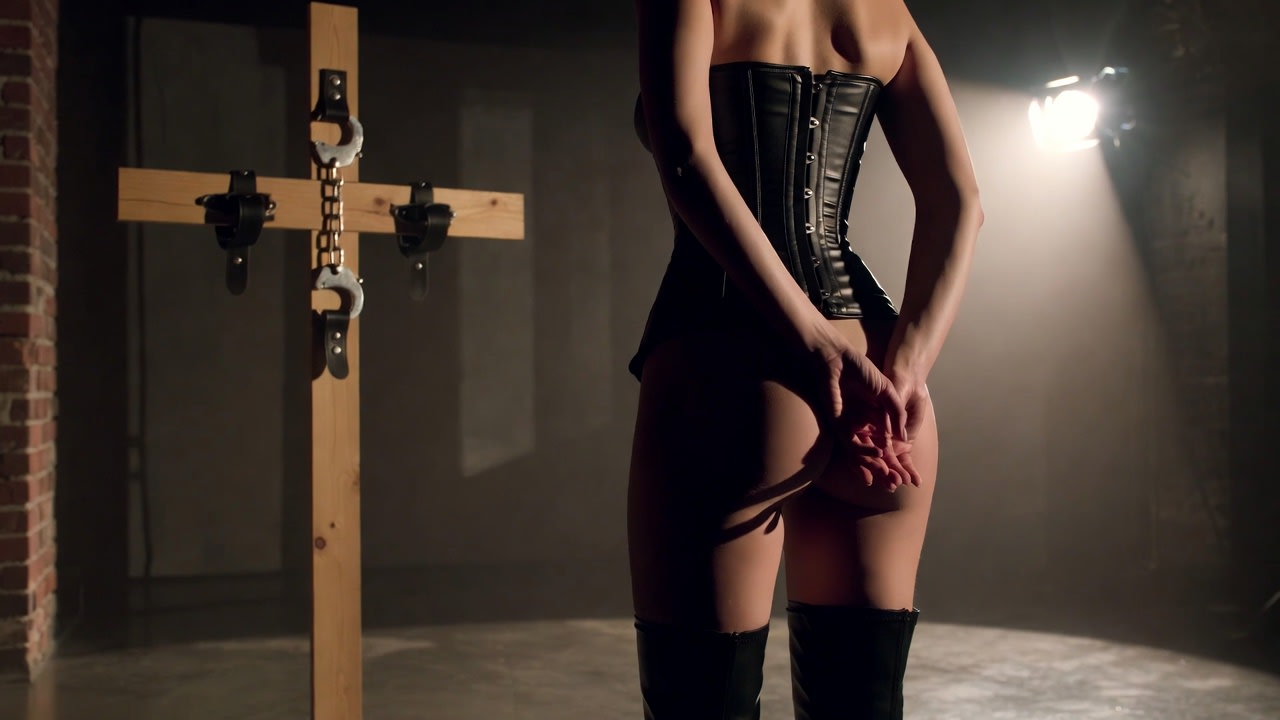
There is a moment most people never talk about. It comes before the first touch, before the first word of command, before a single buckle is drawn tight. It is the moment when the room is ready and you are not yet inside the scene — only standing at its edge, breathing, letting the air change around you.
I love that moment more than almost any other. It is where surrender actually begins.
The room speaks first
Look at a well-kept playroom and you will understand more about power exchange than any manual could teach you. The wooden cross against the wall, fitted with its restraints. The low, warm light that falls in one deliberate pool and leaves the corners dark. The cool of the floor. None of it is decoration. Every object in the room is a promise, and every promise is a question waiting for your answer.
This is what I mean when I say the room speaks first. Before I say anything to the one who kneels for me, the space has already begun the conversation. The St. Andrew's cross does not need to be used to do its work. It only needs to be seen. The eye finds it, the breath catches, and the body remembers — even before anything has happened — that it has chosen to be here.
Anticipation is not a delay before the real thing. Anticipation is the real thing, arriving early.
Why waiting is the deepest part of surrender
People new to this lifestyle often imagine that intensity lives in the act — the restraint, the command, the sensation. And it does live there. But the people who stay, the ones who go deep and keep going deeper, learn something quieter: the longest, sharpest pleasure is in the waiting.
To wait well is to hand over your sense of time. When I tell someone to stand and not move, to face the wall, to breathe and do nothing else, I am not punishing them with boredom. I am giving them a gift most of their life refuses them — permission to stop deciding. The mind that spends all day choosing, managing, performing, finally gets to set the controls down. Someone else has them now. That release is the heart of submission, and you can taste it long before anyone is touched.
This is why I build anticipation on purpose. A scene that begins too fast skips the most beautiful chapter. I would rather make you stand at the edge of the room and feel the minutes stretch. I would rather you hear my boots on the floor and not know which way they are walking. The not-knowing is the point. Trust grows in exactly that gap between what you expect and what I choose.
The corset, the boots, the slow turn
There is a reason a dominant dresses for the room. Not vanity — ritual. The lacing of a corset is a small, deliberate act of becoming. With each pull the spine straightens, the breath shortens and deepens at once, and the everyday self is quietly set aside. By the time the last lace is tied, I am no longer simply a person who had a long day. I am the one who holds the room.
The boots are the same. The weight of them changes how I stand and how I walk, and the one who waits for me learns to read that walk like weather. Slow steps mean patience. A pause means I am looking. The turn — the unhurried turn to face the one who has been waiting — is itself an event. I am in no rush to give it. Let them feel the back of my attention before they feel its front.
None of this is performance for its own sake. It is how I cross from one self into another, and crossing it slowly lets the one who serves me cross it too. We arrive in the scene together, but I lead.
Trust is the architecture under all of it
Strip away the leather and the lighting and what remains is the only thing that ever mattered: trust. The cross on the wall is harmless wood and metal. It becomes meaningful only because two people have agreed, with full clarity, on what it is for. Power exchange is not power taken. It is power given, deliberately, by someone who could withdraw it at any moment and chooses not to.
That is what makes the surrender real instead of theatre. The submissive is never weak. The submissive is the one who decided. Everything I do as a dominant rests on the strength of that decision, and on my refusal to be careless with it. The room can be dark and the scene can be intense, but underneath there must be daylight: a clear yes, clear limits, and a clear way to stop. Without that foundation, none of the rest is worth anything. With it, you can go almost anywhere.
People are sometimes surprised that I speak of safety and tenderness in the same breath as control. They expect a dominant to be cold. But coldness is for people who do not understand power. Real authority is warm. It pays attention. It notices the small flinch and the held breath. It is precisely because I intend to take you to the edge that I must know, exactly, where your edges are.
Consent is not the opposite of intensity
Let me say this plainly, because too many believe the opposite. The conversation you have before the scene — the honest one, about what you want, what frightens you, what is off the table — does not dull the experience. It sharpens it. When I know your boundaries, I can press right up against them with confidence. When you know I know them, you can let go completely.
Surrender requires safety the way a high dive requires water. Remove the water and you do not have courage, you have catastrophe. The clarity is what makes the fall delicious.
Preparing the body, preparing the mind
Before any scene I keep, there is a preparation that has nothing to do with equipment. It is the settling of the mind into presence. The day must be put down. The phone goes dark. The breath slows. I ask the one who serves me to do the same — to arrive, not just in body but in attention.
This is the ritual under the ritual. We light the room a certain way every time, not because the light is magic, but because repetition tells the nervous system we are here now, this is that place. Kink, done well, is full of these small liturgies. A particular collar. A word that begins things. A position to take while waiting. They are anchors. They let the deep state come faster and last longer, because the body has learned the path.
If you are new to all of this, start there. Not with toys or hardware, but with ritual. Choose one small repeated thing — a phrase, a posture, a way of beginning — and let it mean we are crossing over now. Surrender is a practice, and like any practice it rewards return.
The held breath before the first word
So we come back to the room before the scene. The cross waits. The light holds its single warm circle. Somewhere a corset has just been laced and a pair of boots has begun, slowly, to move.
And in that suspended minute — the one nobody writes about — everything important is already happening. The handing over of time. The setting down of the deciding mind. The trust, quiet and total, that makes the rest possible. The desire that grows precisely because it is not yet allowed.
I will turn, when I am ready. The first word will come, when I choose it. Until then there is only this: the waiting, the breath, the deilig ache of being on the edge of surrender and knowing, with relief, that you are exactly where you chose to be.
Stay there with me a moment longer. The best part of any scene is the one that has not started yet.
— Mistress Krigar