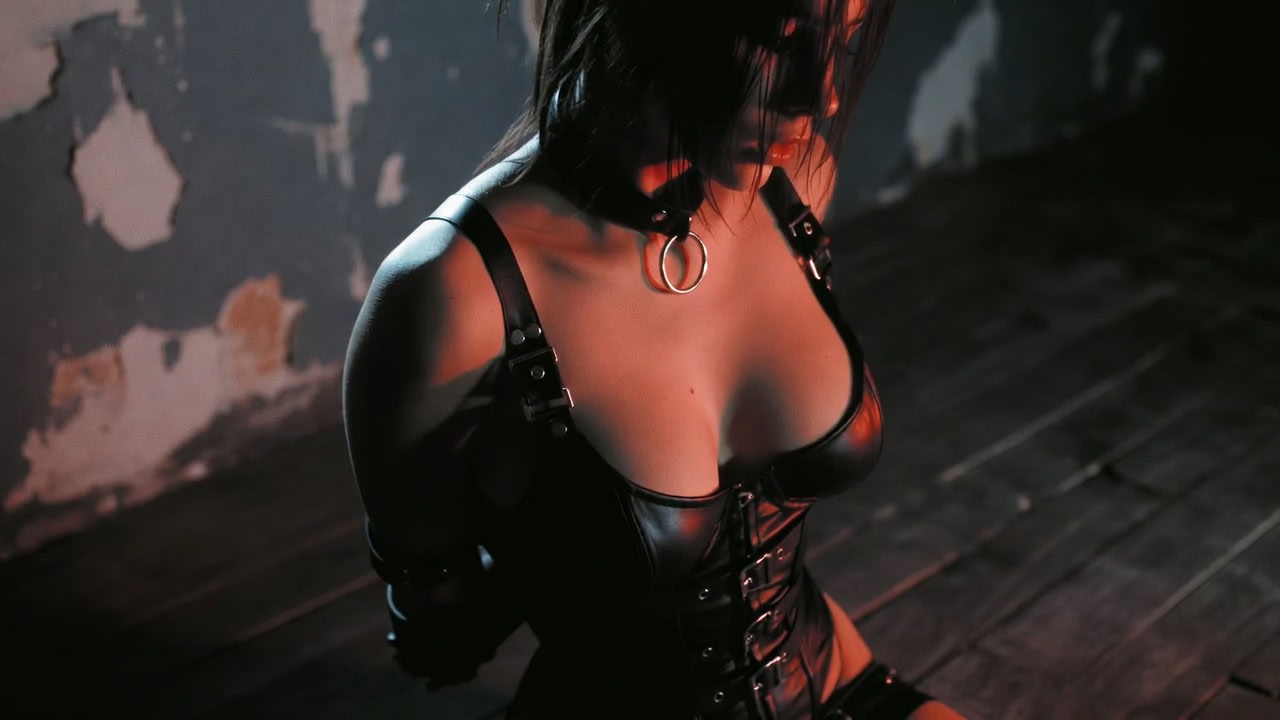
The Ring at Her Throat: Steel, Stillness, and the Open Invitation
Look at her for a moment before you read another word. The room is not beautiful. The plaster is peeling, the floorboards are worn dark, and the only warmth is a slant of red light cutting across her skin. The corset holds her. The harness traces her shoulder. And at the very centre of all of it, where the throat is softest and most undefended, there is a single ring of steel.
Not a chain. Not a padlock. One open circle, catching the light.
People see the leather first. They always do. But the leather is the frame. The ring is the subject. Everything else in the photograph is arranged to lead your eye to that small, deliberate piece of metal resting in the hollow of her neck — and to the stillness of a woman who chose to put it there.
A Ring Is Not a Lock
There is a quiet mistake people make when they imagine collars. They picture restraint. A locked thing. A trap closing.
An O-ring is the opposite of a trap. It does not hold her shut. It holds her open.
A lock says you cannot leave. A ring says here is where you may be held. One is about confinement. The other is about offering. And the woman in that warm red light is not confined by anything you can see. She could stand and walk out of the frame in a single breath. She does not. That is the whole point. Surrender that cannot be withdrawn is not surrender at all — it is only a cage. The ring at her throat is powerful precisely because it is open, precisely because she remains free, and stays anyway.
Why the Open Circle
Of all the shapes a collar could carry, the O-ring endures because it is honest about what it is for.
A buckle fastens. A plate decorates. But a ring is a point of attachment. It exists to receive. It is the place a leash clips, the place a finger hooks, the place a single gloved hand can rest and, with almost no pressure at all, remind her exactly where she stands. The ring does not need to pull to do its work. Most of the time it simply hangs there, cool against warm skin, a small constant weight that says: you are wearing this on purpose, and we both know why.
A Place to Clip
Newcomers often ask what the ring is for, as though it must justify itself with use. It does not. The ring is rarely about the leash that might clip to it. It is about the possibility of the leash. The readiness. The fact that, at any moment her keyholder chooses, that open circle could become a line of connection — and she has already agreed to it.
Anticipation is its own discipline. A ring worn all evening, never once touched, can occupy more of a submissive's mind than an hour of anything louder. She feels it when she swallows. She feels it when she turns her head. It does not let her forget herself, and that — the not-forgetting — is the gift she came for.
The Weight You Choose to Carry
Here is what the photograph cannot show you: how light the ring actually is.
A few grams of steel. Nothing. You could carry a dozen of them in a closed fist and not notice. And yet ask anyone who has worn one in earnest, and they will tell you it is the heaviest thing they own. Not because of the metal. Because of the meaning poured into it.
This is the strange arithmetic of power exchange. The object weighs almost nothing. The agreement behind it weighs everything. We do not hand someone a collar because steel is strong. We hand it to them because the word given over the steel is stronger. The ring is only the visible edge of an invisible thing — a trust, a permission, a yes spoken once and renewed every time it is fastened.
She does not wear the ring because someone made her. She wears it because she decided, in full possession of herself, that being held is a thing she wants. That decision is the heaviest weight in the room. The steel is just where she hung it.
Stillness, and What the Ring Asks
Notice how quiet she is. Head lowered, weight settled, hands unseen. The image is not loud. There is no drama in it, no performance. There is only a woman, a ring, and a stillness that took real strength to arrive at.
That stillness is the discipline the collar asks for. Not obedience as a trick. Composure. The ability to be looked at, to be held, to be the focus of someone's full attention, and to stay soft inside it rather than flinch away. The ring does not demand that she perform. It asks her to settle — to stop managing, stop deciding, stop carrying the thousand small weights of an ordinary day, and let one clean weight rest at her throat instead.
For the One Who Wears It
If you are the one the ring is meant for, understand what you are agreeing to. Not to disappear. To arrive. The collar is not a place to hide from yourself; it is a place to be entirely present. When the ring goes on, the noise is supposed to stop. The endless internal negotiation, the vigilance, the work of being in charge — you set it down. Someone else holds the line for a while. Your only task is to be honest, to stay, and to feel.
That is harder than it sounds, and far more freeing than it looks.
For the One Who Fastens It
And if you are the one who fastens the ring, know that the open circle is a responsibility, not a trophy. She has handed you the noise she carries. She has trusted you with her stillness. The ring at her throat is not proof of your power. It is proof of her trust — and those are very different things to hold. Wear her surrender the way she wears the steel: lightly on the surface, seriously underneath.
The Ritual of the Ring
There is a reason collaring is done slowly, and rarely by accident.
To fasten a ring at someone's throat is a small ceremony, even when no words are spoken. The pause before it closes. The breath she takes as the leather settles. The moment the cool metal touches warm skin and something in her shoulders lets go. None of this is incidental. The ritual is what turns an ordinary piece of hardware into hers — the one ring, the one throat, the one agreement renewed in the act of fastening it.
This is why a collar is not casual jewellery, and why those who live this life treat it with a care outsiders find surprising. It is not about looking dangerous. It is about marking, clearly and gently, the threshold between the ordinary world and the held one. On one side of the ring she is in charge of everything. On the other side, for as long as she chooses, she is in charge of nothing but staying — and that is its own kind of luxury, deep and deliberate and earned.
Trust Is the Real Steel
So return, one last time, to the woman in the warm red light.
The corset is striking. The harness is striking. But strip every buckle and strap away and the truth of the image would still be there in that one open circle: a person who decided to be held, by someone who agreed to hold her well. The leather is the language. The ring is the sentence. And the meaning underneath all of it is the oldest one we know — I trust you with the parts of me I do not show anyone else.
An O-ring is not a lock. It never was. It is an opening, a readiness, an invitation worn in the most vulnerable place on the body, offered freely and taken seriously. That is what makes it beautiful. Not the steel. The yes.
If your throat has been quietly asking what it would feel like to wear one — to set the noise down, to be still, to be held — then you already understand more than you think. The ring is only ever waiting for the choice. The choice has always been yours.
— Mistress Krigar