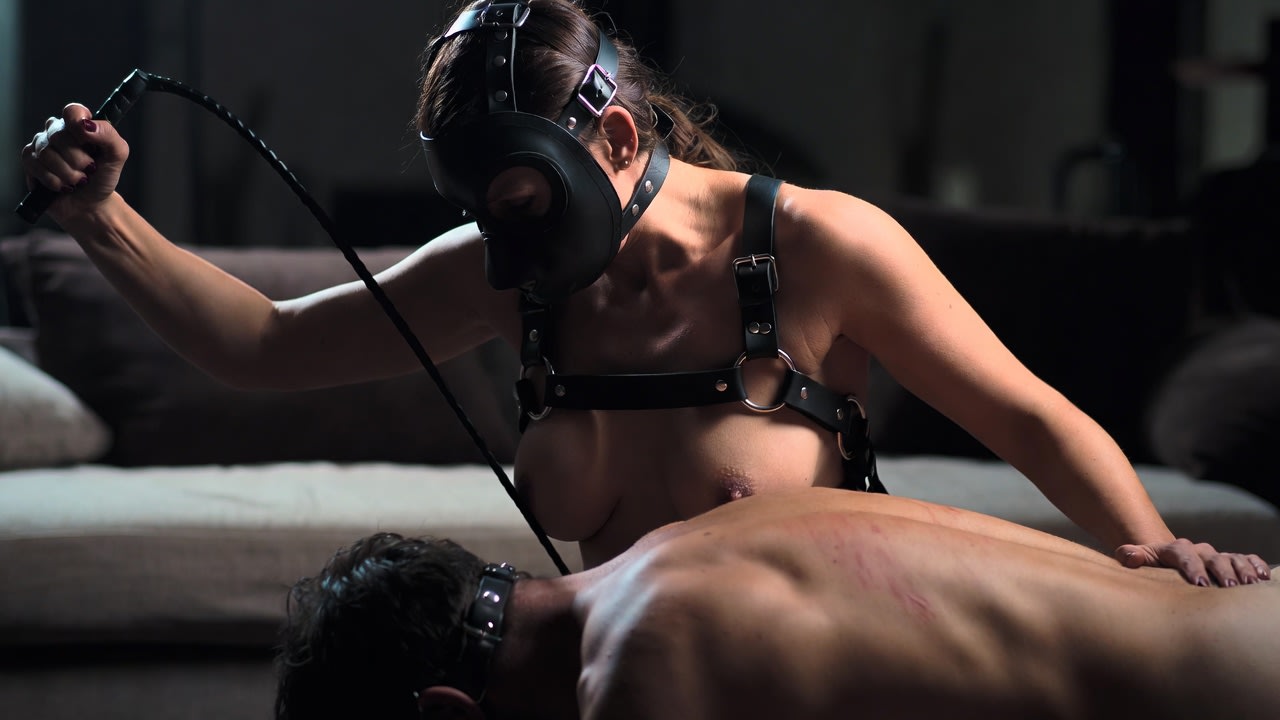
The crop does not need to fall to be felt. Watch the moment it lifts — the wrist cocked, the leather tongue of it hanging in the low light — and you will see the whole room change temperature. Nobody has been touched yet. That is the point.
There is a myth that dominance is about the strike. It isn't. The strike is the least of it. The strike is punctuation. What matters is the long, deliberate sentence that comes before it: the waiting, the aim, the decision withheld. This is a piece about the raised crop, and about everything that lives in the space between lifted and landed.
The instrument that speaks before it touches
A crop is a small thing. A slender shaft, a keeper of leather at the tip, a handle worn smooth by the hand that owns it. It is not a weapon. In the right hands it is closer to a tuning fork — an instrument for finding the exact frequency of a person's attention.
Hold it against skin and do nothing. Let it rest there. The one beneath it will feel more from that stillness than from a dozen careless swats, because stillness is a promise, and a promise carries further than a blow. The crop announces intention. It draws a slow line down the body and says: here, and here, and not yet there.
Precision is the whole art. A crop rewards a dominant who knows exactly where she means to land, and it exposes the one who doesn't. Its small, defined tip means there is nowhere to hide a lazy hand. That is why I love it. It demands honesty from the person holding it.
Why the crop, and not something louder
People new to this often reach for the dramatic instruments first — the ones that make noise, that look like the films. I understand the pull. But the crop is a quieter teacher, and a stricter one. A flogger is forgiving; its many tails spread the sensation and blur the aim. A crop does neither. It speaks in single, precise syllables. One point of contact. One clear intention. Nothing smeared.
That clarity is the gift. When there is only one small tip and one exact place it means to go, both people have to be present. There is no coasting. The dominant must choose. The submissive must feel the choosing. And in that shared, narrowed focus, the rest of the world falls away as cleanly as a light switched off.
Anticipation is the real scene
Ask anyone who has knelt and waited: the mind does more than the crop ever could. Lift it slowly and the body writes its own story — where it will land, how it will feel, whether this is the one. The imagination is a far crueler and far more generous partner than any strip of leather.
This is why I make them wait. Not to torment — though there is a warmth in watching someone strain toward a thing I have not yet given. I make them wait because anticipation is where surrender actually happens. Not in the sensation. In the yielding to not knowing. In handing me the timing and trusting me to keep it.
The crop lands in an instant. The waiting is the whole evening.
When I finally let it fall, it is almost a relief — for both of us. The tension we built together finds its edge. But if I had rushed to that moment, we would have skipped the best part, the way tearing to the last page ruins the book. Patience is not the delay before the reward. Patience is the reward.
Restraint is the dominant's discipline, not the submissive's
People assume the discipline in a scene belongs to the one on their knees. Hold still. Do not flinch. Count. But the harder discipline is mine. To hold the crop up and not use it. To feel the pull toward the easy release of a strike and choose, instead, to wait one more breath. To read the body under me — the catch in the breathing, the small tremor along the spine — and answer it with a fraction rather than a fury.
A dominant who cannot govern herself has no business governing anyone else. The raised arm is not power over another person. It is power over my own impulse. Anyone can hit. Very few can hold, and aim, and choose the gentler landing precisely because it is the harder thing to do.
Reading the body in the dark
Low light is not an accident. In the half-dark the eyes give up some of their dominance and the other senses climb to meet them. I watch differently there — less with my eyes, more with my attention. The shift of weight. The sound of a swallow. The place the shoulders rise toward when they brace, telling me exactly where the fear lives and exactly where the trust is holding.
That reading is the real skill. The crop is only the pen. The scene is written in the pauses — in what I notice, and in what I choose to do with what I notice.
The domestic dungeon: intimacy over spectacle
Notice where this happens. Not a stage. Not some cold, clinical set. A room with a couch and low lamps and the ordinary furniture of a life. This is where most real power exchange lives — in private, in the familiar dark of a shared home, between two people who have chosen each other.
There is something more naked about that than any amount of bare skin. To bring this into the room where you also drink your coffee and argue about dinner is to say the dynamic is not a costume you put on. It is a thread that runs through the whole cloth of how you love each other. The leather is worn like a second skin because, in a sense, it is.
Trust is what makes the raised hand a gift
None of this works without the thing underneath it, the thing you cannot buy or fake: trust. To lie still while a woman lifts a crop over your back is not submission to pain. It is submission to a person. It says: I believe you know where the line is. I believe you will find the edge and stop before the cliff. I believe you have been paying attention.
And I have. That is the contract. The submissive gives up control of the moment; the dominant gives up the luxury of carelessness. Every raised crop is a held responsibility. The harder I am trusted, the more precise I become. Trust does not make me gentler. It makes me exact.
The room that holds its breath
So we come back to the image. A dim room. Leather worn close to the body. One person poised over another, an arm lifted, the crop hanging in the air like a question that has already been answered — just not yet spoken aloud.
This is the part outsiders never understand about the lifestyle. They imagine noise, spectacle, cruelty. What is actually here is quieter and far more intimate: two people who have agreed on the shape of a moment, holding it together, letting it stretch until it is almost unbearable, and finding in that stretched silence something very close to devotion.
The crop will fall. It always does. But if you learn one thing from watching it rise, let it be this — the surrender was never in the sting. It was in the waiting, offered freely, and kept with care.
If the raised crop calls to you
Begin slower than you think you need to. Talk first, in daylight, about where the lines are — the yes, the not-yet, the never. Agree on a word that stops everything, and mean it. Learn one instrument well before you collect ten. And practice the hardest skill of all: holding the moment open a breath longer than is comfortable, and trusting your partner to meet you there.
That is where the deilig lives. Not in the fall. In the held, deliberate, unhurried rise.
— Mistress Krigar