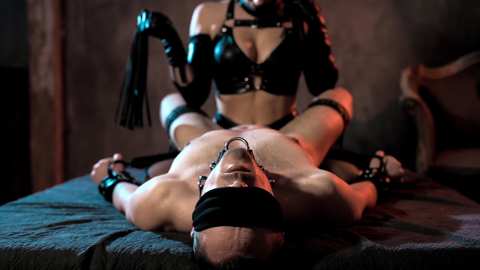
The flogger does very little of the actual work. I say this as someone who owns a great many of them, oiled and hung by weight and reach along one wall of my playroom like a row of quiet instruments waiting to be chosen. People assume the tool is the point. It isn't. The pause is the point. The flogger is just what eventually breaks it.
I want to talk today about that pause — the held second, or ten, or sixty, between a body arranging itself for impact and impact actually arriving. It is the least photographed part of any scene and, in my experience, the part that does the most.
The Body Does the Math Before You Do
Restrain someone properly, take away their ability to see what's coming, and something involuntary starts happening almost immediately: the body begins predicting. It cannot help itself. Muscles brace low in the back. Breath shortens and rises into the chest. The skin itself seems to gather attention, every inch of it suddenly aware it might be next.
This is not something I have to create. It is already there, wired in, the oldest software the body owns. My job is not to install anticipation. My job is to conduct it — to decide how long it plays, how loud, and when it finally resolves.
A flogger raised and then set back down, deliberately, without a word, does more to a nervous system than a dozen careless strikes. The uncertainty of when becomes its own sensation, distinct from anything the leather itself will deliver. I have had subs tell me afterward that the three seconds before first contact lived longer in their memory than the scene that followed it. I believe them. I have felt it from the other side too, in my own training years, long before I ever held a flogger of my own.
Why I Make You Wait
I linger before impact for reasons that have nothing to do with theater. Waiting does three specific things, and I want each of them named plainly, because too much of this practice gets left vague and mystical when it is, underneath the aesthetics, genuinely mechanical.
First, waiting lets me read the body honestly. A tensed shoulder, a held breath, a stillness that has gone slightly too rigid — these tell me more in a pause than almost anything said aloud beforehand. I am watching the whole time, even when it looks like nothing is happening. Especially then.
Second, waiting builds trust in a very specific, very literal way. Every second that passes without harm is evidence. The body is a meticulous record-keeper; it does not believe reassurance, it believes pattern. Enough pauses that resolve safely, and the nervous system starts to relax into uncertainty instead of fighting it. That relaxation is not weakness. It is, quite precisely, what surrender is made of.
Third — and this is the one people least expect — waiting sharpens sensation rather than dulling it. A strike that lands after real anticipation registers differently than one that lands cold. The nervous system, primed and open, receives it fuller. This is why I never rush toward impact. Rushing is not efficiency. It is waste.
Reading the Instrument Before You Ever Swing It
I choose a flogger the way some people choose a word — for weight, for reach, for the particular sound the falls make moving through air before they ever touch skin. That sound matters enormously and is, again, part of the pause rather than the payoff. A soft whoosh, low and controlled, tells a restrained body something is coming without yet saying what, or how hard, or where. I will sometimes let the falls brush skin without any real force behind them at all — pure warning, pure contact, no strike — three or four times before the first real one lands. By then the skin has stopped guessing and started simply waiting, which is a very different and much calmer state to work from.
Positioning matters here too. In the scenes I favor most, I like my partner restrained somewhere I can sit close, near enough that my own presence becomes part of what they're bracing against — my weight settling nearby, my breath audible, the leather of what I'm wearing against their skin before the flogger ever enters the picture at all. Proximity is its own kind of pressure. It says: I am not going anywhere. Whatever comes, comes from right here, from me, and you don't get to look away from that.
What This Is Not
I want to be direct about the line, because it matters more than the technique. Anticipation built with care is not the same thing as anticipation built with cruelty, and the difference is not subtle if you know what to look for.
Cruelty extends a pause past the point where it is teaching the body anything, purely to watch someone suffer the not-knowing. Care extends a pause exactly as long as it is productive, and reads constantly for the moment that productivity turns into something else — dread, panic, a body no longer bracing but genuinely trying to disappear. Those are not the same sensation and they do not look the same from where I sit. Learning to tell them apart, quickly and reliably, is not optional for anyone who wants to hold this kind of control responsibly. It is the actual job.
This is also why I talk endlessly, tediously, to anyone new to impact play about check-ins before a scene ever starts. What does a light tap mean tonight. What does silence mean. What word ends everything immediately, no discussion. I want these agreed upon while both of us are calm and thinking clearly, because the whole architecture of the pause — its safety, its power — depends on both people trusting that architecture completely before the first flogger is ever lifted.
Building It Yourself
If you want to bring deliberate anticipation into your own practice, start smaller than you think you need to. Warmth before intensity. A hand pressed flat against skin, held still, saying nothing, for longer than feels natural. Notice what that stillness alone does before you add a single implement to the mix.
When you do introduce a flogger or a crop or anything with real weight behind it, let the first several passes be barely-there — contact without force, presence without consequence. Let your partner's body learn the shape and rhythm of what's coming before you ever ask it to absorb the real thing. Speed is the enemy of everything I am describing here. Slow is not a compromise. Slow is the entire technique.
And always, before any of it: agree on your language for stopping, pausing, needing air. A pause that is safe depends entirely on both people trusting that any pause can be ended the instant it needs to be, no explanation required, no argument, no delay.
What Waits on the Other Side
The scenes I remember most clearly are rarely the loudest ones. They are the ones with the longest, most honest pauses — a raised hand, held; a breath, drawn out; a room gone so quiet you could hear leather settle against skin like a question being asked. What comes after all that waiting is not simply relief. It is trust, made physical, delivered exactly on time by someone who was watching the whole way through.
That is what I am actually building, every time I make someone wait. Not suspense for its own sake. A body that has learned, all the way down, that uncertainty in my hands is never the same thing as danger.
Breathe. I'm right here. And when it comes, it will be exactly as much as you can hold, and not one measure more.
— Mistress Krigar