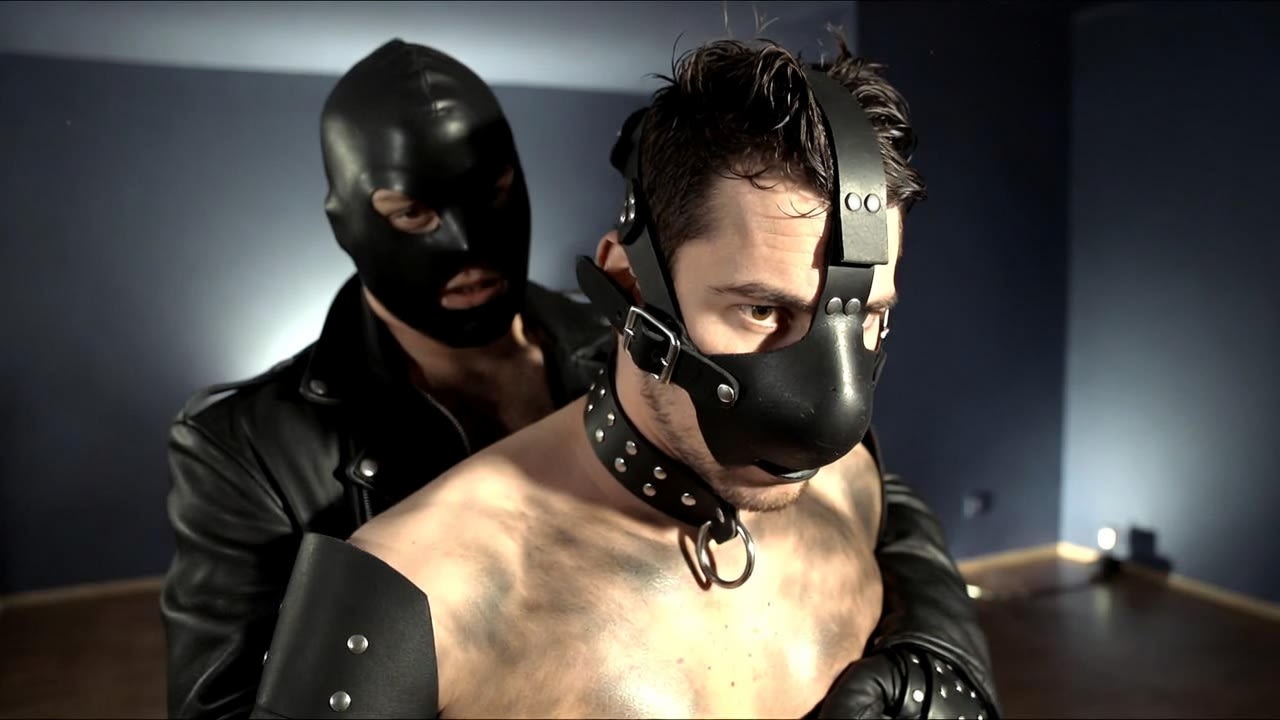
There are two men in the blue-lit room. One wears a hood that erases his face. The other wears a muzzle that takes his mouth. The hooded one stands behind. The muzzled one stands in front, collared, bare-chested, eyes forward. They are not looking at each other. They do not need to.
This is the arrangement I want to talk about. Not the hood alone, not the muzzle alone — the geometry. One man at another man's back, close enough that warmth crosses the gap, and the one in front cannot see a single thing the one behind is about to do.
Most people would call that vulnerable. They are right. What they miss is that vulnerability, chosen and given to the right hands, is the most expensive gift in power exchange. It cannot be faked. It cannot be rushed. And it is never, ever free.
The Front of You Lies. The Back of You Cannot.
Face to face, you perform. Everyone does. You arrange your expression, you manage your eyes, you negotiate with your own fear in real time. The front of the body is a diplomat.
The back of the body has no such talent. It cannot smile. It cannot deflect. When a submissive turns his back to his Dominant and stands still, he has taken away every tool he owns for managing the moment. What remains is the truth: either he trusts the man behind him, or he does not. The shoulders will tell you within seconds. Watch a submissive's shoulder blades when someone he does not trust walks behind him — they climb, they harden, the breath goes shallow. Now watch the same man with a handler he has surrendered to. The shoulders drop. The spine lengthens. The breath sinks low into the belly.
That drop is the whole conversation. Everything else — the leather, the steel, the ritual — exists to earn it.
Two Masks, Two Different Surrenders
Look again at the image of these two men, because the masks are not doing the same work.
The Hood: Authority Without a Face
The handler's hood removes his identity. This matters more than it first appears. A face can be pleaded with. A face can be searched for softness, for hesitation, for a crack to negotiate through. The hood closes that door. What stands behind you is not a man with a mood — it is a role, steady and impersonal, and there is a strange mercy in that. The submissive is not managing a person's feelings anymore. He is answering to a function. Many submissives find that the hooded Dominant is easier to surrender to than the bare-faced one, precisely because there is nothing to perform for.
The Muzzle: The Word, Surrendered
The muzzle takes something different. Not identity — voice. The clever sentence, the deflecting joke, the question asked mostly to delay: gone. For men especially, who are so often taught that their words are their power, this is a profound handover. The muzzled submissive keeps his safeword-equivalent — a gesture, a hum, a signal negotiated long before the leather ever touched his face; that is not optional, it is the floor everything stands on — but he gives up commentary. He gives up the running narration that keeps him one step outside his own experience.
What rushes in to fill the silence is sensation. The buckle at the jaw. The collar's weight. The heat of the man standing behind. Silence, it turns out, is not empty. It is very, very full.
The Handler's Discipline
Now the one behind, because he is doing the harder work, and almost nobody writes about it.
Standing at a man's back and doing nothing — no grip, no push, just presence — is an act of enormous restraint. Amateurs grab. Amateurs fill every silence with a command because the silence frightens them. A handler who knows his craft understands that proximity is the instrument. He stands close. He breathes slowly, audibly, until the man in front borrows the rhythm without knowing it. He lets the moment stretch until it hums.
This is what I mean when I say dominance is not appetite. Dominance is attention. The hooded man in that room is reading everything: the set of the shoulders, the pace of the breath, the small sway that says the submissive is settling into his body instead of fleeing it. Every choice he makes next — when to touch, whether to touch, how long to wait — comes from that reading. Control without attention is just noise wearing boots.
Why Behind Matters
The nape of the neck is one of the oldest alarm systems in the body. Something behind you, unseen, close — every instinct you inherited says turn around. So when a submissive stands still instead, he is not merely following an instruction. He is overriding a survival reflex, on purpose, as an offering. That is why being held from behind lands so much deeper than being held face to face. The body knows exactly what it is spending.
And here is the quiet paradox: once the choice is made, once the reflex is overridden and the handler's stillness proves itself, the back of the neck becomes the calmest place on the body. The alarm, answered often enough by safety, learns to ring differently. What used to say threat begins to say held. Submissives describe it in the same words, again and again: like a wall at my back. Like weather. Like something I could finally lean against.
Trust is not built face to face. Face to face is where trust is negotiated. It is built back to front — proven in the moments you cannot verify, cannot supervise, cannot see coming.
For the Men Who Kneel
Both figures in this room are men, and I will not pass by that without comment.
Male submission is still the surrender people speak of last, and often in a lowered voice — as if a man giving up control has lost something a man is supposed to keep. I have no patience for that arithmetic. It takes a settled man to stand collared and silent while another man holds the room at his back. The fidgeting, the smirking, the need to signal to an invisible audience that he isn't really this — none of that survives the muzzle. What survives is the man himself, quieter than he has ever been, more present than he has ever been, doing the one thing our world almost never permits men to do: receiving.
If you are a man who wants this and has never said so aloud — you are not broken, and you are very far from alone. The want is old, human, and clean. It deserves better than shame. It deserves structure.
Bringing It Home
Because structure is what turns a fantasy into a practice, let me be practical for a moment, as I always am eventually.
Nothing in that blue room happened spontaneously. The muzzle was negotiated. The non-verbal signal was agreed and tested. Limits were named in plain daylight language before anyone's face disappeared into leather. If you want the depth, you build the scaffolding first: talk before, check in after, and treat aftercare as part of the scene rather than an apology for it. A muzzled man who was held well will have things to say when the buckle comes off. The handler who listens to all of it, without defending or deflecting, is doing dominance at its most exact.
Start smaller than the picture, if you are new. Stand behind him while he faces the wall, and say nothing for two minutes. Let him learn your stillness before he ever wears your leather. The muzzle, the hood, the collar — those are graduations. The first lesson is only this: I am behind you, and nothing bad is happening. Repeated until the body believes it.
The Weight at Your Back
In the end, the image is not about leather at all. It is about a question every submissive carries: if I stop watching for danger, will someone else watch for it? The one who stands behind is the answer. He has taken over the watch. The muzzled man's eyes can soften now, his shoulders can fall, because vigilance — that exhausting, lifelong job — has been handed to someone who wanted it.
That is what surrender buys, and why it is worth the price of the reflex it spends. Not escape. Not weakness. Relief. The oldest relief there is: someone at your back, and no need to turn around.
Stand still. He is there.
— Mistress Krigar