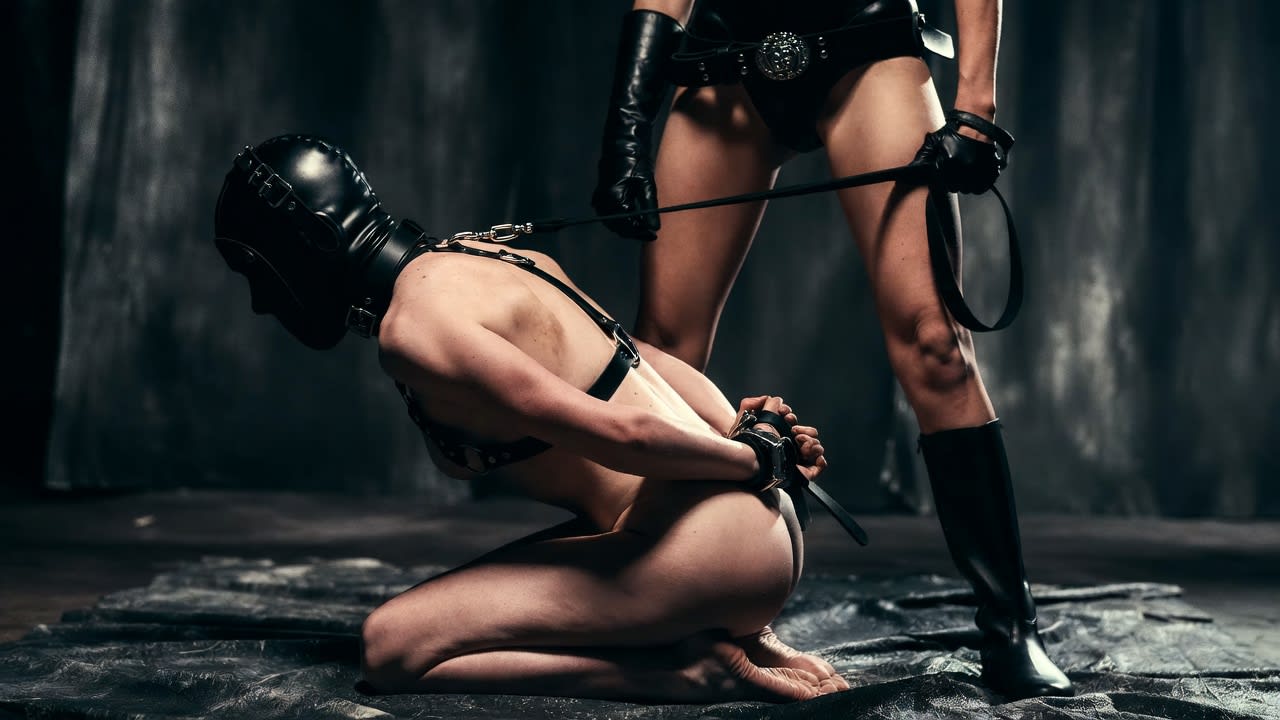
There is a moment, just before the knees touch the ground, when everything in a person goes quiet. The noise of the day, the small negotiations, the constant low hum of being in charge of your own life — all of it thins out. Then the floor rises to meet you, and you are exactly where you chose to be. Down. Held. Still.
People who have never knelt imagine it as a small humiliation. They picture losing. They could not be more wrong. Kneeling, done with intention, is one of the most deliberate acts a person can perform. It is not collapse. It is offering.
The posture is the message
Look at a submissive on the floor — hooded, hands drawn behind the back, spine curved into a soft bow — and the leash running up from the collar to a gloved hand above. The eye goes straight to the line of leather connecting the two. That line is the whole story.
The one on the floor is not smaller. The one standing is not larger. What has changed is direction. All of the kneeling person's attention now flows upward, along that thin strap, toward the one who holds it. And all of the standing one's attention flows down, steady and unhurried, into the body that trusts them.
That is power exchange. Not power taken. Power given, on purpose, with both people awake to exactly what is happening.
Surrender is not weakness — it is precision
I have watched strong people kneel. Surgeons. Executives. The ones who carry a hundred decisions a day and never let anyone see the weight of it. They do not come to the floor because they are weak. They come because, for one held hour, they would like to put the weight down.
There is enormous discipline in that. To surrender well, you have to know yourself. You have to know what you want, where your edges are, and what you are placing in another person's hands. Vague people make poor submissives. The best ones are exact. They say: this far, and here is where it stops, and inside those lines I am entirely yours.
That precision is what makes surrender beautiful. It is not a door blown open. It is a door chosen, opened, and walked through with clear eyes.
What the leash actually carries
A leash looks like control. It is, but not the kind people assume. The leash does not drag. A good hand on a leash is mostly slack — a presence, not a pull. Its real job is connection. It says: I have you. I know where you are. You do not have to hold yourself up right now, because I am holding the line.
For the one who kneels, that slack is the entire point. The tension they carry all day — the tension of being responsible, of being watched, of having to decide — that tension is what they came to release. The leash lets them. It gives them a single thing to feel and a single direction to face. Everything else can wait.
This is why so many submissives describe the floor as the most peaceful place they know. Not despite the leash. Because of it.
Trust is the real architecture
None of this works without trust, and trust is not a mood. It is built, slowly, out of small kept promises.
Before anyone kneels in front of me, we have already talked. We have mapped the boundaries. We have agreed on the word that stops everything, instantly, no questions, no disappointment. The submissive knows that if they use it, I will not sigh, I will not push, I will not make them pay for it later. I will simply stop. That certainty is the foundation the whole scene stands on.
When that foundation is real, surrender becomes effortless. The one on the floor can let go completely because they know the floor will not betray them. The hand on the leash is firm, but it is also faithful. That combination — strength you can lean your whole weight against — is the thing people are really chasing when they explore this lifestyle. Not pain. Not theatrics. Safety dressed in leather.
The one who holds
It is easy to romanticize the submissive and forget the other half of the line. Holding a leash well is its own discipline. It asks for attention, patience, and a steady reading of the body in front of you.
A good dominant is not loud. They watch the breathing. They feel the moment the shoulders finally drop. They know the difference between a stillness that means more, please and a stillness that means I have reached my edge. The control they offer is care made visible. The collar is not a trophy. It is a responsibility worn on someone else's throat.
When I take the leash, I am not taking something from the person at my feet. I am accepting something they have handed me — their trust, their nervous system, their permission to guide them somewhere they cannot get to alone. That is a serious gift. I treat it like one.
The quiet that comes after
There is a particular silence that settles into a room once a scene has found its rhythm. The submissive is down, breathing slow, all that daytime noise finally switched off. The dominant is present, unhurried, holding the line. Nothing needs to be said. The whole arrangement hums on its own.
People outside this world assume the appeal is the intensity. Sometimes it is. But just as often, it is this — the deep, clean calm of two people in their exact right places, each fully responsible for their half of the exchange. Stillness, on purpose. Surrender, by design. There is a Norwegian word, deilig, that means something closer to delicious than merely nice — and that quiet is precisely that. Deilig. Earned.
If you are curious about kneeling
If something in you leaned forward while reading this, pay attention to that. Curiosity is not a confession; it is information. You are allowed to want this. Wanting it does not make you broken, or strange, or less than. It makes you honest.
Start small and start slow. Talk before you touch. Learn the boundaries — yours and your partner's — and write them down if you have to. Agree on the word that stops everything. Begin with something brief and gentle and entirely within your limits, and notice how your body answers. The floor will still be there next time. So will the leash.
And know this: the strongest people I have met are not the ones who never kneel. They are the ones who know exactly when, and to whom, and why.
Down is not defeat. Down is a decision. Make it well, and make it with someone worthy of the line.
— Mistress Krigar