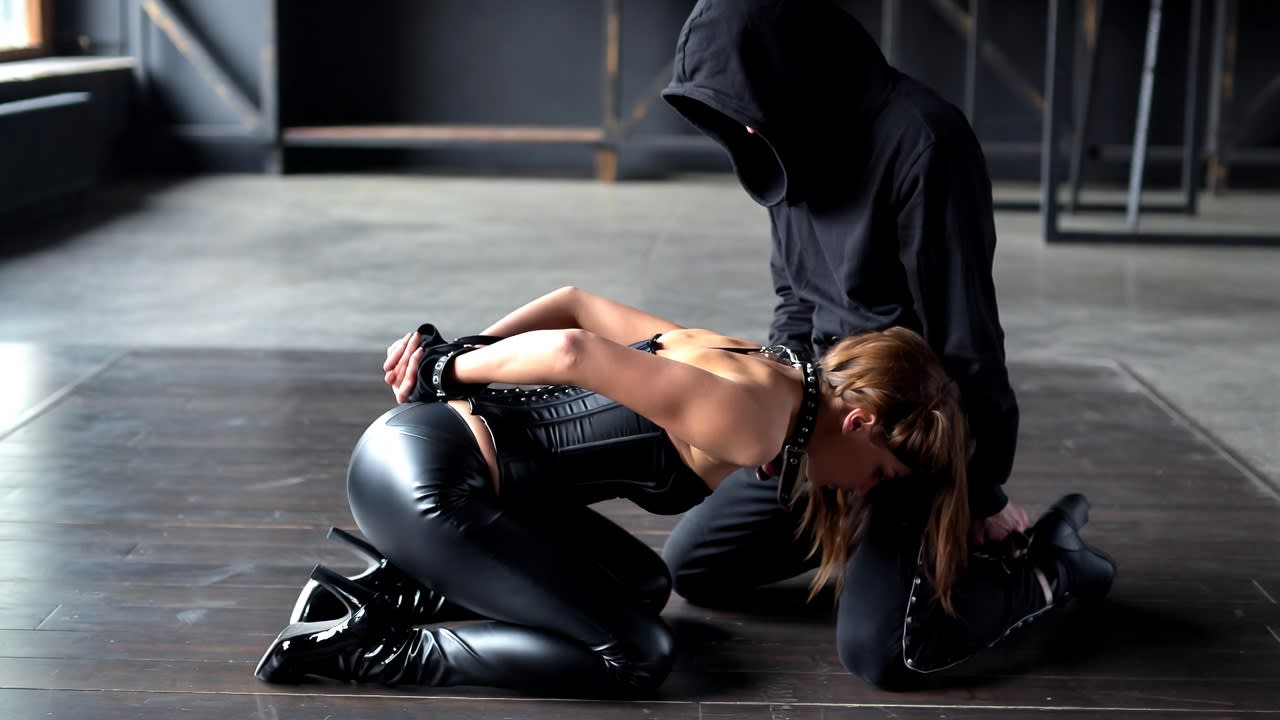
Look at the picture for a moment before you read a word. Two people on a bare wooden floor. One of them is folded forward in a deep bow, forehead sinking toward the boards, wrists crossed and offered behind her back. The other kneels behind her — hooded, unhurried — with both hands at the cuffs. Nothing else is happening. And that is precisely the point: this is the scene. The fastening of the restraints is not the prelude to the ritual. It is the ritual.
We talk endlessly about being bound. We talk far too little about being bound by someone. The cuff itself is just leather and steel; it has no opinion of you. What changes everything is the pair of hands that closes it — how slowly they work, how certain they are, how much attention lives in the fingertips. This piece is about those hands, and about what it means to bow low and offer your wrists to them.
The Offer Comes First
Before anything is fastened, something is given. Look again at her posture: no one is holding her down. The bow is hers. The wrists lifted behind the back are hers. She has arranged her own body into the shape of an offering, and the person behind her is simply — carefully — accepting it.
This is the part outsiders always get backwards. They imagine restraint as something done to a person. Anyone who has knelt like this knows it is something done with a person, and that the submissive moves first. The bow says: here is my balance, my sight of the room, my hands — I am handing them over. The cuffs merely make visible a decision that was already made in the quiet of her chest.
There is enormous power in moving first. It takes far more nerve to offer your wrists than to have them taken. The deep bow is not collapse. It is aim.
The Hands That Fasten
Now watch the second figure. Kneeling — not standing over her, kneeling with her, down on the same cold floor. That detail matters more than any piece of equipment in the frame.
The one who binds is working. Checking the line of the wrist, the roll of the leather, the room left for blood and breath. Two fingers slid beneath a cuff is one of the most intimate gestures in this whole world of ours — a silent question asked directly of the body: too tight? too loose? just so? The body answers before the mouth does.
Slowness Is the Message
A buckle can be closed in two seconds. It should never be. The slowness of a good binding is not inefficiency; it is vocabulary. Every unhurried pass of the strap says: I am not in a rush, because you are not going anywhere, and neither am I. Speed would make it mechanical. Patience makes it ceremonial.
The submissive, bowed and waiting, experiences that patience as warmth spreading through the chest. Each small adjustment lands like a sentence in a language only the two of you speak. You are being handled the way careful hands handle something valuable. Let that word sit for a moment. Valuable.
The Binder Also Surrenders
Here is the quiet secret of the picture: the dominant kneels too. Whoever fastens the cuff accepts everything that comes with it — the vigilance, the responsibility, the duty to watch breath and color and stillness for as long as the restraint stays on. Her freedom is now carried in someone else's hands, and those hands have agreed to carry it. That is its own kind of surrender: the surrender of ease. From the moment the first buckle closes, the binder is on duty.
Power exchange is exactly that — an exchange. Nothing in this frame flows only one way.
What the Body Learns in the Bow
Bound and bowed, the world becomes very small and very honest. The floor is hard and certain under your knees. Your own breath is suddenly loud. The wrists test the cuffs once — everyone tests, it is almost involuntary, the body confirming the truth of its situation — and the leather answers: held.
And then something loosens that has nothing to do with straps. The shoulders drop. The thoughts that circle all day — the lists, the performances, the managing — find nowhere to land, because there is nothing left to manage. You cannot fix anything with your hands behind your back. You are, for once, excused from being capable.
Many submissives describe this as the quietest moment of their week. Not the intensity that may follow, not sensation, not spectacle — this. The pause after the last buckle, head down, hands held, everything decided. Stillness with a witness. It is a kind of rest that unbound people rarely reach, because rest, real rest, requires trusting someone else to keep watch.
Trust Is Built at the Buckle
People assume trust must exist in full before the cuffs come out. The truth is more interesting: trust is manufactured in moments exactly like this one. Every careful fastening is a deposit. The submissive learns, through repetition, that her offer is received with attention rather than appetite. The dominant learns that the offer keeps being made — that last time's care earned this time's bow.
This is why the negotiation, the check-in, the safeword, the aftercare are not the boring administrative wrapper around the "real" scene. They are load-bearing. The bow in this photograph is only possible because of every conversation that happened before it and every gentle unbuckling that ended the nights before this one. Ritual is simply trust made visible, repeated until it becomes beautiful.
A Word to the One Who Offers
If you are the one who bows: offer deliberately. Know your limits and say them out loud, even when your pulse is asking you to skip ahead. A worthy binder will never be less drawn to you because you named a boundary. Boundaries are what make the offer legible — they show exactly where your yes begins.
A Word to the One Who Binds
If you are the one with the buckles: take your time as if time were the gift, because it is. Check twice. Watch the breath. Let your hands be certain and your pace be soft. You are not restraining a body; you are answering an offer. The difference is everything, and the person bowed in front of you can feel which one is happening through half a millimeter of leather.
The Ceremony You Can Keep
Long after the cuffs are off, this is what stays: not the pressure at the wrists but the memory of hands working carefully at your back while you bowed your head and let them. The picture holds no struggle, no drama, no noise. Just two people kneeling on the same floor, one offering, one accepting, both entirely present.
That is what this life looks like when it is done well. Not wildness — attention. Not being overpowered — being received.
Bow slowly. Fasten slowly. The ceremony is in the hands.
— Mistress Krigar