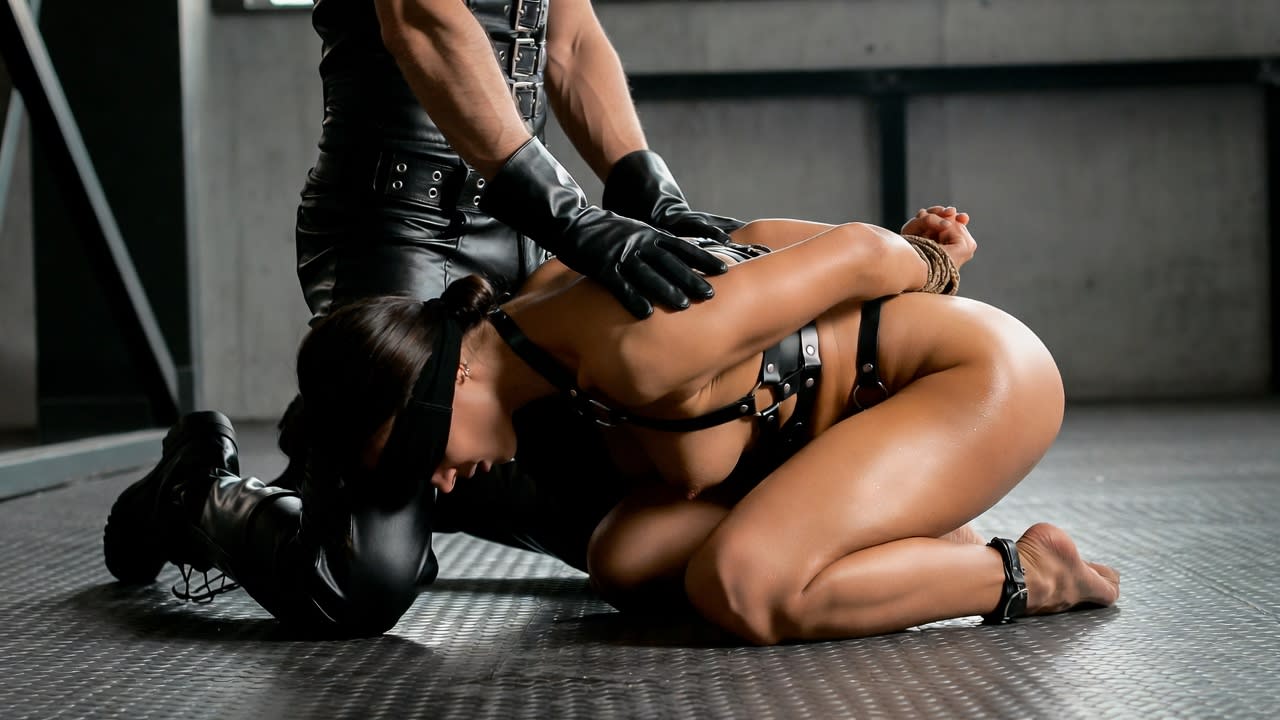
The room is concrete and steel. The floor is cold enough that she feels it through her knees, and she cannot see any of it. The blindfold took the room away first, then the rope took her hands, and what is left is smaller and far more intense: breath, the creak of leather somewhere above her, and one gloved hand resting between her shoulder blades.
Not gripping. Not pushing. Resting.
If you have never worn the blindfold, you might assume the rope is the point, or the kneeling, or the leather. It isn't. The point is that hand. Everything else in the scene exists to make that single touch mean as much as it does.
What the Blindfold Actually Takes
Sight is the sense we negotiate the world with. It is how we check the exits, read the faces, calculate the next move. It is also — and few people admit this — how we perform. As long as you can see, you are composing yourself: your expression, your posture, the version of you that is being watched.
The blindfold ends the performance. There is no one left to compose for, because you can no longer see your audience. What remains is not darkness so much as honesty. Your breath gets louder. Time goes soft at the edges. A minute kneeling in the dark stretches like taffy, and you stop being able to tell whether the scene has lasted moments or hours.
This is why sensory deprivation sits at the heart of so much power exchange. It is not about taking something away from the submissive. It is about removing the last tool of self-management, so that what is underneath — the want, the nerves, the trust — can finally surface without supervision.
The Body Turns Its Volume Up
Deprive one sense and the others lean in to compensate. Skin becomes attentive in a way it never is in daylight. The seam of a leather glove, the temperature difference between the floor and a palm, the faint vibration of a footstep through steel plating — all of it arrives in high resolution. A blindfolded body is not a diminished body. It is a body listening with everything it has.
Touch Becomes the Only Language Left
Here is what the cover of this piece understands, and what a thousand harsher images miss: when sight is gone and hands are bound, touch stops being a gesture and becomes a vocabulary.
A hand at the back of the neck says be still. A palm flat between the shoulder blades says I am here, and you are doing well. Two gloved fingers under the chin say up, and no words are needed at all. The submissive learns this language astonishingly fast, because in the dark it is the only channel that carries any signal. The dominant learns it too — learns to write clearly, because every touch now lands on skin that is listening at full volume.
This is the quiet paradox of the blindfold: it does not isolate the two of you. It forces you closer. Speech can be lazy; touch, in the dark, cannot. Every contact is deliberate or it is nothing.
The Steadying Hand
Watch experienced dominants work and you will notice something the untrained eye skips over. In the intense moments — when the rope is checked, when the position is held, when the submissive is deepest in the dark — there is almost always a hand somewhere on the body that is doing nothing at all. It is not adjusting, correcting, or demanding. It is simply present.
That hand is an anchor. It tells the blindfolded body a continuous, wordless sentence: you have not been left. Everything else in the scene can be intensity, but that one point of contact is pure reassurance, and it is what makes the intensity survivable — more than survivable. Wanted.
Submission without that anchor is just endurance. With it, the dark becomes a place you can actually let go.
Rope as a Question, Trust as the Answer
Her wrists in the image are wrapped, folded up against her back. Rope, like the blindfold, is widely misread. Outsiders see restraint and assume the story is about force. Practitioners know the rope is a question, asked slowly, wrap by wrap: will you let me hold this for you?
The bound answer is not passive. Choosing to stay — when the mind is free even though the hands are not — is one of the most active things a person can do. The rope makes the choice visible. Every minute she remains kneeling is the answer being given again.
And trust, real trust, is built exactly here — not in the grand gestures but in the accumulation of small kept promises. The check-in that actually happens. The safeword that is genuinely honored. The circulation that is genuinely checked, fingers pressed briefly into her palm: squeeze. She squeezes. The scene continues. Architecture, built one brick at a time.
For the One Holding the Rope
Power exchange is not a performance of severity. The dominant in the frame is not looming; he is tending. There is a difference, and every submissive can feel it through a single layer of leather.
If you lead scenes like this one, your work in the dark is threefold. Be predictable in your care and unpredictable only in your pleasures — the body in the blindfold should never have to wonder whether it is safe, only what comes next. Keep one channel of contact open at all times; in sensory deprivation, absence reads as abandonment far faster than you would think. And narrate when it serves you — a low voice in a dark room is its own kind of touch, and the only sense you have chosen to leave her.
For the One in the Dark
Your work is different, and in some ways harder: your task is to stop working. The blindfold will invite your mind to do what minds do — map the room from memory, track footsteps, stay one calculation ahead. Let the invitation expire. You negotiated this scene with your eyes open. You chose the person whose hand is on your back. The thinking was done before the blindfold went on; what happens now is the part thinking cannot reach.
Surrender is not something that is taken from you. It is something you set down, deliberately, the way she has set down her hands into the rope. And it is retrievable at a word — which is precisely why it can be given so completely.
The Scene Ends. The Hand Stays.
Eventually the rope comes off, and the marks it leaves fade in an hour. The blindfold lifts, and the room returns — concrete, steel, ordinary light. What does not return to normal quite so quickly is the two of you.
Aftercare in a scene like this is not an appendix; it is the final chapter of the same story. The hand that anchored her in the dark stays for the water, the blanket, the slow return of the world. Because the deepest thing the blindfold teaches is not about darkness at all. It is this: someone stayed. You could not see them, you could not hold them, and they stayed.
That is the whole art. Not the rope, not the leather, not the cold beautiful floor. The hand at your back — and the certainty, earned touch by touch, that it will still be there when the lights come on.
— Mistress Krigar