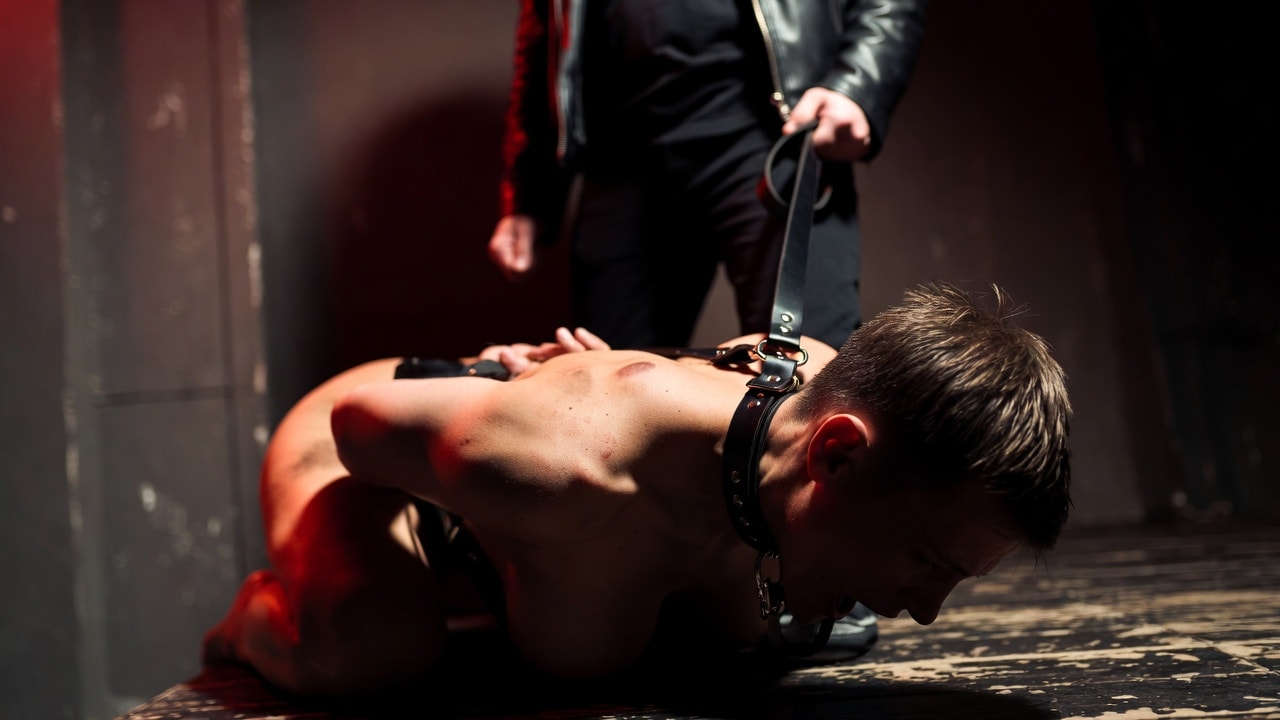
There is a moment, just before the knees touch the floor, when everything in a person goes still. The noise of the day falls away. The shoulders drop. The breath changes. And then — down. Onto the cold concrete, into the low red light, into the one posture the modern world tells us to be ashamed of. Kneeling.
I want to talk about that moment. About the collar that closes around a throat, the leash that runs upward into a steady hand, and the strange, deilig truth that hides inside all of it: surrender is not weakness. Surrender is one of the most deliberate things a person can do.
The collar is not a leash for the body. It is a line to the self.
Look closely at someone wearing a collar properly and you will notice something most people miss. They are not smaller. They are more present. The leather sits at the throat — the most vulnerable place we have, the place we instinctively protect — and instead of fear, there is calm. That calm is the whole point.
A collar does not take anything away. It gives something a shape. It turns a vague longing — to belong to someone, to be held, to be wanted with intention — into a single object you can feel against your skin. Cold at first. Then warm. Then simply yours.
When I fasten a collar, I am not claiming a possession. I am answering a question the other person has been asking quietly for a very long time: will someone hold the weight of me on purpose? The buckle clicks. The answer is yes.
Why the throat, of all places
There is a reason the collar lives at the neck and not the wrist. The throat is where we are most exposed and most honest. It is where the voice comes from, where the pulse shows, where we swallow our fear. To offer it — openly, willingly, with eyes down and breath even — is to say I trust you with the part of me I usually guard. That is not submission as defeat. That is submission as a gift, handed over with both hands.
Kneeling: the most underrated power move there is
We have been taught that standing tall is strength and that going down is humiliation. I find that backwards.
Anyone can stand because they are afraid to kneel. It takes a particular kind of strength to choose the floor — to lower yourself in front of someone and stay open while you do it. To kneel well is to be vulnerable on purpose. There is nothing soft about that decision. It is iron dressed as velvet.
The person on the floor in the low light is not powerless. They have done something most people never manage. They have stopped performing. They have set down the armour they wear all day — the competence, the control, the relentless holding-it-together — and they have let someone else carry it for a while. That is what surrender actually is. Not collapse. A controlled handover.
The relief of not deciding
For people who run everything — the ones who make a hundred decisions before lunch, who hold a company or a household or a whole life together — there is a specific, almost dizzying relief in being told what to do. In kneeling and waiting. In letting a single steady voice replace the constant internal committee.
This is the secret kink-positive people understand and the outside world refuses to: control given away on purpose is not control lost. It is rest. It is the deepest rest some people ever find. The mind that never stops finally gets to be quiet, because someone else is holding the map.
The leash: a line of trust, not a line of force
Now the leash. People who do not understand it see a chain and imagine cruelty. They have it exactly wrong.
A leash, held well, is barely felt. It is not there to drag. It is there to connect. It is a physical, unbroken line between two people that says I have you; you are not drifting; wherever this goes, you are attached to me. The tension in it is not violence. It is reassurance you can feel through leather.
A good hand on a leash is light. It guides, it steadies, it occasionally reminds — never more than that. The submissive is not pulled where they do not wish to go. They are accompanied. The difference is everything. When the leash goes taut for a heartbeat, it is not a threat. It is a touch. It says still here. Still watching. Still yours. And the body on the other end softens, because being held — truly held, with attention — is what it came for.
Power exchange is a conversation, not a conquest
Here is what the cliché gets wrong about dominance and submission. It imagines one person doing something to another. The reality is that the two are doing something together, and the one who appears to be in command is in fact serving most of all.
To dominate well is to pay attention without pause. To read the breath, the shoulders, the tiny flinch and the long exhale. To know when to press and when to soften. The leash does not run only one way. The dominant is bound to the submissive by responsibility — the duty to be worthy of all that trust placed in their hands. Underneath the leather and the low light is something almost tender: two people negotiating, in a language of glances and pressure and breath, exactly how much weight one will carry and how much the other will give.
Consent is the spine of all of it
None of this exists without consent. Real consent — enthusiastic, specific, ongoing, and able to be withdrawn in a single word. The collar means nothing if it was not freely offered. The leash is just a strap if there is no yes running through it.
Before anyone kneels, the boundaries are spoken aloud. What is wanted. What is off-limits. The word that stops everything instantly, no questions, no disappointment. This is not the unsexy paperwork before the real thing. This is the real thing. The trust that lets someone surrender completely is built entirely on the certainty that their no will always be honoured. Power exchange without that is not dominance. It is just harm, and I have no interest in it.
Surrender is a practice, not a personality
You do not have to be born a certain way to feel the pull of this. You do not have to wear the collar in daylight or tell a soul. Surrender is something you can practise quietly, in the dark, with one person you trust — and walk back into your loud, demanding life carrying a secret softness that no one can see.
Many of the strongest people I know are the ones who kneel best. The surgeon, the executive, the single parent who holds the whole world up with both arms. For them, the floor is not a fall. It is the one place they are allowed to be held instead of holding. They go down so they can, for once, stop carrying everything.
That is the deilig paradox at the centre of it all. You give up control and you find peace. You bare your throat and you feel safe. You kneel and, for the first time all day, you stand to lose nothing.
A quiet invitation
If something in you went still while you read this — if the idea of kneeling did not embarrass you but pulled at you instead — pay attention to that. It is not shameful. It is not broken. It is a part of you asking, very quietly, to be met.
You do not have to understand it all at once. You do not have to do anything tonight. Surrender begins long before the knees touch the floor. It begins the moment you stop pretending you do not want to be held.
The collar waits. The leash is steady. And the floor, in the low red light, is more comfortable than the world ever told you it would be. Come down when you are ready. I will be holding the other end.
— Mistress Krigar