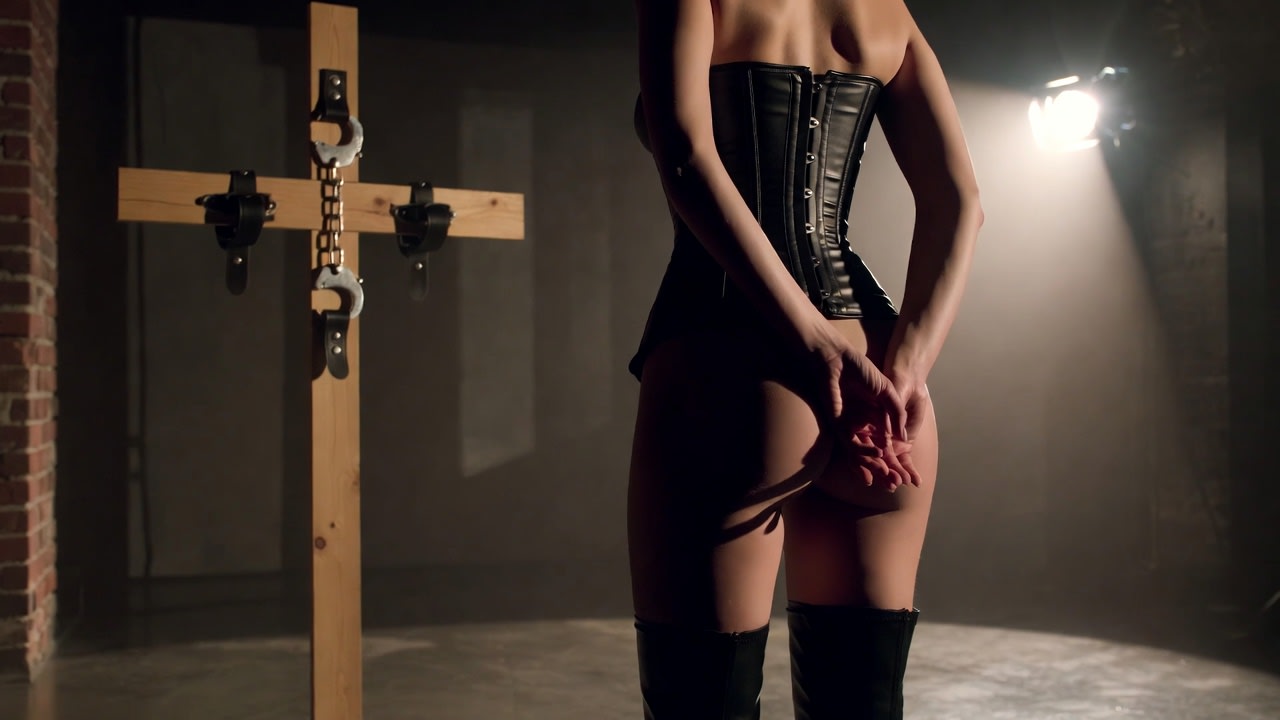
The cuffs are empty.
Look at them. Two curves of steel and leather, hanging open on the arms of the wooden cross, patient as everything in that room is patient. They have held wrists before. They will hold wrists again. But right now they hold nothing at all — and the woman standing before them has not been touched.
She stands in the single warm light, laced into her corset, boots to the thigh, and her hands are clasped behind her back. Not cuffed. Clasped. Fingers folded over fingers at the small of her spine, in exactly the place a restraint would put them.
No one is holding her there. That is the point. That is the whole point.
The Restraint That Comes Before the Restraints
People new to power exchange think the scene begins when the buckle closes. They imagine surrender as something done to you — the cuff, the rope, the firm hand on the shoulder. Something external. Something you can point to afterwards and say: that is what held me.
They are wrong, and the empty cuffs know it.
Before any restraint touches skin, there is a quieter one already in place. It was fastened the moment she was told to stand there — there, on that spot, facing the cross — and to put her hands behind her back and wait. It has no weight. It leaves no mark. You could not photograph it if you tried, and yet it holds her more completely than the steel ever will.
It is her own obedience. Worn like a garment she laced herself into.
Why the Unbound Wait Is Harder
Here is a truth that surprises almost everyone the first time they live it: being restrained is easy. Once the cuff closes, the decision is made for you. You can lean into it. Test it. Let it carry the weight of your surrender so you don't have to.
Standing still when nothing holds you — that is work.
Every second, her body offers her the exit. Her hands could unclasp. Her feet could turn. The door is unlocked, the room is quiet, and no force on this earth keeps her facing that cross except the instruction she was given and her decision to honor it. She must choose her stillness again, and again, and again — one breath at a time, for as long as I decide the waiting lasts.
That is not passivity. That is the most active thing happening in the building.
The Cross Is a Question
The St. Andrew's cross is the most honest piece of furniture in any playroom. It does not pretend to be anything else. Two beams, four points, and a shape that fits a spread and offered body the way a frame fits a painting. When it stands empty in the lamplight, it is not a threat. It is a question.
Will you?
And the beauty of the long minute before the scene is that she gets to answer slowly. Not once, in a rushed yes at the beginning of the evening, but continuously — with her straight spine, her lowered eyes, her folded hands. Her whole posture is consent, restated with every breath. Anyone can say yes with their mouth. She is saying it with her stillness, which is a far more expensive currency.
Anticipation Is Not the Absence of the Scene
Do not call this waiting. Waiting is what you do at a bus stop.
This is marination. This is the slow warming of a body that knows what is coming and is not permitted to hurry toward it. Behind her, somewhere outside the pool of light, there may be footsteps. Or there may be silence, which is worse, and better. Her skin has already begun listening. The back of her neck has become an ear. Every small sound in the room lands on her like a fingertip.
A scene that begins this way is already halfway done before anyone lifts a hand. The corset holds her breath shallow and intentional. The boots hold her posture. The instruction holds everything else. By the time the cuffs finally close over her wrists — if they close at all tonight — they will not be taking her freedom. They will be confirming something she has already given.
What the Empty Cuffs Teach the Dominant
This lesson is not only hers.
A dominant who needs the hardware is not yet finished learning. Rope, steel, leather — these are beautiful instruments, and I love them the way a calligrapher loves a good pen. But the pen is not the handwriting. If your control evaporates the moment the toys are out of reach, it was never control; it was equipment.
The empty cuffs are a discipline for the one in charge, too. They ask: can you hold her there with a sentence? Can your instruction, spoken once, quietly, keep its shape for ten minutes without being repeated? When she stands unbound and stays anyway, she is not only proving her surrender. She is proving your authority — that it is real, that it works on the honor system, that it survives in the space between touches.
That proof is worth more than anything you can buy in a shop.
Stillness as Devotion
There is a reason so many traditions — monastic, martial, meditative — treat stillness as the highest discipline. The body wants motion the way the mind wants noise. To stand still is to override a thousand small rebellions per minute: the itch, the shift of weight, the urge to glance over the shoulder just to know.
When a submissive offers that stillness to someone, it becomes devotion in its purest form. Not the dramatic devotion of grand gestures, but the granular kind — surrender performed at the resolution of individual seconds. Nobody applauds it. Most nights, nobody even sees it. The lamp sees it. The cross sees it. That is enough, because it was never a performance for an audience. It is a practice, in the oldest sense of the word: something done repeatedly, carefully, until it changes the person doing it.
The Moment Before Is Yours to Keep
Here is what I want you to take from that lamplit room, whether you kneel or command or simply stand at the edge of this world looking in.
The scene you are waiting for is not the reward, and the waiting is not the price. The waiting is the first act — often the truest one. The empty cuffs, the clasped hands, the long warm minute in which nothing happens and everything is happening: that is where power exchange actually lives. Everything after is elaboration.
So the next time you are told to stand and wait, do not endure it. Inhabit it. Feel the instruction resting on your shoulders like hands. Notice that you could leave, and then notice — with pride, with heat, with a strange calm you will want again — that you are not leaving.
Nothing is holding you.
You are holding you. On my word.
And that, more than any buckle ever fastened, is what surrender means.
— Mistress Krigar