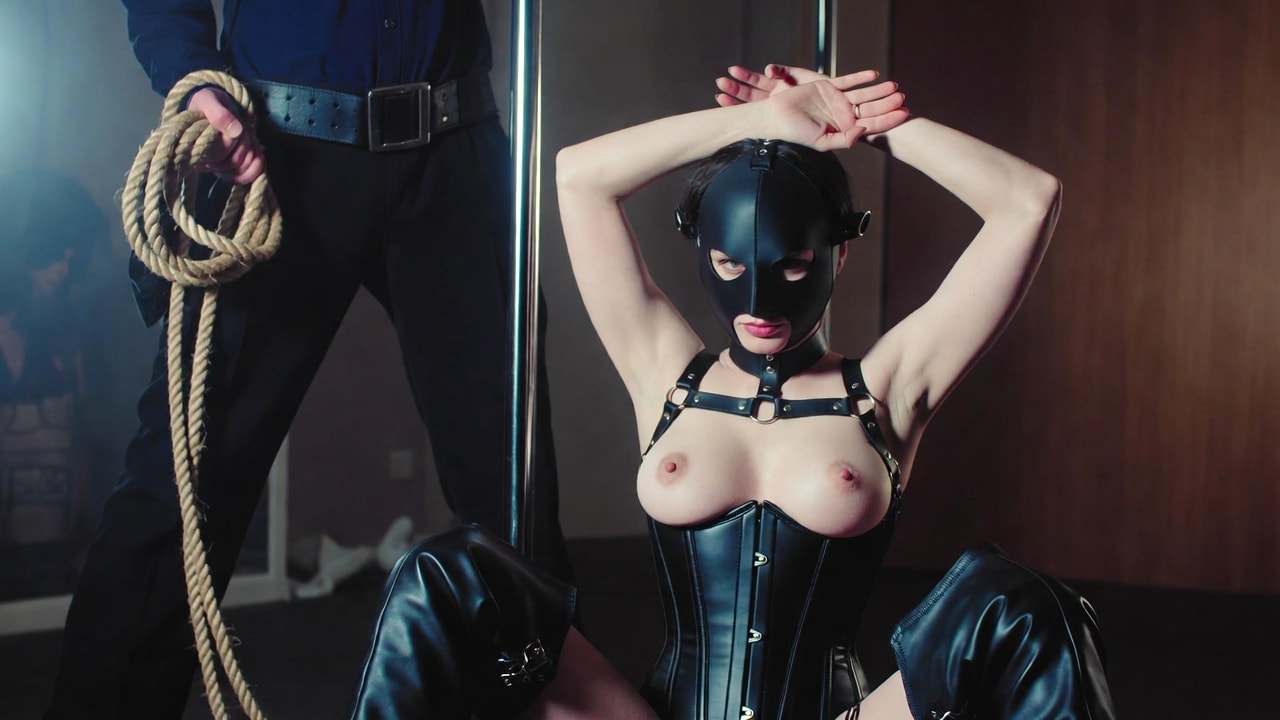
She has not touched you yet.
She is standing a little way off, unhurried, and in her hand there is a coil of rope — natural fibre, wound into a neat loop, the kind of coil that has been made a hundred times by hands that know exactly what they are doing. You are kneeling. Your arms are raised, crossed at the wrist above your head, held there by nothing but her word. The hood has narrowed your world to breath and heartbeat and the small bright fact of her presence somewhere in front of you.
Nothing has been tied. And yet — be honest — the scene began minutes ago.
This is the part almost no one photographs, and the part every experienced submissive remembers most vividly: the waiting. The long, deliberate, exquisite interval between the moment the rope appears and the moment it first touches skin. I want to spend some time there with you, because I believe the waiting is not the prelude to surrender. It is surrender, in its purest and most demanding form.
The rope does nothing. The rope means everything.
A coil of rope on a shelf is hardware. A coil of rope in a dominant's hand is a sentence that has not been spoken yet.
That transformation happens entirely in the mind — which is exactly why it is so powerful. The rope is a promise made visible. When she lifts it, checks it, runs a length of it slowly through her fingers, she is not preparing equipment. She is letting you watch her decide. Every second she takes is a second in which you understand, more deeply, that the pace of this evening belongs to her.
Psychologists have a dry word for what floods you in that moment: anticipation. In the lifestyle we have better words. The Norwegians would call the feeling of sinking into it deilig — delicious, indulgent, something you let yourself have. Anticipation is desire with nowhere to go. It builds like water behind a closed lock. And a skilled dominant knows that the lock, not the water, is where her real power lives.
Why waiting is harder than rope — and why that is the point
Anyone can hold still while they are held. The bind does the work; you simply live inside it.
But to hold still because you were told to — to keep your own wrists crossed above your head with no knot to blame, thighs beginning to speak to you, shoulders slowly warming — that is a different discipline altogether. Nothing restrains you except your own decision, renewed every single second, to stay.
This is what I mean when I say the waiting is the deepest part of the rope. The knots, when they come, will confirm something. The waiting is where that something is created. You are not being made to submit. You are submitting, actively, continuously, with your whole body, in full view, before a single strand touches you.
The body keeps its own time
Stay in that raised-arm position for two minutes and your body begins a quiet negotiation. Your breath wants to shorten; you learn to lengthen it. Your mind wants to leap forward to the tying; you learn to bring it back. This is not so different from meditation — except that meditation rarely has a witness, and the witness is everything. She sees your effort. She sees the tremor you tried to still. Being seen in your effort, and staying anyway: that is the offering.
Ritual turns nerves into meaning
There is a reason we speak of rope ritual rather than rope routine. Ritual is repetition with meaning poured into it. The same coil, checked the same way. The same silence before the first command. The same position, assumed without being asked, because your body has learned what this room is for. Ritual tells your nervous system a story it can trust: you know this shape, you chose this shape, you are safe inside this shape. Inside that safety, arousal and stillness can exist at once — which is the paradox at the heart of every good scene.
What the dominant is doing while she "does nothing"
From the outside, she is simply standing there, rope in hand. From the inside, she is working.
She is reading you. The rise of your ribs. The set of your fingers. Whether your stillness is settled or brittle. The waiting is not only your test; it is her instrument panel. A dominant who rushes to the tying learns nothing. One who waits learns everything she needs to make the next hour precise instead of merely intense.
She is also, quietly, making you a gift. By taking her time, she is telling you that this evening will not be consumed — it will be savoured. Urgency is flattering for a moment; patience is flattering for a lifetime. When someone with all the power chooses slowness, what she is saying is: you are worth doing properly.
Trust is built in the pauses
Much is written about trust in power exchange, most of it about the dramatic moments — the suspension, the blindfold, the edge. But trust is not really built at the edge. It is built in the pauses, because the pauses are where you have time to think.
In the waiting, everything is voluntary and everyone knows it. You could lower your arms. You could speak. You could use the word that ends it all — and the deepest reassurance in the room is that both of you know it would be honoured instantly, without sulking, without penalty. Consent is not the form you agreed on beforehand; it is the living current running through every one of those slow minutes. The waiting proves, over and over, that you are staying because you want to. There is no shame anywhere in that. There is only intention.
Bringing the waiting into your own dynamic
You do not need a studio, a hood, or a hundred metres of hemp to practise any of this. The waiting scales beautifully.
If you lead: next time, slow the beginning by half. Let the tools be seen before they are used. Give a position and then give silence, and watch what the silence teaches you about the person holding it. Resist the urge to fill the air. The air is doing your work for you.
If you follow: notice the moment you start wishing things would hurry — that is the exact place your practice lives. Breathe into it. Report it honestly afterwards. The submissive who can say "the waiting undid me more than the rope did" is giving their dominant the most useful map there is.
And for both of you: talk afterwards about the pauses, not just the peaks. Aftercare is not only for the body. The waiting stirs deep water — pride, exposure, want, the small grief of a scene ending — and deep water deserves a companion on the shore.
The knot is the punctuation. The waiting is the sentence.
When the first wrap finally comes — rope drawn slow across raised wrists, snugged with that particular sound fibre makes against skin — it will feel like an arrival. It should. But understand what you are arriving into. The knot only holds what the waiting already built: your attention, your consent, your decision, renewed a hundred times, to be exactly where you are.
So the next time you see the coil in her hand and feel that ache of not yet — do not rush past it. Kneel into it. It is not the delay before the good part.
It is the good part.
— Mistress Krigar