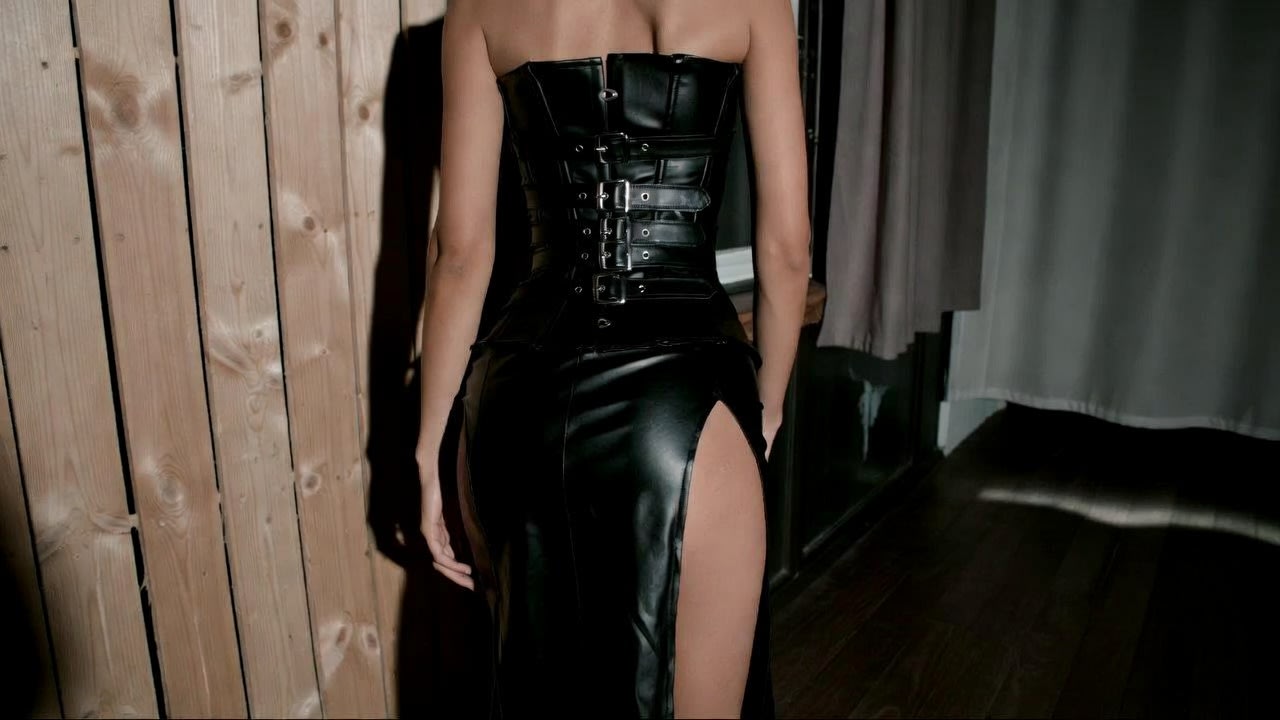
She is turned away from you. Black leather catches the low light, and a row of buckles runs down her spine like punctuation. The room is warm — pale wood, a heavy curtain, a floor that has seen things. Nothing about the picture is loud. And yet you cannot look away.
That is the point.
A leather corset is not a costume. It is an argument made in silence. Before a single word is spoken, before a wrist is offered or a knee touches the floor, the corset has already said everything: I have decided how I want to be held.
The Garment That Holds You to Your Word
Most clothing asks nothing of you. You put it on, you forget it, you move through your day. A corset refuses to be forgotten. It sits close. It keeps a hand at your ribs all evening. With every breath, it reminds you that you are wearing it — and that you chose to.
This is the first secret of the piece. Structure is not the opposite of freedom. For the right person, in the right room, structure is freedom. The boning, the panels, the buckles drawn one notch tighter than comfortable — they take the endless noise of choice and quiet it down to a single clear line. You no longer have to hold yourself together. The garment does it for you.
There is relief in that. Anyone who has ever wanted to stop deciding, just for an evening, understands it immediately.
Why leather, and why buckles
Silk flatters. Lace teases. Leather commits. It does not drape and forgive; it holds a shape and asks you to hold it too. It warms to the body and keeps that warmth. It remembers the line of whoever last wore it.
And the buckles — those are not decoration, whatever the catalogue says. A buckle is a decision you can hear. A zip hides; a lace blurs into a soft knot; but a buckle closes with a small, deliberate sound, one notch at a time. Each one is a tiny ceremony of yes. Tightened by your own hand, it is a promise to yourself. Tightened by another's, it is something far more interesting.
Dressing as Ritual, Not Vanity
Here is where the uninitiated misunderstand. They see the corset and think seduction — a trick to be looked at. They are not wrong, but they are reading the surface.
The deeper truth is that getting dressed like this is a ritual of transition. It marks a threshold. On one side of it you are the version of yourself who answers emails, who is reasonable, who carries everyone. On the other side you are the version who is allowed to want a single, simple thing and to be honest about it.
The corset is the doorway between the two.
Watch how it actually happens. The straps are loosened first, laid open. The body is offered to the garment. Then the slow work begins at the base of the spine — one buckle, then the next, each pull drawing the waist in, drawing the breath shorter, drawing the mind to a finer point. By the time the top clasp meets, something has shifted. The person who started is not quite the person who finishes.
That shift has a name. We call it surrender, and most people get it backwards.
Surrender is not collapse
Surrender is not giving up. It is not weakness dressed in leather. It is the most deliberate act in the whole exchange — a strong person choosing, with full hands, to set something down and let another carry it for a while.
The corset teaches this in the body before the mind can argue. You cannot slouch in good boning. You cannot hide. You are held upright, presented, your posture decided for you — and instead of feeling trapped, you feel, strangely, taken care of. The restriction is the reassurance. The limit is the embrace.
This is the paradox at the centre of every honest power exchange: the one who yields is not the one with the least power. She is the one with enough to give some away.
The Architecture of Trust
Look again at the back of that dress. The buckles run where she cannot easily reach them. That placement is not an accident of fashion. It is the whole philosophy of the thing, stitched into the design.
A garment that fastens behind you is a garment that assumes someone else. It is built for a hand that is not your own. To wear it fully is to admit that you want to be tended to — that part of the pleasure is in not being able to do it all yourself.
That admission is the real intimacy. Not skin. Trust.
What the dominant hand actually does
There is a particular tenderness in being the one who laces another in. People imagine dominance as force. The genuine article is closer to attention. It is the patience to draw each strap evenly. It is noticing the breath change and easing by a single notch. It is the steadiness of a hand that has decided, calmly, that it will take responsibility for how this person is held tonight.
Control, done well, is a form of care so precise it can look like stillness. The corset makes that visible. Every buckle the dominant closes is a small contract: I see exactly how tightly you can be held, and I will not take you past it without your eyes telling me yes.
That is the difference between restraint and harm — and it is the only difference that matters. One is built on listening. The other never bothered to learn how.
The High Slit and the Lesson of Tension
Notice what the dress withholds. It is closed, structured, severe from the waist up — and then, at the leg, it opens. One long line of bare skin where the leather parts.
This is not a contradiction. It is the entire grammar of desire in a single cut.
Tension lives in the gap between control and revelation. Cover everything and you have a wall. Reveal everything and you have nothing left to give. The art — in a garment, in a scene, in a whole relationship of power exchange — is the held middle: mostly contained, with one deliberate opening that says there is more here, and you will not be shown all of it tonight.
Restraint is what makes revelation mean something. The corset knows this. So should anyone who wants to keep a fire lit longer than a single evening.
Coming Back: The Unlacing
Every ritual needs an ending, and the unlacing is the most overlooked part of it. The buckles come open in reverse — slower, usually, than they went on. The waist eases. The breath lengthens. The held posture softens back into an ordinary spine.
This is the return through the doorway. It deserves the same care as the entrance, and often more. Aftercare is not an add-on; it is where trust is either confirmed or quietly broken. A hand on the back. Warmth. A few plain words. You did well. I have you. We are back now. The same attention that drew the first strap tight should loosen the last one.
Surrender given is a gift. The unlacing is how you say thank you for it.
What the Corset Asks of You
So when you see her there — leather, buckles, the warm dark room, the long slit and the turned shoulder — understand that you are not only looking at a beautiful thing. You are looking at a philosophy you can wear.
It says: structure can be a kindness. Limits can be an embrace. Surrender is strength spent generously, and control is care made exact. It says that the most powerful thing in the room is sometimes the person who has chosen to be held.
You do not need leather to begin. You do not need an audience. You need only the honesty to know how you want to be held, and the trust — in yourself first, then in another — to ask for it out loud.
Lace it slowly. Mean every notch.
— Mistress Krigar