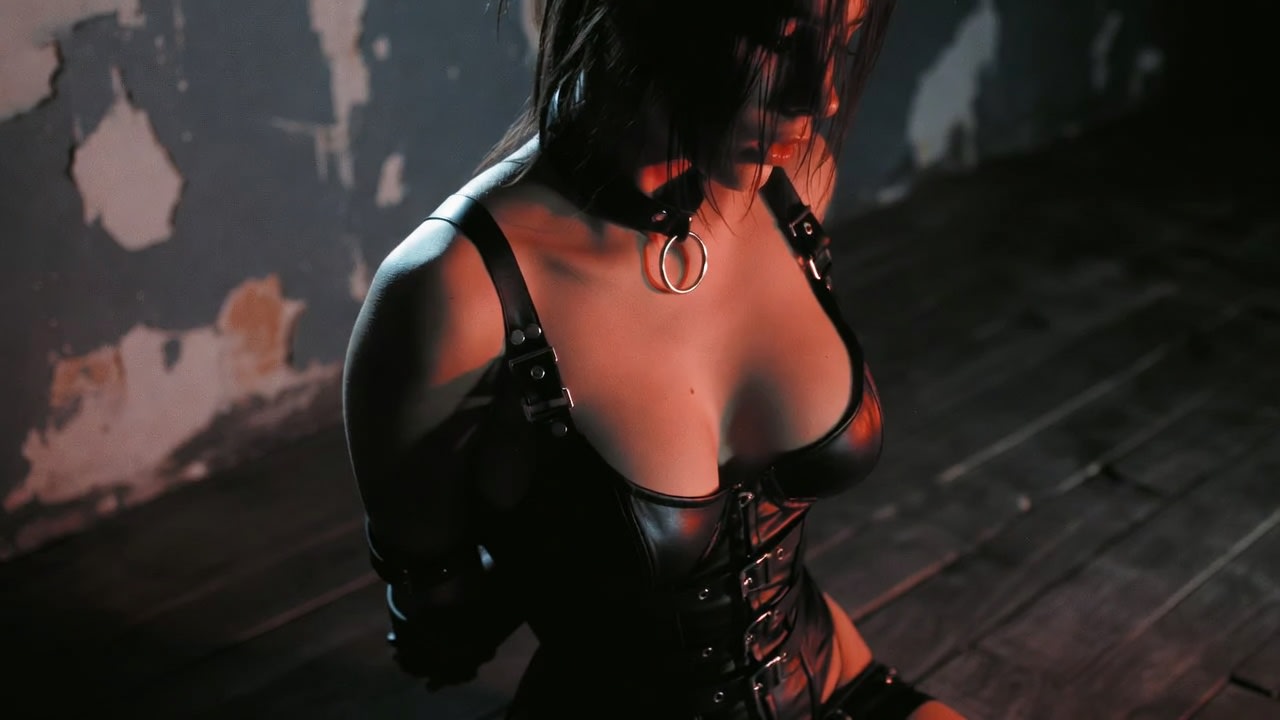
Look at her. Then notice what she is not doing. She is not looking back.
The room is nothing special. Bare boards, a wall losing its plaster, one low red light that turns skin to warm copper. She kneels in the middle of it, laced into black leather, the steel O-ring bright at her throat, arms drawn behind her back. And her head is bowed. Her hair has fallen forward like a curtain someone closed on purpose.
Most people read that posture wrong. They see defeat. They see someone made small. They have never knelt, and it shows — because anyone who has knelt like this knows the truth the picture is quietly telling you: the bowed head is not an absence of will. It is will, aimed downward, deliberately.
The Gaze Is the Last Thing You Surrender
Strip away everything else and the eyes remain a kind of armor. You can be collared, cuffed, laced into a corset that dictates every breath — and still hold on to control with nothing but your gaze. Watching is managing. Watching is anticipating, calculating, bracing. As long as your eyes track the room, some part of you is still running the scene from the inside.
That is why the downcast gaze is the deepest cut of all the small surrenders. It is voluntary blindness with the eyes still open. Nobody has taken her sight — no blindfold, no hood. She has simply chosen not to use it. There is a profound difference between sight that is taken and sight that is laid down, and that difference is the entire art of submission.
A blindfold says: I trust you enough to let you take this from me.
A bowed head says: I trust you enough to give it up myself, and to keep giving it up, second by second, when nothing stops me from looking.
One is a lock. The other is a vow.
What the Body Is Saying When the Eyes Say Nothing
Submission is a language, and posture is its grammar. Every element of the kneel in that red-lit room is a word placed with intention.
The knees
Kneeling lowers the body beneath the standing eye-line of the one she serves. It is a physical sentence: you are above me because I put you there. Not gravity. Not force. Choice, repeated every second she stays down.
The bound arms
Arms behind the back open the chest and take away the body's small defenses — no crossed arms, no shielding hands. What is left is presentation. The torso offered forward, the balance entrusted to the floor and to whoever governs the room.
The collar
The O-ring catches the light for a reason. A ring is an invitation for attachment — for a leash, for a finger, for a claim. Worn at the throat, over the most vulnerable inches of the body, it says: this part of me has an owner, and I wear the proof where everyone can see it.
The bowed head
And above all of it, the head tips forward, the hair falls, the face disappears. This is the signature at the bottom of the letter. Everything else could be costume. The bowed head is the part that cannot be faked comfortably, because it is the part that costs the ego something.
Looking Down Is Not Shrinking
Let me be precise, because this is where the outside world gets it most wrong.
A person who shrinks looks down because they are hoping not to be seen. Their shoulders cave. Their body apologizes for existing. There is nothing of that in the kneel you are looking at. The back is held by the corset's discipline. The chest is open. The knees are set with intention on hard wood, not folded in collapse. This body is not hiding. It is displayed — composed like a still life, and fully aware of being seen.
The downcast gaze on a body like that is not shame. It is ceremony.
Think of every formal tradition you know. The bow before the match. The lowered eyes in the old courts. The kneel before the crown. Humans have always used the lowered gaze to mark the presence of something that outranks the moment — not because they were worthless, but because they understood that reverence is a form of attention. The submissive who bows her head is not saying I am nothing. She is saying this — you — is worth my reverence. There is enormous self-possession in that sentence. You cannot give away what you do not own.
The Stillness Underneath It
There is another layer, and it is the one that keeps people coming back to this posture long after the novelty of leather has softened into familiarity.
When you stop watching, you start feeling.
The gaze is a busy organ. It feeds the mind an endless stream of things to evaluate. Lower it, and the stream thins. What rises instead is everything the eyes usually drown out: the creak of a floorboard under a shifted knee. The exact temperature where the red light warms one shoulder. The leather's grip along the ribs with each breath the corset permits. The weight of steel at the collarbone. Her own heartbeat, suddenly loud.
This is the quiet mechanics of subspace — not a trapdoor you fall through, but a room you enter one lowered defense at a time. The bowed head is very often the door. Ask submissives where a scene truly began for them and many will not name the first touch. They will name the moment they stopped looking. The moment the room narrowed to breath and warmth and waiting, and the mind — that tireless, watching mind — finally went soft.
For the One She Kneels For
If you are the one standing in that room, understand what you have been handed.
A lowered gaze is not a small courtesy. It is a live offering that renews itself every second, and it deserves a dominant who receives it the way it was given: deliberately. Move slowly. Let her hear you before she feels you. Let the wait have shape. A bowed head hears everything — the footstep, the breath, the pause that stretches just long enough to mean something. Sloppy silence is wasted on her. Intentional silence is a gift returned.
And when you finally touch the collar, or lift her chin to bring her eyes back up to yours — know that this is the other half of the ritual. The gaze that was laid down is raised again, but only by your hand. That single upward motion, chin following fingers, eyes arriving last, is one of the most intimate exchanges two people can build. It cost her something to look down. It should mean something when you bring her back.
A Practice, Not a Pose
For those who kneel, or want to learn: the bowed head rewards practice the way any devotion does.
Do not begin with an hour on hard wood in full leather. Begin with two quiet minutes. Kneel where you will not be disturbed. Set your knees, settle your breath, and lower your gaze to the floor in front of you — and keep it there. Notice the itch to look up. Notice how loud your mind gets when it loses its favorite toy. Stay. The itch passes. What follows the itch is the point: a stillness with weight to it, like a hand resting on the back of your neck.
Build from there. Add the collar when the posture feels like home. Add the wait. If you serve someone, let them decide when your eyes come up — and feel what changes in you when that decision is no longer yours. Kept gently and consistently, this small ritual becomes an anchor: a physical sentence your body can say on the days when words are difficult. I am here. I am yours. I am not watching, because I do not need to.
The Most Articulate Silence
Back to the room. The red light. The peeling wall that has seen more honest hours than most well-kept parlors ever will.
She has not moved. That is the point of her. In a world that rewards the loudest voice and the quickest glance, she has chosen the one gesture that refuses both — head bowed, eyes down, throat ringed in steel, patience worn like a second corset. She is not waiting for permission to exist. She is existing, completely, inside a moment she chose and shaped and offered upward.
The downcast gaze is the most articulate sentence a submissive ever speaks. It says: I see you so clearly that I no longer need to look.
Learn to read it, and you will never again mistake a bowed head for a beaten one.