The Bow: Why Kneeling Is the Strongest Thing You Will Ever Do
There is a moment, just before the knees touch the floor, when everything in you wants to stay standing.
That moment is the whole point.
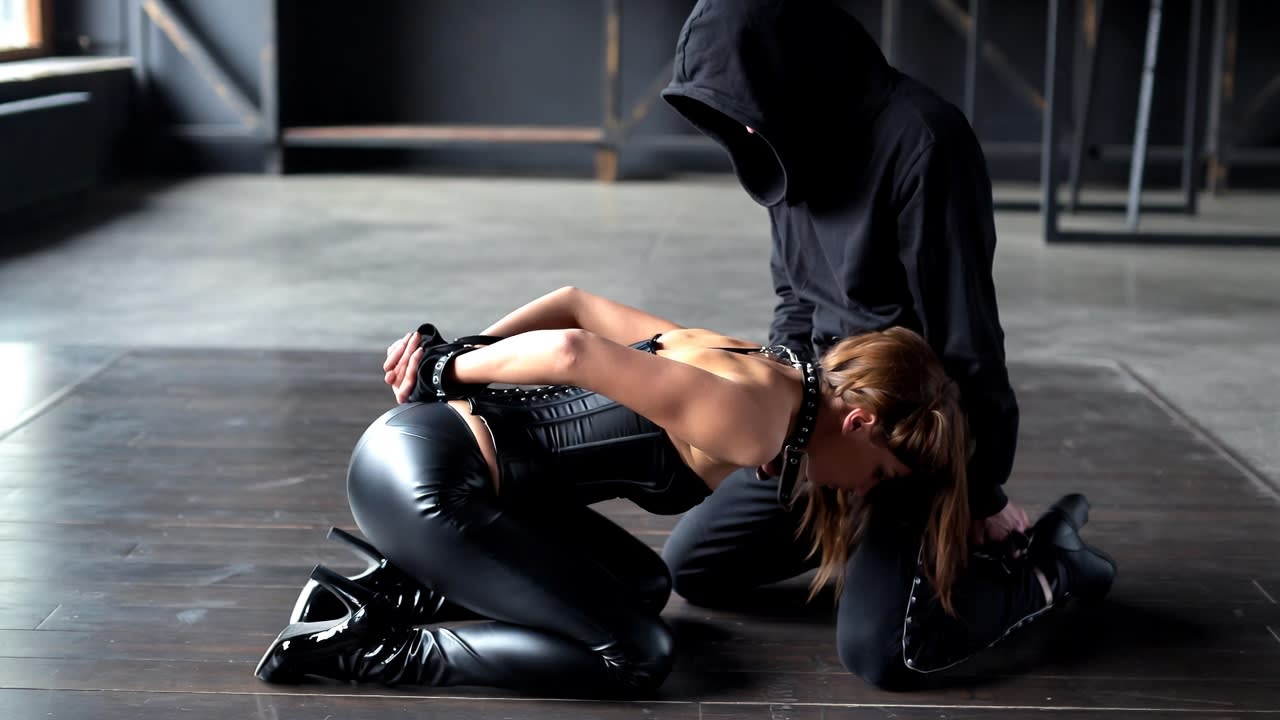
Look at her. The room is dark and wide, the windows tall, the floor cold under bare skin. She has lowered herself — folded forward, wrists drawn behind her, the long line of her back curved into a bow. Above her, a figure waits, hooded, unhurried, certain. Nothing is being taken from her. Everything is being offered. There is a difference, and that difference is the only thing that matters.
People who have never knelt think it is about being small. They have it exactly backwards.
What the body knows before the mind agrees
Kneeling is older than any of us. We kneel to pray, to propose, to grieve, to be knighted. The body already understands that lowering yourself is not the same as being lowered. One is done to you. The other you choose, with your whole weight, on purpose.
In power exchange, the choosing is the erotic charge. Not the floor. Not the posture. The decision.
She could stand. She is not trapped — restraint here is ritual, not a cage. She could say one word and the whole scene would dissolve into two people and a quiet room. She knows this. He knows this. And because they both know it, her bow means something. Consent is not the small print at the bottom of desire. It is the foundation the entire thing is built on. Take it away and you do not have surrender. You have something ugly wearing surrender’s clothes.
So she kneels because she wants to. That is the part outsiders cannot see in the photograph. The wanting.
Surrender is not the absence of power
Here is the thing I tell everyone who comes to me convinced that submission means giving up:
The submissive sets the terms.
She decides what she offers and what stays hers. She names the limits. She holds the word that ends everything. The dominant moves only inside the space she has opened. Read that again. The one on her knees drew the borders of the entire country, and then invited someone in to rule it.
That is not weakness. That is authorship.
What she surrenders is something subtler and far more valuable: the exhausting, constant labour of being in charge of herself every second of every day. The vigilance. The deciding. The holding-it-all-together that modern life demands without ever once saying thank you. For an hour, she sets it down. Someone else carries it. And in that handing-over she finds a stillness most people chase their whole lives and never reach.
This is why the strong ones kneel. The people who carry the most are often the ones who most need, sometimes, to be carried.
The hood, the wait, the weight
Notice the figure standing over her. Hooded. Faceless. Patient.
Dominance done well is not loud. It does not shout or strut. The theatrical dom — all snarl and spectacle — is usually the one who understands the least. Real authority is quiet. It is the stillness of someone who does not need to prove anything because they have already been trusted with everything.
His patience is the gift answering hers. She has given him her surrender; he answers with attention. Total, unhurried, unwavering attention. To be seen that completely — to have another person hold the whole of you in their focus and not look away — is rarer than any touch. Most of us go through our days half-noticed. Here, she is the only thing in the room.
That exchange — her trust for his attention — is the real transaction. Everything else is just the beautiful, deliberate staging around it.
Trust is the thing being built
Strip away the leather and the dark room and what remains is almost embarrassingly tender: two people building trust in real time, with their bodies, out loud.
She trusts him to read her. To notice the breath that changes, the muscle that tightens, the line she did not say but meant. He trusts her to tell him the truth — to use her word, to keep nothing hidden, to let him know when enough is enough and when it is not nearly enough yet. This is not a single leap. It is a thousand small confirmations, each one earned, each one deepening the next.
This is why power exchange, practised with care, can feel more intimate than any conventional encounter. You cannot fake your way through it. The structure demands honesty. The roles, paradoxically, are what let people finally be real.
How the bow begins
If you are reading this and feeling the pull of it — the quiet, slightly frightening pull — start gently. Surrender is not a performance you have to nail on the first try. It is a practice.
Begin with the small protocols. Kneeling for a held breath before a conversation that matters. A ritual that marks the shift from the day’s noise into a space that is only yours. A single instruction, given softly, followed completely. You do not need a dungeon. You need intention, a partner you trust, and the honesty to say what you actually want.
And you need to talk first. Always. Negotiation is not unsexy — it is the most seductive conversation two people can have, because it is the conversation where you say, out loud, this is who I am and this is what I ache for. Limits, words, aftercare, the shape of the thing. Decide it awake, so you can let go fully once you begin.
The bow comes later. The bow is easy, once the trust beneath it is real.
After the floor
There is a moment after, too. When the scene ends and she rises, and someone wraps her in warmth and quiet and the plain, steady reassurance that she is safe and held and good. Aftercare is not an afterthought. It is the other half of the bow. Surrender that closes properly is what makes the next surrender possible.
That is the whole arc, really. Down, and held, and back up again — softer, lighter, more herself than before. Not diminished. Returned.
So the next time you see a woman on her knees in a photograph like this one and think you understand what you are looking at, look again. The cold floor. The patient figure. The long, deliberate bow.
She is not the powerless one in this room.
She is the one who decided.
SubSurrender is an adults-only space for the curious and the committed. Everything here rests on consent, trust, and the slow, deliberate art of letting go. Come as you are.