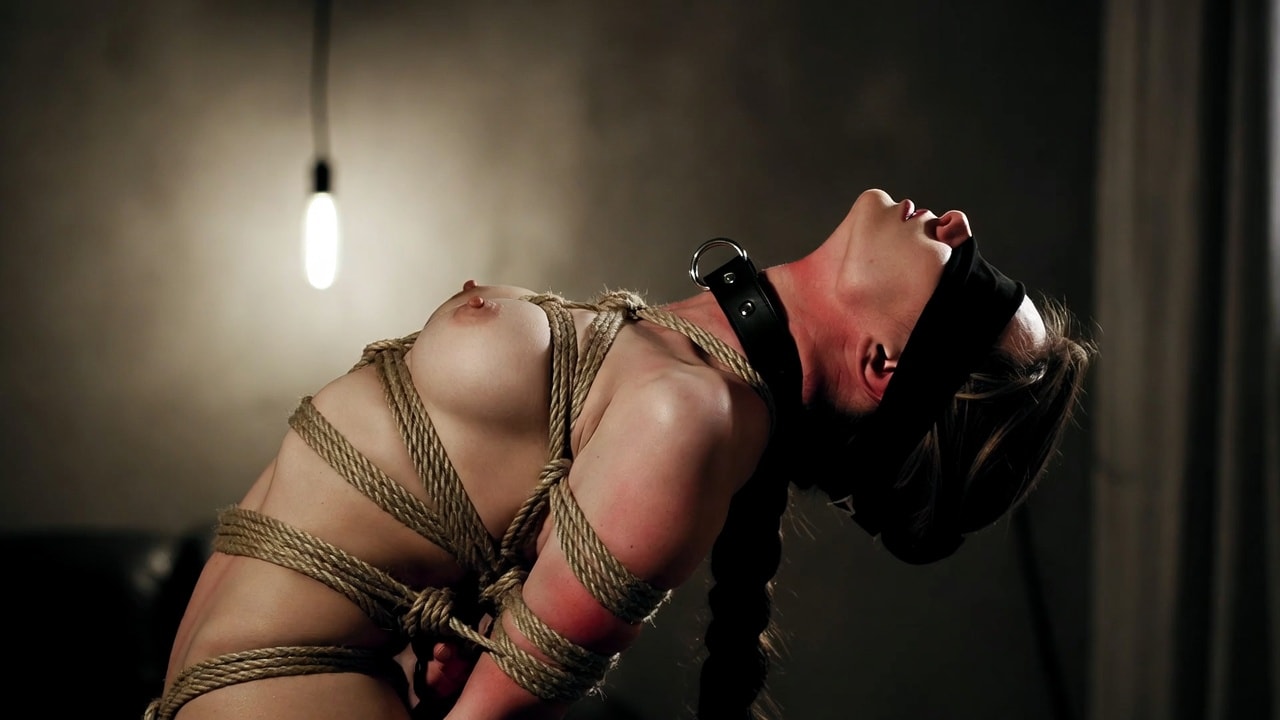
There is one light in the room. A bare bulb on a black cord, burning quietly against a concrete wall. Beneath it, a body is bending backward — not falling, not collapsing. Bending. Rope crosses the chest and wraps the arms, drawn firm and deliberate, and the spine follows the pull the way a bow follows its string. The head tips back. The braid hangs. The throat rises into the light.
This is the arch. And if you have ever been taken into it, you know it is not a pose. It is a confession.
The Shape Rope Makes of You
Most bondage begins with symmetry. Wrists together. Knees on the floor. Hands folded at the small of the back. Tidy shapes, obedient shapes. The arch is something else. The arch is what happens when the rope stops asking you to be tidy and starts asking you to open.
A body arched backward cannot guard itself. The chest lifts. The belly stretches long. The shoulders draw behind you where they can do nothing on your behalf. Every instinct you have spent a lifetime training — curl in, cover up, watch the door — is gently, firmly overruled by hemp and knots and someone else's intention.
That is the point. The arch is not decorative. It is the physical grammar of yielding. When I bend someone into it, I am not arranging them for a photograph. I am asking a question with my hands and the rope, and the body answers it long before the mouth could find words.
Tension Is a Form of Holding
People who have never been tied imagine rope as confinement. Those who have been tied know better. Good rope does not squeeze; it holds. Each wrap carries a share of your weight and your effort, the way a hand at the back of your neck carries the decision you no longer have to make.
In the arch, this becomes unmistakable. You are bent past the point where you could comfortably hold yourself, and yet you are not straining. The tension in the lines is doing the work. Lean into it and the rope answers back — steady, indifferent to your doubts, absolutely reliable. Many describe the moment they stop fighting the bend and start resting inside it as the moment the scene truly begins. The body understands before the mind does: you are not trapped. You are carried.
The Bared Throat
Look at what the arch offers upward. Not the eyes — those are covered. Not the hands — those are bound away. The throat.
Of all the vulnerable places a body has, the throat is the one we defend without thinking. We tuck our chins in arguments. We swallow before we lie. Predator and prey alike know what the throat means, which is why baring it has meant surrender for longer than we have had language.
A collar sits at that throat in the image of this scene — dark leather, a steel ring resting against the skin. The collar names what the arch performs. Kept. Claimed. Held to something. When the head tips back and the collar catches the light, the ring becomes the still center of the whole composition: one small circle of steel that says someone holds the other end of this story, even when no leash is clipped to it.
To bare your throat on purpose, for a person you have chosen, inside limits you have negotiated — that is not weakness. That is the most deliberate thing a body can do. It takes far more nerve to be open than it ever took to be guarded.
Darkness Inside the Bend
The blindfold changes the arithmetic of everything above. Take sight away and the arch stops being something you present and becomes something you inhabit.
Behind the blindfold there is no bulb, no wall, no watching. There is only what you can feel: the rope's bite softened by careful placement, the stretch along your ribs, the cool air on your lifted chest, the heat of someone near you whose footsteps you track like weather. Every sense you have left leans in to compensate, and the body becomes exquisitely honest. You cannot perform for an audience you cannot see. You can only feel what is true.
This is why sight is so often the first thing a Dominant takes and the last thing returned. In the dark, anticipation does half the work. A fingertip becomes an event. A voice becomes an instruction from everywhere at once. The waiting itself — that long, suspended not-knowing — becomes its own sensation, and some of us come to crave it more than the touch it precedes.
You Do Not Fall Into an Arch. You Are Led There.
Now the unglamorous truth, which I will give you plainly because it matters: a shape this deep is built, never grabbed.
Bodies are not identical. Shoulders have histories. Backs have opinions. The bend that looks effortless in a photograph is the product of warm-up, of placement chosen to protect nerves and joints, of two people who talked before anyone touched rope. What they negotiated — limits, safewords, signals for hands that cannot speak — does not appear in the frame, but it is holding the frame up, exactly like the lines you cannot see.
And when it ends, it ends slowly. Rope comes off in the reverse order of care it went on with. Blood returns. Sight returns, gently, to eyes that have been elsewhere. Someone is wrapped in something warm and told, in whatever words the moment needs, that they were magnificent. The arch is a deep dive; aftercare is the ascent. You do not skip decompression. Not ever.
Why the Deepest Shapes Ask for the Longest Trust
There is a simple rule in rope, and it is a rule in power exchange generally: the more a position takes from you, the more the person holding you must have earned. A tied pair of wrists asks for an evening's trust. The arch — blind, bound, bent open, throat to the light — asks for the kind that is built in layers, scene over scene, conversation over conversation, proof over proof.
That is not a barrier. That is the whole reward. Trust on that scale does not arrive by accident; it is trained, tested, deepened deliberately — the same way a body is slowly taught to bend. The submissive who can rest inside that shape did not get there by being fearless. She got there by being known.
What the Body Is Saying
So return, one last time, to the room with the single bulb. The concrete, the quiet, the rope crossing skin in clean strong lines. The body bent back like a drawn bow — full of tension, full of purpose, aimed entirely at the person who bent it.
Here is what the arch says, in the language older than words:
I am not watching the door. I am not guarding my throat. I am not holding myself up. You are doing all of it, and I have decided to let you.
That decision — renewed breath by breath, in the dark, at the end of well-placed rope — is the beating heart of surrender. Not the giving up. The giving over.
If you have felt it, you already know the difference. If you have not, the rope is patient. It has been waiting longer than you have.
— Mistress Krigar