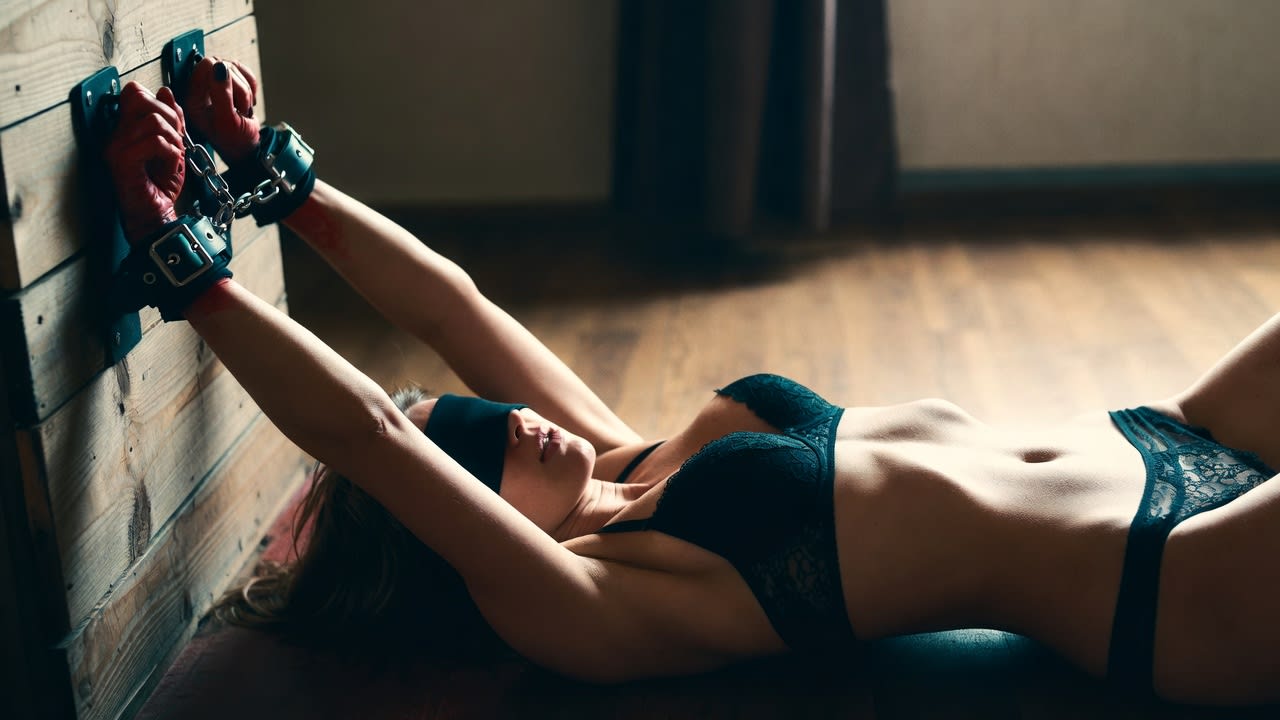
There is a certain kind of restraint that does not lift you. It does not stretch you toward the ceiling, does not put you on display at eye level, does not ask you to stand tall and take it. It brings you down instead. Down to the boards. Down to where the light lies in long warm stripes across the floor and the wall smells faintly of old wood. Down to a low anchor point — two plates bolted into planks, a short chain, a pair of leather cuffs — and a simple, patient instruction: stay.
This is a love letter to the anchor point. To being chained low rather than strung high. To the blindfold that closes the last door. And to the art — because it is an art — of staying put.
Down Is Not Lesser
People new to restraint often imagine it vertically. The cross. The frame. The raised arms, the stretched spine, the body presented upright like something in a gallery. There is beauty in that, and I have written about it before. But the vertical body is still, in some quiet way, performing. It is standing. It is holding itself.
The body brought to the floor holds nothing. The floor does that work now.
When I chain a submissive low — wrists cuffed, chain run short to a fixed point just above the baseboard — something changes that no standing position achieves. The whole length of her rests. Shoulder blades against wood. The back of the head finding its place. Gravity, which she has spent her entire day resisting, becomes an ally. She is not suspended above her life. She is laid down inside it.
Down is not lesser. Down is closer. Closer to the ground, closer to the breath, closer to the truth of what she came here to do: stop holding herself up for a while, and let someone else decide what happens next.
The Anchor Point Is a Promise
Look at the hardware, sometime, before you look at the body attached to it. The bolted plate. The ring. The chain with its cold, deliberate links. None of it is decorative. Every piece exists to hold, and to keep holding, without effort and without fatigue.
That is what makes an anchor point different from a hand. A hand gripping your wrists is a person choosing, moment by moment, to keep you. It can tire. It can wander. An anchor point does not tire. Once the clip closes, the holding is settled — and the one who fastened it is free to do something far more interesting than grip you. She can watch you. Circle you. Leave the room and let you listen for her steps on the boards.
Why fixed beats held
A submissive held by hands is always, faintly, negotiating: is the grip loosening, tightening, ending? A submissive fixed to a point negotiates nothing. The question is answered. And when a question is answered, the mind that was working on it goes quiet.
That quiet is the whole prize. It is what people mean when they talk about the peace of restraint, and it is why the click of a clip on a ring can slow a racing pulse rather than quicken it. The chain says what a lover's arms can only try to say: this is decided. You may stop asking.
The Blindfold Closes the Last Door
Chain the wrists and the body settles. Cover the eyes and the mind settles — eventually. Not at first. At first the mind does what minds do: it scrambles for the light, reads sounds like braille, builds the room out of memory and guesswork. Where is she standing. What was that. How long has it been.
Let it scramble. This is part of the descent, not a failure of it.
Because after the scrambling comes the softening. The blindfolded mind, finding nothing to grip, does exactly what the cuffed hands did — it stops gripping. Time loosens. The stripes of afternoon sun she cannot see still warm the floor beneath her, and she begins to measure the world in that warmth, in the grain of the wood under her shoulders, in the small sounds of a house being lived in. Sight is the sense of control. Take it, with consent and care, and what remains are the senses of presence: heat, texture, weight, breath.
She is not in the dark. She is in her body. Those are different countries, and the blindfold is the border between them.
The Art of Staying Put
Here is what no one tells you: the chain only holds the wrists. Everything else stays put by choice, renewed over and over, breath by breath.
She could shift. Could pull. Could fill the silence with questions and wriggling and the small rebellions that ask for attention. The ones who are new usually do, and there is no shame in it. But watch one who has learned. The stillness is not slack; it is chosen, the way a held note is chosen by a singer. Her hands rest open near the cuffs instead of straining against them. Her breathing is long. She has stopped performing patience and started inhabiting it.
That is the art. Restraint provides the occasion; she provides the surrender. No hardware in the world can do that part for her, which is exactly why it means something when she does.
What the one holding the keys is doing
Do not imagine the dominant is idle while all this unfolds. Keeping someone on the floor is slow, attentive work. I am reading the color of her skin, the rhythm of her ribs, the small tells of hands and mouth. I am deciding when nearness is a gift and when absence is. I chose the length of that chain. I chose the height of that anchor. Every inch of her stillness was designed, and she can feel that it was — that is what lets her rest inside it. Care is not the soft opposite of control. Care is what control is for.
Before the Floor: The Unglamorous Essentials
Because I would rather be clear than mysterious: none of this belongs in your life without the groundwork. Negotiate before anyone is cuffed — what is welcome, what is off the table, what word or signal ends everything at once. A restrained, blindfolded person is never left alone beyond what was explicitly agreed, and never out of earshot. Cuffs are checked for circulation; a blindfolded partner is told, or touched, before anything new happens. And afterward there is warmth, water, and time — the quiet unwinding the lifestyle calls aftercare, which is not an appendix to the scene but its final chapter.
Trust is not the mood of this arrangement. It is the load-bearing structure. The wall holds the chain; the agreements hold the wall.
What You Take Back Up With You
Eventually the clip opens. The blindfold lifts and the room floods back — wood, window, the ordinary furniture of an ordinary day. She flexes her fingers. She is, by every outward measure, exactly who she was an hour ago.
But something comes back up from the floor with her. The nervous system remembers that it is possible to stop bracing. The mind remembers what it felt like when the question of control was, for one warm hour, entirely answered. People who have never knelt to anything call restraint a loss of power. Those who have lain chained in a stripe of afternoon sun know better: it is the deliberate, temporary setting down of a weight most people never realize they are carrying.
The anchor point is bolted low on the wall, and it is not going anywhere. Neither am I.
Come down to the floor when you are ready. You will be kept.
— Mistress Krigar