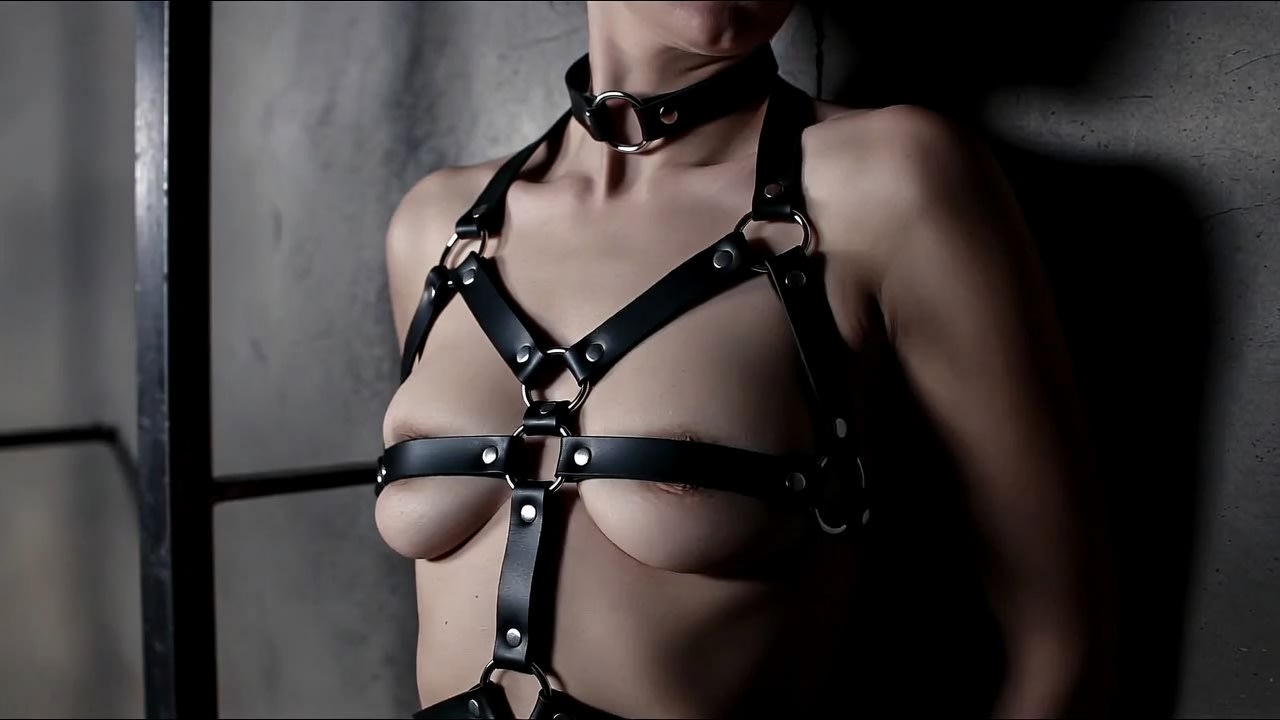
Look at the image for a moment before you read anything. A body against bare concrete. No silk, no lace, no softness offered as apology. Only black leather laid across skin in clean, deliberate lines — a collar with a single steel ring at the throat, straps meeting at rings on the chest, rivets set with the patience of a craftsman. Nothing about it is accidental. That is the first thing a harness tells you: someone decided exactly where every line would go.
This post is about that decision. About what happens to a body — and to the person living inside it — when it is drawn in straight lines.
The Harness Is a Map, Not a Costume
Most clothing hides. It drapes, it suggests, it forgives. A harness does the opposite of all three. It conceals nothing. It sits against bare skin and does not pretend to be anything other than what it is: structure.
Follow the straps in the picture. One line circles the throat. Two travel down over the shoulders. They meet at a ring, cross, divide, and continue — over the chest, beneath it, down the centre of the body. Each strap frames a region of skin the way a window frames a view. The body is not covered. It is organised.
That is why I call the harness a map rather than a costume. A costume asks you to become someone else. A map shows you where you already are. When the harness is buckled on, the wearer does not transform into some fantasy character. She becomes more precisely herself — her breath, her posture, her bare skin — held inside a set of lines someone else drew for her.
And for many submissives, that is the entire point.
Why Structure Feels Like Care
Here is something the vanilla world rarely understands about power exchange: restraint, done well, does not feel like deprivation. It feels like being held.
Think of what a harness actually does, physically. It applies a light, constant pressure along fixed paths. When the wearer inhales, the straps answer. When she moves, they remind. It is the same principle that makes a heavy blanket calming, the same reason a firm hand between the shoulder blades can quiet a racing mind. The nervous system reads steady, predictable pressure as presence. Someone is here. Something is holding you. You can stop bracing now.
A harness delivers that message continuously, without a word being spoken. It is a dominant's grip made ambient — attention you can wear.
The Difference Between Being Bound and Being Held
Rope pins. Cuffs fix. A harness does neither — and this is what makes it its own discipline. The wearer of a harness can walk, kneel, stand, serve. Nothing stops her. The leather takes no freedom from her at all.
What it takes is something subtler: the option of forgetting. Every breath presses skin against strap. Every turn of the head moves the collar. Hours into wearing it, the harness is still speaking, still repeating its one quiet sentence: you are inside a frame that was chosen for you. Not trapped. Framed. There is a world of difference, and the body knows it long before the mind finds words for it.
The O-Ring: A Small Circle With a Long Meaning
Look again at the throat. At the centre of the collar sits a steel ring, and that ring deserves its own paragraph, because nothing in kink is more quietly eloquent.
An O-ring is an anchor point. It exists so that something may, at some moment, be attached to it — a leash, a finger, a length of chain, intent. Most of the time, nothing is. And that is precisely its power. The ring hangs at the hollow of the throat as a standing invitation, a possibility held open. It says: access exists here, and it belongs to someone.
The rings where the chest straps meet do the same work in a different register. Mechanically they distribute tension; symbolically they are junctions — the points where the lines of the design commit to one another. Steel does not stretch and does not forget. Placed at the centre of a harness, it is the hardware of a promise.
What the Wearer Learns
I have put harnesses on bodies that arrived at my door carrying an entire week of noise — deadlines, obligations, the endless performance of being competent in public. And I have watched, more times than I can count, the same change arrive somewhere around the last buckle.
The shoulders come down. The breath drops from the chest into the belly. The eyes soften and lower, not in defeat but in relief. What the harness teaches, faster than almost any lecture on submission, is this: you do not have to hold your own shape right now. The leather is doing it. I am doing it.
For the submissive who spends her days being the strong one, the organised one, the one everyone leans on — that lesson is not a small thing. It is the deep exhale she has been waiting for, sometimes for years. Structure from outside permits softness inside. That trade is the quiet engine of every good power exchange, and the harness is that trade made physical, wearable, snug against the ribs.
The Ritual of Being Buckled
A harness should never be thrown on the way one throws on a jacket. The putting-on is half its meaning. Done properly, it is unhurried: strap by strap, buckle by buckle, each one drawn to the correct hole — not the tightest, the correct one — while the wearer stands still and lets it happen.
Standing still while someone dresses you in their intention is its own act of surrender. No rope is involved. No command has been given. And yet by the final buckle, the dynamic between the two of you has already been established as clearly as if it had been read aloud. Ritual does that. Repetition does that. The body remembers who fastens the straps.
Choosing and Wearing a Harness Well
Because I am practical as well as demanding, a few standards I hold:
Fit is everything. A harness should sit like a firm hand — present at every point, cruel at none. If it bites, chafes, or leaves the wearer counting minutes, it is fitted wrong. Leather should be snug enough to be felt with each full breath and loose enough that two fingers slide beneath any strap.
Quality is respect. Real leather, solid rings, rivets that hold. The harness in this image would still be beautiful in ten years — softened, darkened, shaped to the one body that wore it. Cheap hardware breaks the spell exactly when you want it unbroken.
Consent is the first buckle. Everything I have described — the pressure, the symbolism, the ring at the throat — matters only because the wearer chose it. A harness accepted eagerly is a frame; one imposed is merely a strap. The difference is not in the leather. It is in the yes that preceded it.
The Frame and the Picture
Return once more to the image. Concrete, shadow, skin, and those unhesitating black lines. Notice that the harness does not diminish the body it holds. It does what a good frame does for a picture: it declares that what sits inside it is worth framing.
That is the last and largest truth of the harness. It is not decoration, though it is beautiful. It is not restraint, though it is felt. It is a statement, written in leather and steel, worn against the skin where no one may see it or where everyone may — and the statement is simple:
This body is held. This surrender has structure. Someone drew these lines with care, and someone chose to stand inside them.
Stand still. Breathe against the straps. Let the geometry do its quiet work.
— Mistress Krigar