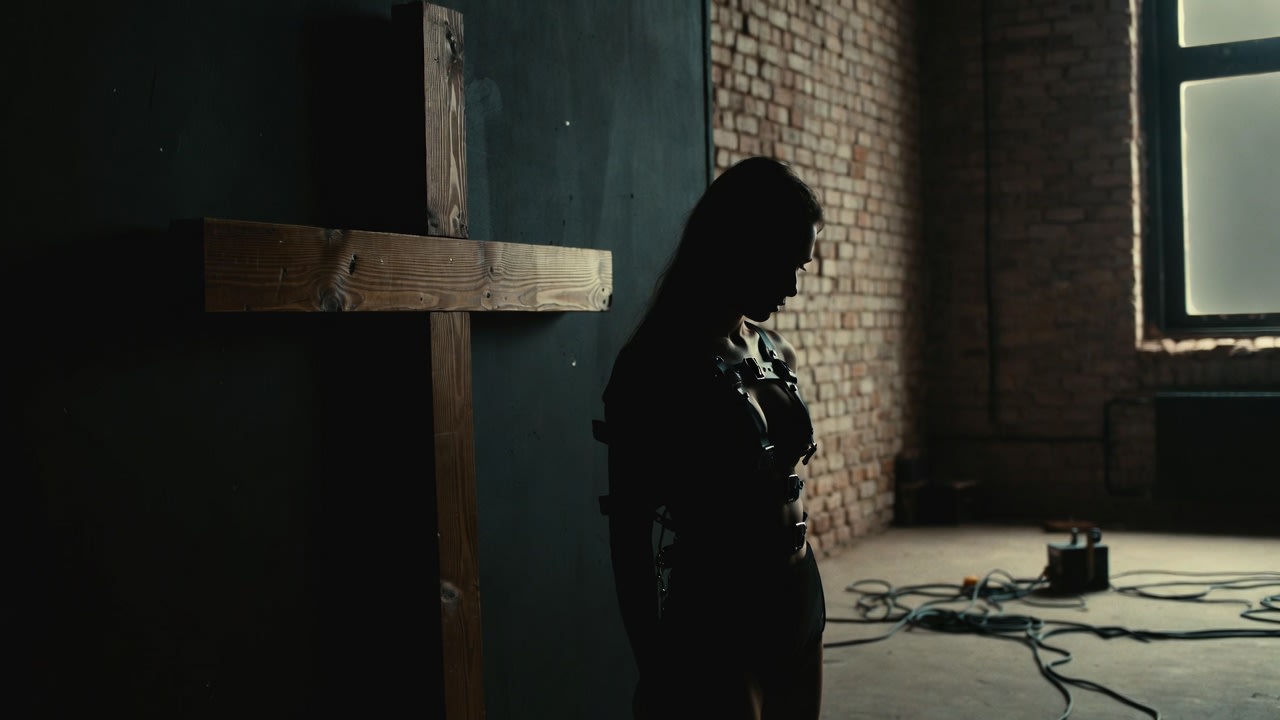
The room is quiet in the way only honest rooms are quiet. Brick, bare floor, a window going soft with afternoon light. Cables coiled where the work happens. And a wooden cross against the wall — plain, heavy, patient.
She stands beside it. Not on it. Not against it. Beside it.
Her head is bowed. The harness is already buckled. And nothing is happening.
Except that everything is happening. This is the long minute before you are bound, and I want to talk about why it may be the most important minute in the whole scene.
The cross is furniture. The waiting is architecture.
A bondage cross is a simple thing. Two beams, good wood, solid joints. It does not seduce anyone on its own. In an empty room it is just carpentry.
What gives it weight is what it is for. A cross is a promise of position: arms placed, body opened, stillness enforced by leather and buckle rather than by willpower. When you stand near one, you feel that promise the way you feel weather coming.
And that is precisely why I do not hurry anyone onto it.
The scene does not begin when the first cuff closes. It begins when she crosses the room and stops beside the frame, and understands — in her body, not just her mind — what the frame is waiting to do. The wood does the speaking. I let it.
Anticipation is an instrument
Most people think of anticipation as the absence of something. The scene has not started yet; therefore this is dead time. They are wrong, and their scenes are thinner for it.
Anticipation is an instrument, and like any instrument it rewards the one who knows how to play it slowly. In that long minute beside the cross, her pulse is doing more work than any tool I own. Her imagination is more thorough than my hands could ever be. Every second I do not touch her, she binds herself a little tighter.
I am not being cruel by making her wait. I am being generous. I am giving her time to arrive.
The bowed head
Look at the posture. Head lowered, hair falling forward, hands quiet. No one arranged her like that. No rope requires it.
A bowed head is a sentence spoken without sound. It says: I am here on purpose. I have stopped negotiating with the moment. Do with this stillness what you intend to do.
There is a common misunderstanding that submission begins when the restraints are on — that surrender is something done to a person. The bowed head corrects this. Surrender is something a person does. It happens first, freely, standing, unbound. The leather that comes later only confirms a decision that was already made.
That is why the minute beside the cross matters more than the hours on it. On the cross, she has no choice. Beside it, she has every choice — and she stays.
What the harness already knows
She is not naked in this moment, and she is not dressed. She is harnessed. Straps over the shoulders, rings at the sternum, buckles down the spine. A harness is a strange and beautiful in-between: clothing that offers nothing to weather or modesty, and everything to intention.
A harness is a map of where control will travel. Each ring is an anchor point that has not been used yet. Each strap is a line waiting to be pulled taut. Wearing one is like standing in a doorway — you are not inside yet, but you have clearly stopped being outside.
By the time she reached the cross, the harness had already taught her body the first lesson: you are held. Not restrained yet. Held. There is a difference, and the difference is where trust lives.
Bare rooms make bare attention
Notice where this happens. Not a velvet dungeon. Not a stage set. A raw room — brick walls, a workshop floor, cables that have nothing to do with romance.
I prefer rooms like this, and I will tell you why. Ornament is a form of noise. Velvet and candlelight tell you what to feel, the way a laugh track tells you when something is funny. A bare room tells you nothing. It leaves the whole burden of meaning on the two people inside it — on her stillness and my patience and the wooden frame between us.
In an unfinished room, nothing performs. So no one performs. What is left, when performance is subtracted, is attention. And attention — full, slow, undivided — is the true luxury of this life. Anyone can buy candles. Very few people can stand in silence beside another human being and be entirely there.
Light from one window
One window is enough. It draws her outline and keeps her face in shadow, and that is right for this minute. Before a scene, a submissive does not need to be seen in detail. She needs to be seen in shape: the line of the shoulders coming down from tension into rest, the head lowering by degrees, the hands giving up their small tasks.
I watch that outline the way a sailor reads water. When the shape goes quiet, she is ready. Not before.
The dominant's half of the stillness
Here is what is rarely written about that minute: it disciplines me too.
It would be easy to move quickly. Eagerness is always available. But a dominant who rushes to the buckles is a dominant who serves her own appetite first, and that is not dominance — that is hunger wearing a costume.
The wait is where I do my quietest work. I read her breathing. I confirm, without a word, everything we negotiated when the lights were bright and the conversation was ordinary: what is welcome, what is not, what word brings everything to a stop. Consent is not a form you sign at the door. It is a temperature in the room, and I check it constantly, the way you check a fire.
Only when I am certain — of her, of myself, of the frame's every bolt — do I cross the floor.
Trust is built standing up
People imagine trust is proven in the intense moments, at the peak of a scene. In truth, trust is built earlier, in the unremarkable ones. In the conversation beforehand. In the checking of hardware. In the minute beside the cross, where she can still simply walk away — and learns, once again, that nothing but her own desire is keeping her there.
That is the paradox at the heart of this whole beautiful practice: restraint only means something when it is chosen by someone free. The cross does not create her surrender. It receives it.
When the first cuff finally closes
Eventually, the minute ends. I step in. The first cuff closes with a small, definite sound, and the wood accepts the weight of an arm.
And here is the secret every experienced submissive knows: that moment feels like an exhale, not a beginning. Relief, not shock. The decision was made long ago, standing in the quiet, head bowed, beside the frame. The buckle merely says out loud what the stillness already said.
So if you are new to this — or if your scenes have started to feel like a checklist — try this: slow the doorway. Stand beside the cross before you touch it. Let the waiting do its patient work on both of you.
The wood has stood there all day. It can wait another minute.
So can I.
— Mistress Krigar