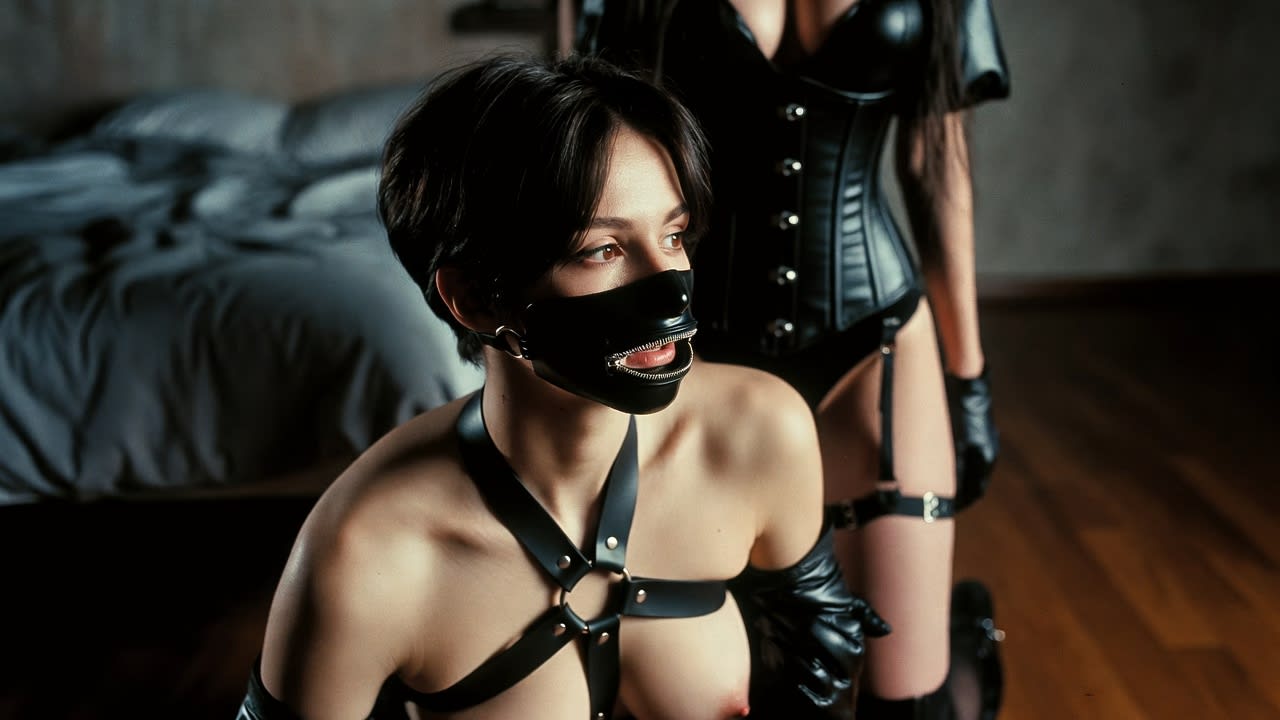
You are on your knees, and she has not touched you.
That is the whole scene, if you describe it badly. A submissive kneeling on a warm wooden floor, harness buckled, mouth held quiet. A Dominant standing behind her in laced leather, close enough that the air itself feels occupied. Nothing is happening — and everything is happening. Because the most underrated instrument in all of power exchange is not the crop, not the rope, not the collar. It is presence. Where she chooses to stand. How long she chooses to stay there. What she does — and pointedly does not — do next.
Tonight we talk about the one who stands behind you.
The geometry of behind
Behind is a deliberate place. Understand that first.
Face to face is conversation. Side by side is companionship. But behind — behind is authority. Behind says: you do not need to see me to know I am here. It removes the submissive's favorite crutch, the constant visual check-in, the little glance that asks am I doing well, are you pleased, what happens next? When she stands behind you, all of those questions must be answered by a different sense entirely. By the creak of a floorboard. By warmth arriving at the back of your neck. By the small displacement of air that tells you she has shifted her weight, and is considering you.
A submissive who kneels facing her Dominant is performing for an audience. A submissive who kneels with her Dominant behind her has given up the performance. There is no face to read, no approval to harvest. There is only the task of being exactly what you were told to be — still, open, attentive — with no confirmation except trust.
That is why the position feels so much larger than it looks. Nothing about it is decorative. It is a working arrangement between two people who mean it.
Presence is the first instrument
New Dominants reach for tools. Experienced Dominants reach for time.
Anyone can fill a room with implements. It takes far more confidence to fill it with yourself — to stand behind a kneeling submissive and simply remain, unhurried, while she learns the true length of a minute. Presence is the first instrument of dominance because it is the one that cannot be faked. A flogger swings the same for anyone. But stillness with intent, attention without touch, the patience to let anticipation ripen instead of rushing to spend it — that is signature. That is the difference between someone playing a role and someone holding one.
And the body knows the difference. Ask any submissive what undid her, and she will rarely name the implement. She will name the moment before it. The waiting. The sound of gloves being drawn on, somewhere out of sight. The knowledge that she was being looked at, thoroughly, and could do nothing about it but be worth looking at.
Being watched is being kept
There is a reading of this scene that misses the point entirely — that being watched from behind is exposure, vulnerability as threat. Look closer at the picture. The kneeling one is not braced. Her shoulders are down. Her eyes are soft and somewhere else, the gaze of a person whose mind has finally stopped narrating.
Because being watched by the right person is not surveillance. It is keeping. It says: nothing about you is unattended right now. Not your breathing, not your posture, not the tremor in your hands you thought you hid. Every signal you give off is being received. For people who spend their daylight hours being half-noticed by everyone — competent, reliable, invisible — the experience of being wholly attended to is close to unbearable in the sweetest way. The submissive on the floor is not enduring attention. She is drinking it.
This is what outsiders misread about dominance and submission. They see a hierarchy and assume neglect flows downward. In truth, a kneeling submissive is often the most carefully observed person in any room she will ever be in.
The quiet mouth, the loud body
She is not speaking tonight. That was decided for her, and she agreed to it long before the buckles did.
Take away speech and something interesting happens: the body becomes articulate. A held breath is a sentence. Leaning back a half-inch toward the warmth behind you is a paragraph. The Dominant who stands behind a quiet submissive is not receiving less communication — she is receiving better communication, stripped of politeness and performance, the honest telemetry of a nervous system that has decided it is safe.
And it works in both directions. Denied her Dominant's face, the submissive learns to read presence the way sailors read weather. She knows the difference between a pause that means I am admiring you and a pause that means I am about to change your evening. That fluency takes practice. It is one of the pleasures of a long dynamic that no first scene can counterfeit.
The negotiation you did not see
Everything in this picture was talked about first, in daylight, in plain words, with both people fully dressed and free to say no.
That is not the fine print of the scene. It is the foundation of it. A quiet mouth still has a voice — a gesture held in reserve, a signal rehearsed until it is reflex, agreed exits that work even when words are off the table. Limits were named. The shape of the evening was consented to, specifically, by adults who wanted it. The submissive kneels inside an architecture of agreements, and that is precisely why she can afford to look so unguarded. Surrender without structure is just risk. Surrender inside structure is rest.
If you take one practical thing from tonight, take that: the depth of a scene is set weeks earlier, in conversation. Trust is not a mood. It is a record.
Why the bed stays unmade
Notice the room itself. Low light. An unmade bed, sheets still holding the shape of ordinary life. This is not a dungeon set. It is someone's home on an ordinary evening — and that is the most honest detail in the frame.
Power exchange does not live in special rooms. It lives in the same space where you sleep and argue about the duvet and drink coffee badly. The lifestyle, for most of us, is exactly this: ordinary rooms made ceremonial by intention. You do not need equipment to make a threshold. You need two people who agree that when she stands there, and you kneel here, the room changes its rules.
That is a skill. Like every skill on this platform, it is built by repetition — small rituals kept daily, tasks completed when no one would have noticed if you hadn't, streaks maintained not for the numbers but for what the numbers stand for: I said I would, and I did.
Learning to be stood behind
If you are new to this and the picture stirs something you cannot fully name, start smaller than you think you should.
Kneel in a quiet room and let someone you trust simply stand behind you for five minutes. No implements, no costume, no script. Just presence and breath. Notice what your mind does — how it begs for a glance, how it invents worries to fill the silence, and then, somewhere around minute three, how it stops. That stopping is the doorway. Everything else in this lifestyle — the leather, the rituals, the sweet severity — is refinement of what you find on the other side of it.
And if you are the one standing: stand like you mean it. Unhurried. Attentive. Generous with your patience and stingy with your touch, until the stillness itself has done its work. The one kneeling in front of you is giving you the most expensive thing she owns — her unguarded back. Be worth it.
She stands behind you. Not to catch you failing.
To catch you.
— Mistress Krigar