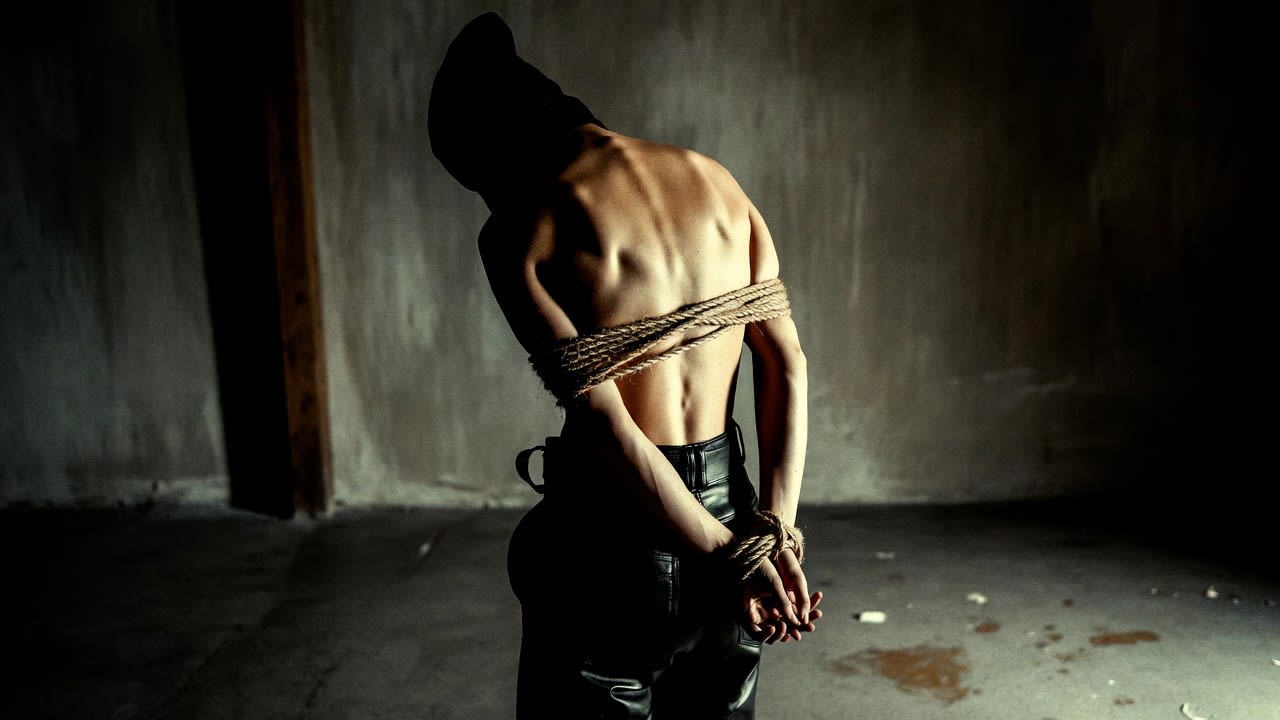
Look at the figure in the photograph. Hands gathered behind the back. Rope crossing the spine in patient, deliberate turns. The head covered, the eyes taken, the room bare and grey around the body. Nothing is happening. And everything is.
This is the part of rope nobody photographs well: the stillness. Not the struggle, not the spectacle. The quiet that arrives once the last knot is set and there is, finally, nowhere to go. I want to talk about that quiet. About rope space, sensory surrender, and why being bound and blind can feel less like losing control and more like setting it down.
The first knot is a question
Every binding begins as a question asked with rope instead of words. Will you let me? The wrist offered, the breath that catches, the small nod. Consent is not a form you sign once and forget. It is alive in the room, renewed with every turn of the line.
People imagine bondage as something done to a person. It is closer to something built with them. The one tying reads the body — where it tenses, where it softens, where it asks for more pressure and where it asks for mercy. The one being tied answers without speaking. A conversation runs underneath the silence, and it is one of the most honest conversations two people can have.
What the rope actually holds
Rope holds the body, yes. Wrists, arms, the long muscles of the back. But that is the least interesting thing it does.
What rope really holds is the part of you that never stops managing. The planner. The one who answers emails at midnight, who carries everyone, who cannot remember the last time the to-do list was empty. Restraint takes the steering wheel out of those hands. Not cruelly. Kindly. The way you take a heavy bag from someone who has been carrying it too long.
The body lets go before the mind does
Notice the shoulders in the image — dropped, not braced. That is the tell. When the rope is right, the body stops fighting before the mind agrees to. Muscles that have been clenched for years remember how to be still. Breath slows. The jaw unlocks. There is a particular sigh that happens about a minute into good rope, and once you have heard it you will recognise it anywhere. It is the sound of someone arriving.
The hood, and the mercy of not seeing
Then there is the dark. The hood, the blindfold, the simple act of taking sight away.
We think of our eyes as how we receive the world. They are also how we perform for it. We watch ourselves being watched. We check, we measure, we arrange our faces. Take the seeing away and that whole exhausting machinery powers down. No mirror. No audience. No version of yourself to maintain.
What rushes in to fill the dark is sensation. The texture of the rope. The temperature of the room on bare skin. The sound of footsteps circling, slow and unhurried. A single touch lands differently when you cannot see it coming — softer feels softer, and anticipation becomes its own kind of caress. Sensory surrender is not deprivation. It is concentration. The world narrows to what you can feel, and what you can feel becomes enormous.
Rope space: where surrender becomes stillness
There is a state experienced people call rope space — a cousin of subspace, reached not through intensity but through restraint and time. It is less a high than a deep tide going out. The chatter in the head quiets. The sense of time loosens. The body feels heavy and warm and far away, and the only thing left is the rope, the breath, and the presence of the person who tied you.
It is, frankly, one of the most peaceful states a person can enter while fully awake. Meditators chase it for years on a cushion. Rope can open the same door, because it removes the one thing meditation asks you to surrender by willpower: the need to be in charge of yourself for a while.
What it feels like from the inside
From the outside, nothing. A still body in a quiet room. From the inside: an enormous letting-go. Floating. Trust made physical. The relief of being held so completely that there is no decision left to make except to breathe and be exactly where you are. Many submissives describe it as coming home to a place they did not know they had left.
Trust is the real restraint
Here is the truth the rope only hints at: the knots are not what holds you. Trust is.
Any binding can be undone in seconds by the person who tied it. The restraint that actually matters is the agreement underneath — that the one with the rope will keep watch, will read your body, will stop the instant stopping is needed. You are not surrendering to rope. You are surrendering to a person who has earned it. That is why the bond between two people who do this well runs so deep. They have practised, in the most literal way, the thing every intimate relationship is built on: I will hand you something fragile, and you will not let it fall.
Which is also why this is never something to rush, and never something to do with someone you do not yet trust. Surrender given to the wrong hands is not surrender. It is risk. Build slowly. Talk first, and talk plainly. Agree on a way to say stop — a word, a sound, an object held in the hand and dropped when speech is gone. Keep something near to free the body quickly. The discipline around the edges is what makes the abandon in the middle possible.
The part the photograph does not show
After the rope comes the part no one frames or posts: the unwinding. The lines come off slowly. Sight returns. Warmth is offered — a blanket, water, the simple weight of an arm around the shoulders. The one who let go is gently called back, and the one who held them stays close while they return.
This is not an afterthought. It is the other half of the act. Going that deep means coming back, and coming back is easier with someone steady beside you. The care that follows surrender is what turns an intense experience into a tender one. Skip it and you have only done half the work.
Why we keep coming back to the rope
People assume bondage is about control, and they are right, but they have the direction backwards. It is not about taking control. It is about the profound relief of safely setting it down — of being so thoroughly held that you can finally stop holding yourself.
In a life that asks you to be capable every waking hour, that is not a small thing. It is rare. It is, in the oldest and best sense of the word, deilig — a pleasure you sink into rather than chase.
So look at the figure once more. The bound hands. The covered eyes. The dropped shoulders. That is not a person who has lost something. That is a person who has, for a little while, put down everything they were carrying — and trusts someone enough to keep it safe until they are ready to pick it up again.
That is the quiet at the centre of the rope. And once you have felt it, the silence never sounds empty again.
SubSurrender is an adults-only space for consensual power exchange. Everything here begins and ends with consent, communication, and care.