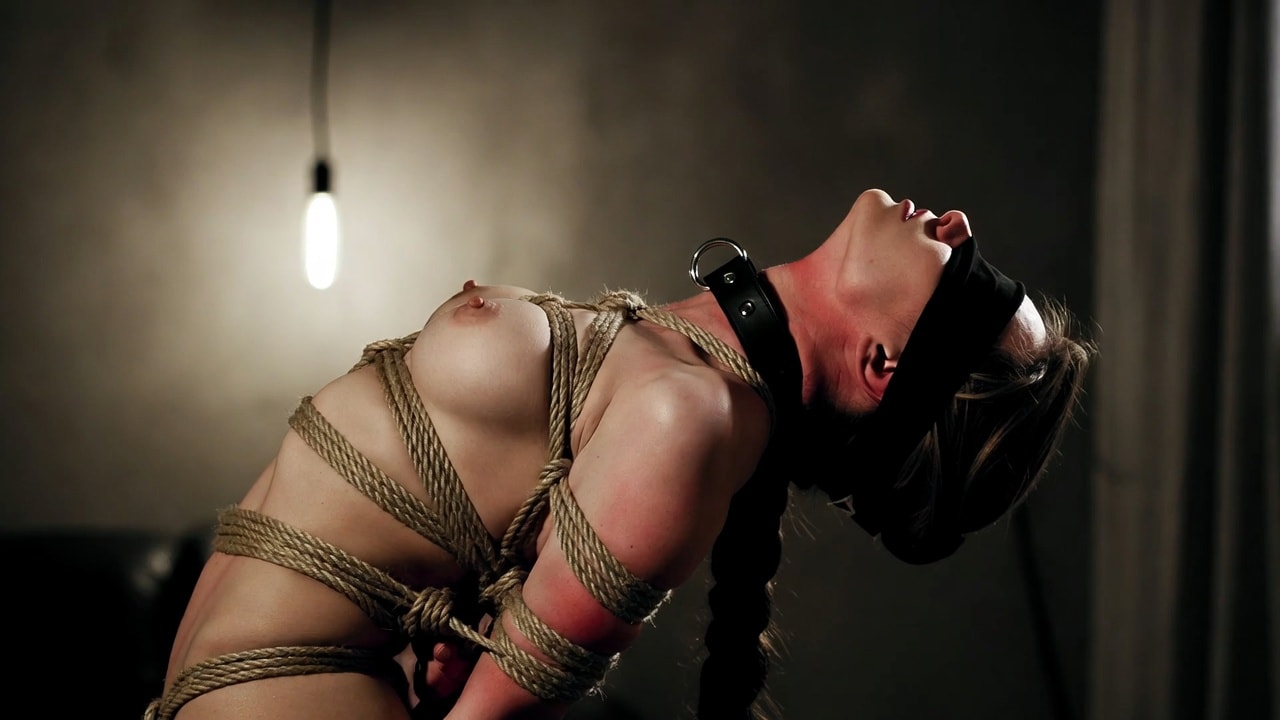
There is a moment, just before the first wrap of rope, when the room goes quiet. Not silent — quiet. The kind of quiet that lives in the body. A single bulb hangs overhead, throwing one warm circle of light onto bare skin, and everything beyond it falls away. This is where surrender begins. Not with a dramatic gesture. With stillness.
I want to talk about that stillness. About rope, the collar, and the blindfold — three simple things that, used with intention, become a language of trust. Not because they are pretty, though they are. Because of what they ask of you, and what they give back.
Surrender Is Not Weakness
Let us settle one thing first.
Surrender is often mistaken for losing. People imagine submission as something taken — power stripped away, will overruled. That is not what happens in a good scene. What happens is the opposite. Surrender is something offered. Deliberately. With both eyes open, right up until the blindfold goes on.
To hand someone your stillness — to let yourself be bound, to let your head fall back, to trust that the hands around you know what they are doing — that is not weakness. That is one of the most concentrated acts of strength a person can perform. You have to be very sure of yourself to let go that completely.
The submissive in a rope scene is not passive. She is doing the hardest work in the room: staying present, staying open, choosing again and again to trust. The rope only holds the body. The trust holds everything else.
The Rope: A Conversation You Can Feel
Look at how jute rope sits against skin. It is not soft. It has texture, weight, a faint smell of fibre and earth. It warms as it is handled. When it wraps across the body it does not simply restrain — it speaks.
This is the heart of shibari, the Japanese art of rope bondage. Each wrap is a sentence. Each knot is a held breath. The person tying is not just securing limbs; they are reading the body underneath their hands — the rise and fall of the ribs, the tension that gathers and releases, the small involuntary sounds that say more, or slower, or yes.
Why rope, when there are buckles and cuffs?
Because rope takes time. That is the entire point.
A cuff snaps shut in a second. Rope is laid on slowly, line by line, the tie building like a piece of music. The waiting is part of the pleasure. By the time the last wrap is set, something has already shifted. The body has surrendered before the mind quite noticed it happening. There is a Norwegian word I keep returning to — deilig. It means something close to delicious, but warmer, more bodily. The slow build of rope is deilig. It is meant to be savoured, not rushed.
Rope is about pressure, not pain
A common misunderstanding: that bondage is about pain. Good rope is about pressure. The even, grounding squeeze of cord against the torso, holding you the way a strong embrace holds you, except it does not let go. For many people this pressure is profoundly calming. The nervous system, given clear and constant input, finally stops bracing. The shoulders drop. The breath slows. The mind, so used to running, goes quiet under the weight of being held.
That is the paradox at the centre of all of this. Being bound can be the most free a person feels all week.
The Collar: Belonging, Worn at the Throat
Now look higher. At the throat, a band of leather, a single steel ring catching the light.
The collar is the oldest symbol in this world, and the most misread. From the outside it can look like ownership in the crudest sense. From the inside it is something far more tender. A collar says: you are mine to care for. It is a promise worn where everyone can see it, and where the wearer feels it with every breath.
There is a reason the throat is chosen. It is the most vulnerable place on the body, and the most honest. To offer your throat is to offer your guard. When someone fastens a collar there — gently, deliberately — and you feel the cool ring settle against your skin, a quiet certainty arrives with it. I have been claimed. I am held. I do not have to decide anything right now.
For the one who fastens it, the collar is not a trophy. It is a responsibility. You do not collar someone and then look away. The ring is a handle on a duty of care. That is the part the films never show.
The Blindfold: When the World Goes Dark, the Body Wakes Up
And then the blindfold.
This is the smallest piece of fabric and the largest shift. The moment sight goes, everything else turns up. The whisper of rope being drawn through a hand becomes enormous. The warmth of breath near the ear lands like a touch. Anticipation stretches time until a single fingertip, set anywhere on the skin, becomes the only thing in the universe.
Sensory deprivation is not deprivation at all. It is redirection. Take one sense away and the others rush in to fill the silence. The blindfolded body becomes a listening instrument, tuned entirely to the person holding the other end of the rope.
It also does something gentler. Behind the blindfold, there is no performance. No worrying about how you look, no managing your own expression, nowhere your eyes need to dart. There is only sensation and trust, and the dark, and the next breath. Many people find their deepest stillness there — that floating, unguarded state where surrender stops being a thing you do and becomes a place you are.
Power Exchange: The Trust That Holds the Whole Thing Up
None of this works without trust. Rope without trust is just restraint. A collar without trust is just leather. A blindfold without trust is just fear in the dark.
What transforms these objects into intimacy is the agreement underneath them — the power exchange. One person offers control. The other accepts it, and with it, the full weight of responsibility for the other's wellbeing. This is not a free-for-all. It is the most negotiated, most attentive form of closeness I know.
Consent is the foundation, not the formality
Before any rope is touched, there is conversation. What is wanted. What is welcome. What is absolutely not. A safeword — a single clear word that stops everything, instantly, no questions, no disappointment. Limits are not the fence that keeps pleasure out. They are the walls that make the room safe enough to let go inside.
A dominant worth trusting wants those limits. Demands them, even. Because the surrender only means something when it is freely given by someone who knows they can take it back at any moment. The power is real precisely because it was handed over, and can be reclaimed with a single word.
Aftercare: the scene does not end when the rope comes off
When the last wrap is unwound and the blindfold lifted, the work is not finished. This is when care becomes most important. Warmth. Water. A steady arm. Quiet words. The body, having floated so far out, needs to be brought gently back to shore.
Aftercare is where dominance reveals its true face. Anyone can tie a knot. Holding someone afterward, watching them return to themselves, making sure they feel safe and seen — that is the whole art. Surrender given is a gift. It is repaid in tenderness.
What Surrender Teaches
People come to rope and collar and blindfold for all kinds of reasons. Curiosity. Desire. The pull of something they have circled for years without naming. What surprises most of them is what they find underneath.
They find rest. The particular rest of being completely held and completely accepted, with nothing to prove and nothing to manage. They find that letting go, done in safe hands, is not a loss of self but a meeting with it. They find that trust, given fully and received with care, is its own kind of ecstasy.
That is the quiet architecture of surrender. Three simple things — rope, collar, blindfold — and underneath them, the oldest exchange there is: I will let go, and you will hold me.
Begin Where You Are
If something in you leaned in while reading this, that is worth listening to. You do not have to understand it. You only have to be curious, and honest, and willing to go slowly.
Start with conversation. Start with one wrap of rope, one quiet evening, one trusted person. Surrender is not a single dramatic leap. It is a practice — patient, intentional, deilig — and it begins the moment you decide you are ready to be held.
The bulb is still warm. The rope is waiting. There is no rush.
— Mistress Krigar
SubSurrender is an adults-only space for exploring power exchange, submission and the kink lifestyle with intention and care. Eighteen and over only. Always negotiate, always consent, always practise safely.