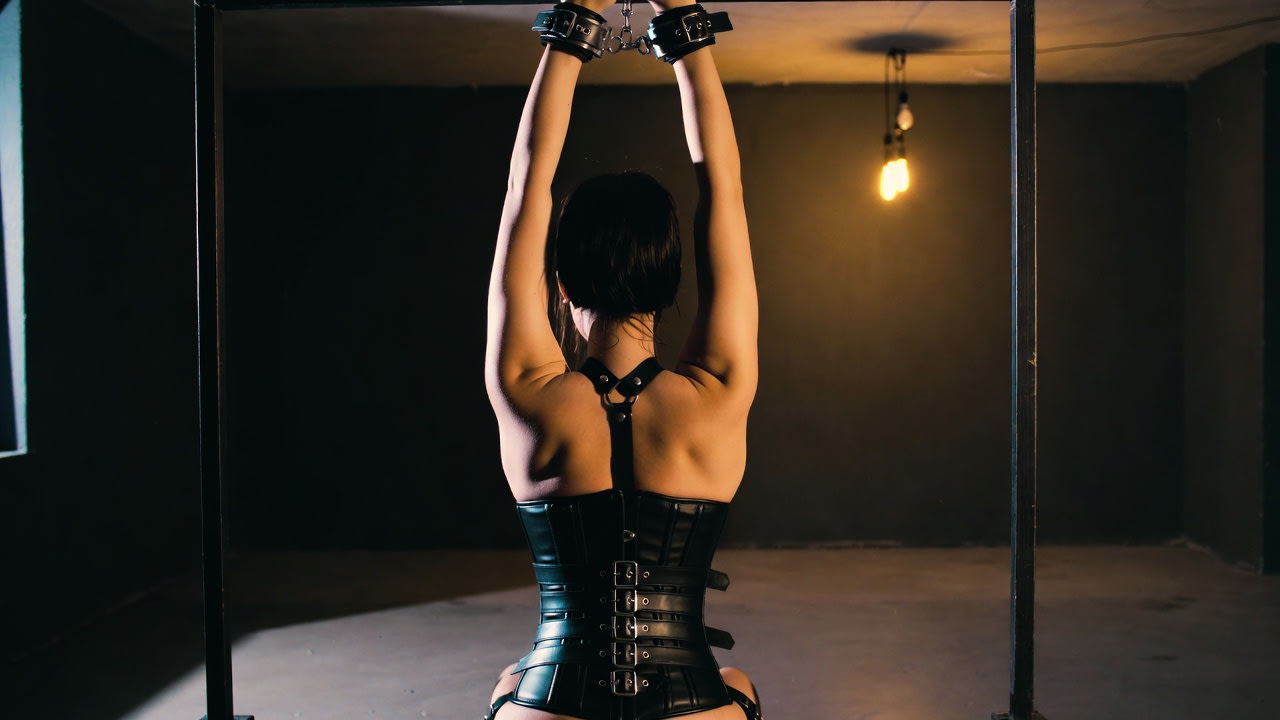
The room is nearly empty. Bare walls. A concrete floor swept clean. A steel frame, and one bulb burning low and warm above it. Beneath the frame, she kneels. Her arms are raised. Her wrists are cuffed to the crossbar. Her corset holds her spine like a quiet hand at her back.
Nothing is happening. And everything is happening.
This is the overhead bind. It is one of the oldest shapes in restraint, and one of the most misunderstood. People look at raised arms and cuffed wrists and see helplessness. I look at that same shape and see something else entirely: an offering, made with the whole body, held long enough to become true.
The Shape of Offering
Think about what raised arms mean. We lift our arms to stretch. To reach. To celebrate. To give ourselves over. It is one of the few postures the body cannot perform casually — you cannot half-raise your arms and hold them there. The position asks for commitment. Gravity makes sure of it.
When a submissive lifts her arms to the frame and lets the cuffs close around her wrists, she is not being taken. She is giving. The distinction matters more than anything else on this platform. Restraint that is imposed is just force. Restraint that is offered is a language — and the overhead bind is one of its clearest sentences.
The shape says: I am not going anywhere. I chose that. Now it is out of my hands, and I wanted it out of my hands.
Why Overhead Is Different
Hands bound behind the back create modesty, containment, a folding inward. Hands bound in front allow a kind of privacy — you can still shield yourself, still curl around your own center.
Overhead removes all of that. The torso is open. The breath is visible. There is nowhere to fold, nothing to hide behind. Every inhale shows. Every small tremor in the arms shows. The position is honest in a way few others are, which is exactly why it earns its place. It cannot be performed. It can only be inhabited.
The Corset: Held at the Center
Look at her waist. The corset is not decoration, though it is beautiful. Laced properly, a corset is architecture. It holds the center of the body the way the cuffs hold the wrists — firmly, evenly, without argument.
There is a reason corsetry and restraint have walked together for so long. Both work on the same principle: pressure, applied with intention, reads as presence. A well-fitted corset is a sustained embrace. It changes the breath — makes it higher, more deliberate. It changes the posture — you do not slouch in steel boning. It keeps the body honest while the mind lets go.
For the one wearing it, the effect is quiet and constant. You are held at the wrists. You are held at the waist. The body receives the same message from two directions at once: you are kept. Some people spend years looking for a feeling that clean.
The Wait: Where the Real Work Happens
Here is what the photographs never show you: time.
The first minute in an overhead bind is easy. The body is curious, alert, a little proud of itself. The fifth minute is different. The arms have opinions now. The mind starts negotiating — shift your weight, roll your shoulders, count something, anything.
And then, somewhere past the point where distraction runs out, a door opens. The negotiating stops. The breath settles into the corset's rhythm. The weight of the arms becomes just weight — a fact, not a problem. The mind, with nothing left to manage, goes quiet.
Submissives describe this state in different words. Floating. Dropping. Going soft. What they are describing is the same thing: the moment when waiting stops being endured and starts being received. That shift cannot be rushed and cannot be faked. It is earned in minutes, on the knees, under one warm bulb.
Stillness Is Not Passivity
Understand this clearly, because the difference defines everything we do here: the woman in that frame is not doing nothing. She is doing something extraordinarily difficult. She is staying.
Staying with the ache in her shoulders. Staying with the exposure. Staying with the not-knowing — when the door will open, when the waiting will end, what comes next. Stillness under restraint is an active discipline, the way holding a note is active for a singer. From the outside it looks like silence. From the inside it is the loudest thing in the room.
Trust Is the Real Restraint
The cuffs on her wrists are leather and steel. They are real, and they matter. But they are the smallest part of what is holding her.
What actually keeps her in that frame is everything that happened before it: the conversations, the limits laid out and respected, the safeword agreed and honored, the slow accumulation of evidence that the person who put her there can be trusted with her. Take that away and the same cuffs become meaningless — or worse. Restraint without trust is just hardware.
This is why the overhead bind belongs to established dynamics, not first meetings. The position asks the body for total openness. The body will only give that when the nervous system has been persuaded, over time, that openness is safe here. You cannot buckle trust on. You build it, buckle by buckle, month by month.
For the One Who Holds the Keys
If you are the one who closes the cuffs, understand your side of the frame. Her stillness is not your absence. Stay in the room. Watch the breath, the color of the hands, the small signals that words cannot send when someone is deep in the quiet. Check the wrists. Mind the circulation and the clock — arms overhead have real physical limits, and honoring them is not an interruption of the scene. It is the scene.
The bulb above her is a good teacher: one steady light, always on, never flickering. Be that.
Being Seen: The Single Light
Notice what the room is not. It is not a dungeon crowded with equipment. There is no audience, no spectacle, no noise. One frame. One light. One held body.
The starkness is the point. Everything inessential has been removed so that one thing can be fully felt: she is seen. The light falls on her back, her laced spine, her lifted arms, and there is nothing else in the room to look at — which means, for once, there is no competing for attention, no performing for it. Attention is simply given, completely.
Many people come to surrender looking for exactly this and do not have the words for it. Not pain. Not even sensation. Just the experience of being the only thing in the room that matters, for as long as the light stays on.
Beginning Your Own Practice of Stillness
You do not start with a steel frame. You start smaller, and you start with words.
Talk first. Limits, health, signals, aftercare — the unglamorous conversation that makes everything else possible. Then let the body learn gradually. Hands held still without any cuffs at all, simply because you were told to keep them there. Wrists resting against a headboard. Short intervals, honestly reviewed afterward. The shape can be practiced long before the hardware arrives, and the practice is the point — the cuffs only ever confirm what the will has already offered.
And when the day comes that you kneel beneath your own frame, arms up, breath high in a laced ribcage, waiting in a pool of warm light — you will understand what she understands. That reaching up was never about the ceiling.
It was about letting go.
Stillness is a skill. Here, it is also a practice — measured, witnessed, and rewarded. When you are ready to be held to a standard, you know where to kneel.
— Mistress Krigar