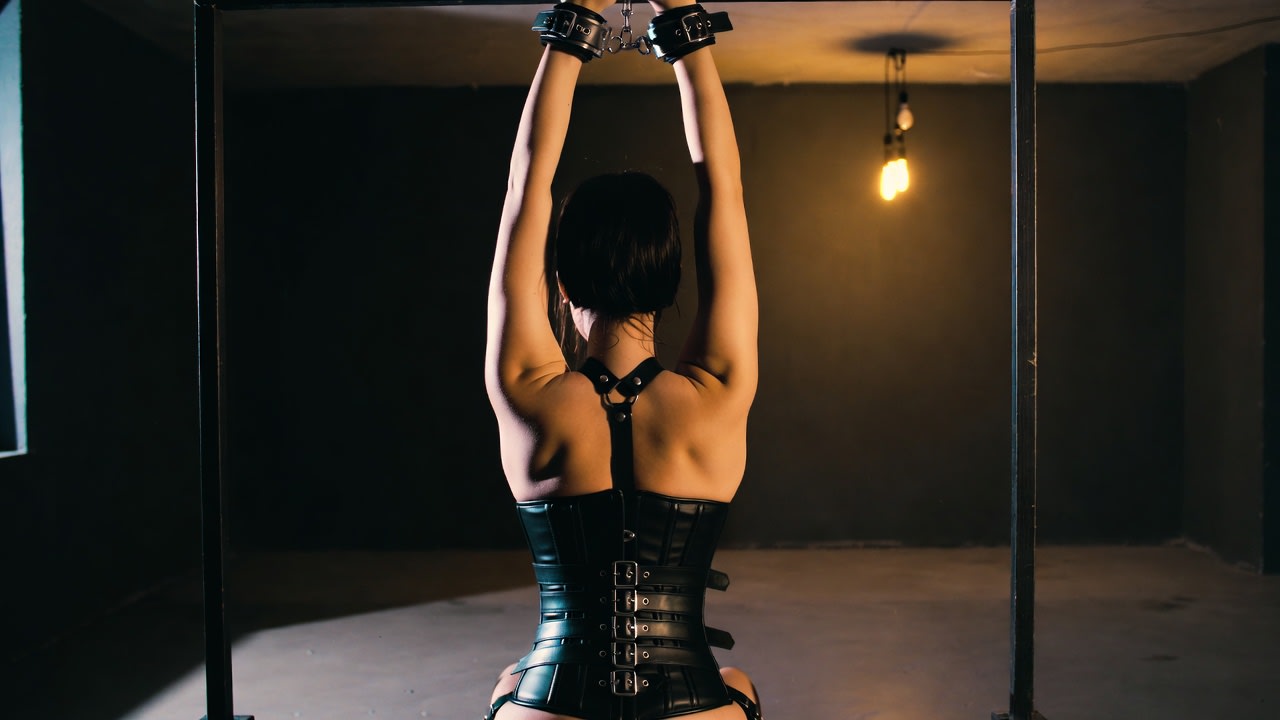
One Light in the Dark: Restraint, Patience, and the Warmth That Waits With You
There is a moment, before anything is done to you, when everything is already happening.
Your wrists are up. The cuffs hold. The room is dark except for one small bulb, warm as a coal, throwing a low amber glow across bare shoulders and the long line of a spine. You are kneeling. You are laced into leather that holds your breath as surely as the cuffs hold your hands. And nothing is moving. That stillness — that is the scene. Everything after it is only an echo.
This is a piece about that stillness. About restraint not as a climax but as a place you go. About what patience does to desire when you cannot rush it, cannot fidget out of it, cannot leave. About the single light that waits with you in the dark.
Restraint Is Not About Being Stopped
People who have never knelt in it assume restraint is about force. About being held down, held back, prevented. They picture struggle.
It is almost the opposite.
Restraint removes the struggle. When your hands are bound above you, there is suddenly nothing to do with them — and so the long, exhausting work of deciding, reaching, adjusting, performing simply stops. You are given the rarest permission a body ever receives: the permission to do nothing. To be held in one shape and let everything else fall away.
The cuffs do not take your power. They take your busyness. And in the quiet that opens up behind that, something far older than arousal begins to surface — relief.
The corset says the same thing in another language
Look at the leather drawn tight around the waist, buckle after buckle climbing the spine. A corset is not decoration. It is a held breath made wearable. It tells your body, in pressure rather than words: slow down, sit straighter, feel each inhale meet its limit. It is restraint you can carry standing up. It is discipline you can feel against your skin all evening.
Together — the cuffs above, the leather around the ribs — they make a sentence. You are held. You may stop holding yourself.
The Patience Is the Point
Notice what the scene withholds. No hand reaching in. No instrument. No climax. Just a woman, a kneel, a light. The waiting is not the part before the scene. The waiting is the scene.
This is where so many newcomers misunderstand power exchange. They want the action. They want to know what happens next. But a good Dominant knows that anticipation is the most exquisite tool in the room, and that it costs nothing but nerve to use it. To make someone wait — well-bound, warm, safe, and certain they are being watched — is to let desire do its own slow work.
Time stretches when you are restrained. A minute becomes a country you live in. Your hearing sharpens. The hum of that little bulb, the faint creak of the bar above you, the sound of your own breath against the leather — these become enormous. You are not bored. You are tuned. Every sense is leaning forward, listening for the next thing, and the next thing is in no hurry to arrive.
That, deilig as it is, is the gift of patience: it makes you present. You cannot anticipate the future and flee the moment at the same time. Restraint pins you to now.
The One Light
I want to talk about that bulb. The single warm light in the long dark room.
It is not an accident of décor. It is the whole emotional architecture of the scene. Darkness everywhere — and then one steady, golden point that does not flicker and does not leave. In a space designed to strip away the ordinary world, that light is the one thing that stays.
This is what trust looks like rendered in a single object. When you surrender — when you give your hands, your breath, your stillness to another person — you are not stepping into nothing. You are stepping into the dark with one warm light kept burning on your behalf. The Dominant is that light. The structure of the scene is that light. The agreement you made before a single cuff closed is that light.
You are in the dark. You are not abandoned in it.
Why the dark makes surrender possible
Shame lives in bright, total visibility — in the feeling of being seen all over, judged, measured. The low light of a scene does something tender instead. It hides what you do not want examined and reveals only what is offered: the curve of a back, the rise of the breath, the obedient stillness of bound hands. You are seen exactly as much as you have chosen to be seen, and no more. That is not concealment. That is consent, made visible.
What Surrender Actually Asks of You
Let me be plain, because the soft-focus talk can hide the real work.
Surrender is not collapse. It is not going limp and letting things be done to you. It is an active, deliberate offering — and it asks for three things.
It asks for honesty. Before the cuffs, you say what is true: what you want, what you fear, where the edges are. Surrender built on a lie is just performance, and it will not hold weight. The kneel is only beautiful because somewhere before it, two people told each other the truth.
It asks for trust earned in daylight. You do not hand your stillness to a stranger and hope. Trust is built in the small, unglamorous moments — the check-ins, the kept word, the safeword honoured the instant it is spoken. The drama of the dark is paid for in the boring reliability of the light.
It asks for presence. The whole point is to be here, in the held breath, in the waiting. To not float away. Good restraint, paradoxically, keeps you grounded enough to feel everything.
For the One Who Holds the Light
And to the Dominant — because surrender is never a solo act — the stillness asks as much of you.
To bind someone is to accept that you are now the warm light in their dark. That is not a power to wear casually. The person kneeling has handed you their busyness, their vigilance, their right to flee. In return you owe them your full attention. Watch the breath. Watch the hands. Read the body that can no longer easily speak. The art is not in how tightly you can bind, but in how completely you can hold.
Make them wait — yes. But never make them wonder whether you are still there.
The Quiet After
Eventually the cuffs open. The leather loosens. The body comes back to itself slowly, like a hand uncramping. This is not the end of the scene; it is the most important part of it. Warmth, water, a blanket, a steady voice. The light brought close.
What people remember, days later, is rarely the most intense sensation. It is the stillness. The feeling of having been held in one shape long enough to finally let go. The strange, clean peace of having wanted nothing for a while except to remain exactly where they were told to remain.
That is the deep promise underneath all of this — under the leather and the cuffs and the careful dark. Not pain. Not even pleasure, exactly. Permission. The permission to stop performing, stop deciding, stop holding yourself up, and simply kneel in the warm light of someone who has agreed to keep it burning.
Come into the dark. There is one light here, and it is waiting for you.
— Mistress Krigar