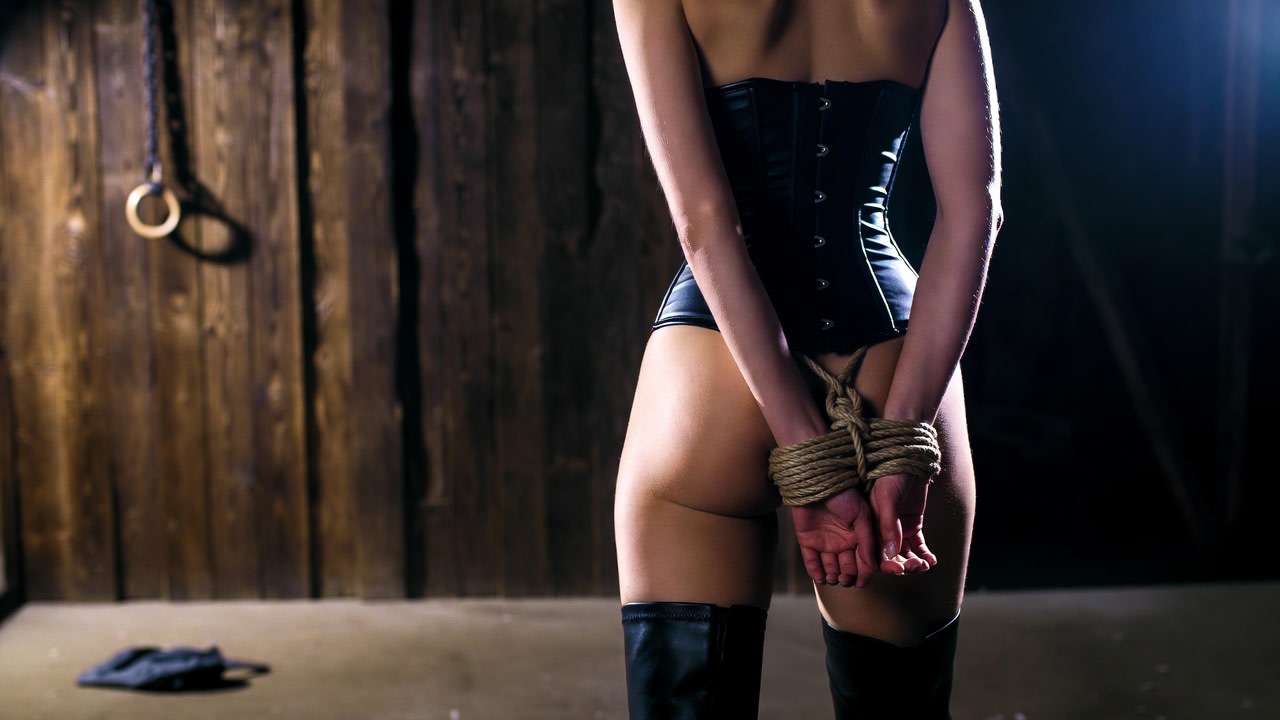
Everyone thinks surrender happens on the knees. The kneel is the postcard of submission — the shape people picture first, the one the films reach for, the one beginners assume is required. But walk into the room in the photograph above and look again. She is standing. Boots planted on old floorboards. Spine long inside the laced corset. Wrists crossed at the small of her back, wrapped in rope the colour of hay. Nothing about her is collapsed. And yet nothing about her is free.
That is the standing bind. And I will tell you something I have learned over many years of tying, waiting, and watching: it is often the deeper surrender of the two.
Why standing changes everything
Kneeling gives you somewhere to go. The floor holds you. Gravity finishes the gesture for you, and the posture itself does half the emotional work — down is down, and the body understands it instantly.
Standing gives you nothing. No floor to rest into, no shape to disappear inside. You hold your own weight, your own balance, your own posture — while your hands, the tools you would use to steady yourself, are taken away behind you. The rope removes exactly one thing: your grip on the world. Everything else you must keep doing yourself.
That is the quiet cruelty and the quiet gift of the standing bind. It does not let you collapse into submission. It asks you to carry it. Upright. Awake. Present in every muscle from heel to crown.
The body tells the truth upright
A body that stands bound cannot hide. The breath shows in the shoulders. The nerves show in the fingers, which open and close slowly against nothing. The weight shifts from one boot to the other when the waiting grows long. Whoever tied the rope reads all of it from across the room, the way you read weather.
This is why I favour the standing bind early in a scene. Before anything else happens — before a word, before a touch — the standing wait shows me everything I need to know about where someone actually is that evening. Restless or settled. Performing or honest. Bracing or opening. The rope asks the question; the posture answers it.
The anatomy of the wait
Look at the photograph once more. Notice what is not happening. No one is touching her. Nothing is being done. There is a ring on the wall, unused. Clothing discarded on the floor, already forgotten. The scene is entirely, deliberately still.
The wait is not the pause before the scene. The wait is the scene.
Those long minutes of standing — hearing footsteps somewhere behind you, or nothing at all — do more work than any implement ever could. Anticipation is the strongest sensation in the room, and it costs nothing but patience. The one who ties knows this. The one who is tied learns it, standing there, as the minutes stretch and every small sound becomes enormous.
What the hands do when they can do nothing
There is a detail in the image I want you to find: her palms are open. Not fists. Not clawing at the rope. Open.
Open hands are the last stage of the wait. Bound hands begin busy — testing the wraps, measuring the knot, negotiating with the situation. Then, somewhere in the stillness, the negotiation ends. The fingers soften. The palms turn outward, unguarded. It is the body's own signature on the agreement: I am not holding anything anymore. Not even resistance.
When I see open palms behind a bound back, I know the rope has finished its real work. The knot only ever holds the wrists. The stillness is what holds the person.
Dignity is not the opposite of surrender
Here is the misunderstanding I correct most often, in messages and in person: people believe that to submit is to be made small. Lowered. Reduced. And so they think a standing, straight-backed, laced-and-booted figure must be something other than submissive — a domme, surely, or a rebel not yet broken in.
No. Surrender and dignity are not rivals. In the standing bind they are the same gesture.
The corset in the photograph is doing more than shaping a waist. A corset holds the spine tall whether the mood is tall or not; it is architecture for the posture, a second discipline laid over the first. Laced in and roped, she could not slump if she wanted to. The submission is not in being lowered. It is in being held to a standard — upright, presented, composed — and consenting to be held to it for as long as the one holding the rope decides.
That is a far more demanding yielding than the kneel. Anyone can fall. Standing still, beautifully, while everything in you wants to fidget or turn around — that must be chosen, and chosen again every minute the wait continues. Upright surrender is surrender renewed continuously. That is why it runs so deep.
The back turned to the room
She faces the wall. The room — and whoever is in it — exists only as sound and warmth somewhere behind her. This is the second removal the standing bind performs: first the hands, then the eyes.
To stand with your back to the one who bound you is to give up surveillance. You cannot watch for what comes next. You cannot read a face for clues, prepare a reaction, manage the moment. You can only listen, and breathe, and trust that the person behind you is exactly who they showed themselves to be in every conversation before the rope ever touched skin.
Which brings us, as everything in this lifestyle does, to trust.
The rope is only as good as the conversation before it
Nothing in that photograph is improvised. A bind like that — comfortable enough to hold, secure enough to mean it — comes after negotiation, not before it. Wrists have angles they like and angles they do not. Shoulders have histories. Standing has limits measured in minutes, and those minutes were discussed, agreed, and are being counted by the person who tied the knot.
This is what outsiders miss when they see rope and think of force. Rope is the most premeditated object in the room. Every wrap is a sentence in an agreement two adults wrote together: what is wanted, what is off the table, what word ends everything instantly, who checks the hands and how often. The tighter the trust, the softer the rope can afford to feel.
If you are new and this image stirs something in you, understand: the knot is the last step of a long, unhurried, entirely sober conversation. Anyone who wants to skip that conversation does not deserve your wrists.
Bringing the standing bind into your own practice
You do not need a rustic room or a wall ring to explore this. You need patience and honesty, and a partner worth both.
Start with time, not tension: a simple wrist tie, hands behind the back, and ten quiet minutes of standing while your partner simply remains in the room. No touch, no talk. Notice what the stillness surfaces — restlessness, calm, heat, the strange loudness of your own breathing. That noticing is the practice.
Posture is the discipline: shoulders back, chin level, weight even. When the body wants to sag, choose the standard again. If a corset helps you hold the line, lace it. If a word helps, let it be given and obeyed.
And afterward — because there is always an afterward — untie slowly, warm the wrists, and talk. What felt endless? What felt safe? What do you want more of? The rope comes off in seconds. The conversation is what makes the next bind possible.
Stand still. That is the whole instruction.
The kneel will always have its place; I would never take it from you. But do not let it convince you it is the only door. Some of you will find your deepest quiet not by going down, but by staying up — spine long, hands roped and open, eyes on the wall, held to a standard by someone who chose you carefully and was chosen carefully in return.
Surrender, done well, does not always look like falling.
Sometimes it looks like standing perfectly still — and meaning it.
— Mistress Krigar