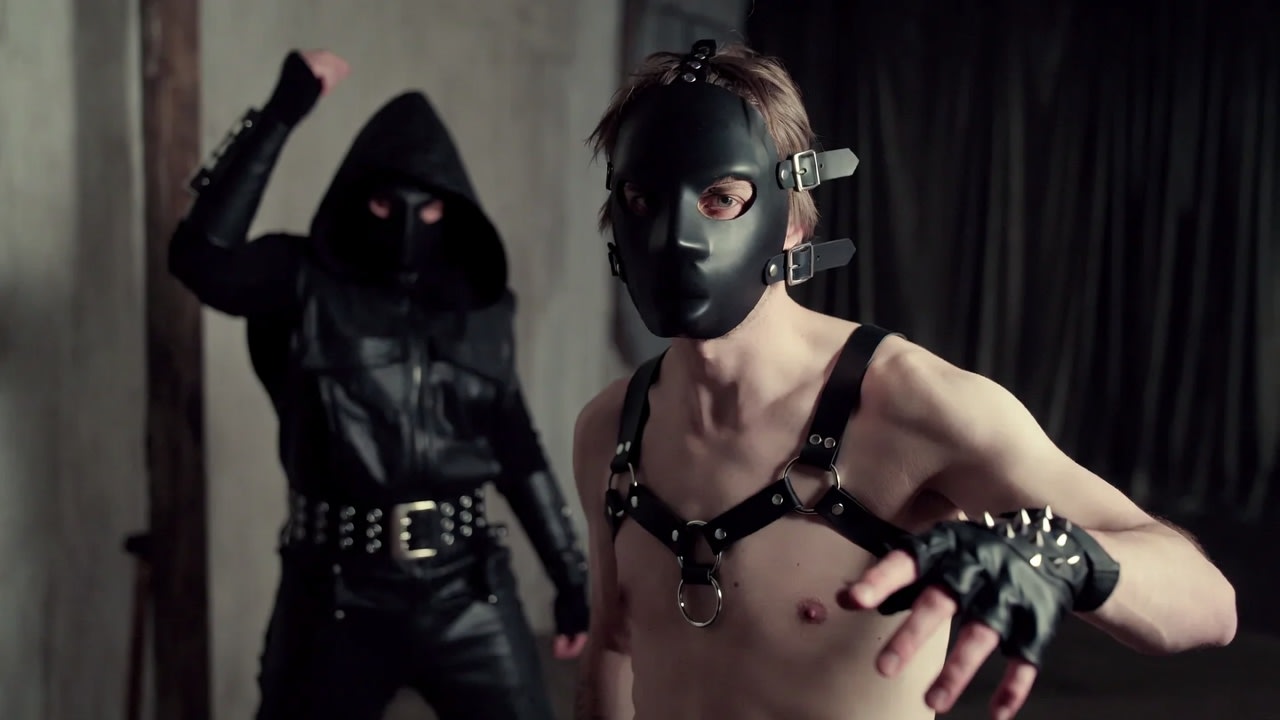
There are two figures in the room. One stands behind, hooded, sheathed in black leather from throat to wrist, a studded belt cinched at the waist, arm half-raised — not in threat, but in ownership of the moment. The other stands forward, bare-chested, ribs drawn with the clean black lines of a harness, face closed behind a buckled mask. Two people. No faces. And somehow, more honesty in that frame than in a hundred photographs of smiles.
That is the paradox we are here to sit with. The mask does not hide you. It reveals you.
The face is a job. The mask is a rest.
Think about what your face does all day. It performs. It reassures colleagues, softens disagreements, apologizes before your mouth does. You arrange it in mirrors and elevators. You manage it in meetings. By evening, the muscles around your eyes are tired in a way sleep does not fix, because the fatigue is not physical. It is the fatigue of being watched — and of watching yourself being watched.
Now buckle a mask over all of that.
The first thing most people report is not fear. It is exhale. The face is off duty. No one can read you, so you can stop writing. Whatever your eyes do behind the mask is yours alone. For a submissive, this is the antechamber of surrender: before you can give yourself to someone, you have to stop performing yourself for everyone.
Psychology has a cold word for this — deindividuation, the loosening of self-consciousness when identity is concealed. In a mob, it is dangerous. In a negotiated scene, held inside consent and care, it is something else entirely: permission. The mask quiets the narrating self, the one that hovers above every intimate moment asking how do I look, am I doing this right, what do they think of me. Silence that voice, and what remains is sensation, breath, and the presence of the one who put the mask on you.
What the image knows
Look at the frame again. The room is bare — raw plaster, a dark curtain, a wooden beam. Nothing decorative. Nothing to hide behind except what they are wearing. That bareness matters. Anonymity is not clutter; it is subtraction. The scene strips away the room, the wardrobe, the face, until only two things are left: the body, and the dynamic between the two people who brought it there.
The harness: lines that say held
The harness on the forward figure is not armor and it is not decoration. It is a diagram. Straps meet at a single steel ring at the sternum — the anchor point, the place where a hand, a leash, a moment of stillness can take hold. A harness on bare skin says two things at once: exposed and held. The chest is open, vulnerable, undefended. And yet the body is framed, contained, claimed by clean black geometry. That is the whole grammar of submission in one object. You are not covered. You are kept.
The buckles: slowness as ceremony
Notice that the mask does not slip on. It buckles — twice at the temple, once over the crown. Each buckle is a small delay, and the delay is the point. Ritual lives in slowness. Every strap drawn through its keeper is a sentence in an agreement: you are entering a different state now, and you are entering it deliberately. By the third buckle, the person who walked into the room is already somewhere else. Not gone. Deeper.
Two masks, not one
And here is the detail most people miss: the dominant is masked too. Hooded, closed, anonymous. This is not an oversight. Power exchange is not one person dissolving while the other stays ordinary. Both step out of their daylight selves. The hooded figure behind is not a person from the office who happens to hold a flogger; they are the role itself, distilled — presence without biography. When both faces disappear, what remains between the two bodies is the purest version of the dynamic: intention on one side, offering on the other.
Why being no one feels like being someone at last
There is a reason masked balls, confession booths, and anonymous letters have always loosened tongues. Identity is heavy. It carries your history, your reputation, your family's expectations, every version of you that others hold. Anonymity sets the weight down.
For many submissives, the deepest shame is not the desire itself — it is being seen desiring it. The mask resolves this with elegant mercy. Behind it, you can want what you want without your face confessing on your behalf. You can kneel without managing your expression. You can be reduced to breath and skin and obedience, and discover that reduction, chosen freely, feels less like loss and more like arrival. You were never so present in your body as the moment your face stopped mattering.
The Norwegians have a word I am fond of: deilig. Delicious, luxurious, deeply good. That is what anonymity feels like when it is done right. Not cold. Not clinical. Deilig — the dark, warm luxury of being no one, for someone.
The trust underneath the leather
Let me be precise, because this is where fantasy and practice must shake hands.
Anonymity in a scene is a costume worn over trust, never instead of it. The two figures in that room know each other's names. They negotiated before a single buckle was touched: what is welcome, what is off the table, what word or gesture stops everything. A mask can muffle expression, so a responsible dominant compensates — checking in more, reading breath and posture and the small language of hands, agreeing on signals that need no face. The submissive surrenders sight of themselves; they never surrender the right to be heard.
That is the quiet engineering behind every beautiful dark image: consent doing its work invisibly, like the stitching inside a good leather glove. The mask is only safe to disappear into because someone you trust is watching over the person you left at the door — and will hand them back to you, gently, when the buckles come off.
Aftercare for the unmasked
And when they do come off — that moment deserves its own tenderness. Re-entering your face is stranger than leaving it. The light feels loud. Your name feels like a coat you have not worn in years. Good aftercare here is simple and unhurried: water, warmth, a hand at the back of the neck, no demand for conversation until the person behind the mask has finished arriving. The scene is not over when the leather is off. It is over when you are wearing yourself comfortably again.
Begin where you are
You do not need a leather room and a full hood to touch this. Anonymity scales. A blindfold is a mask worn on the inside. A simple half-mask from behind a bedroom door changes more than you expect. Even structure can be a kind of mask: a task given and completed, a rule followed, a role stepped into — each one lets you set down the daily self for a while and act from somewhere quieter.
That, in the end, is what this whole practice offers. Not escape from who you are, but relief from having to constantly perform it. The mask takes something small — a face. It returns something enormous: a self with nothing left to manage, standing in a bare room, held by clean black lines and the presence of someone worthy of the offering.
Put it on slowly. Buckle by buckle. And notice, in the dark behind the leather, how much of you is finally there.
— Mistress Krigar