Muzzled: On Silence, Surrender, and the Voice You Choose to Give Up
There is a particular kind of quiet that only arrives when the mouth is no longer yours to use. Not the quiet of a held tongue — that is willpower, and willpower is loud inside the skull. I mean the deeper quiet that comes when speech has been taken, gently and deliberately, and you are left with nothing to do but feel.
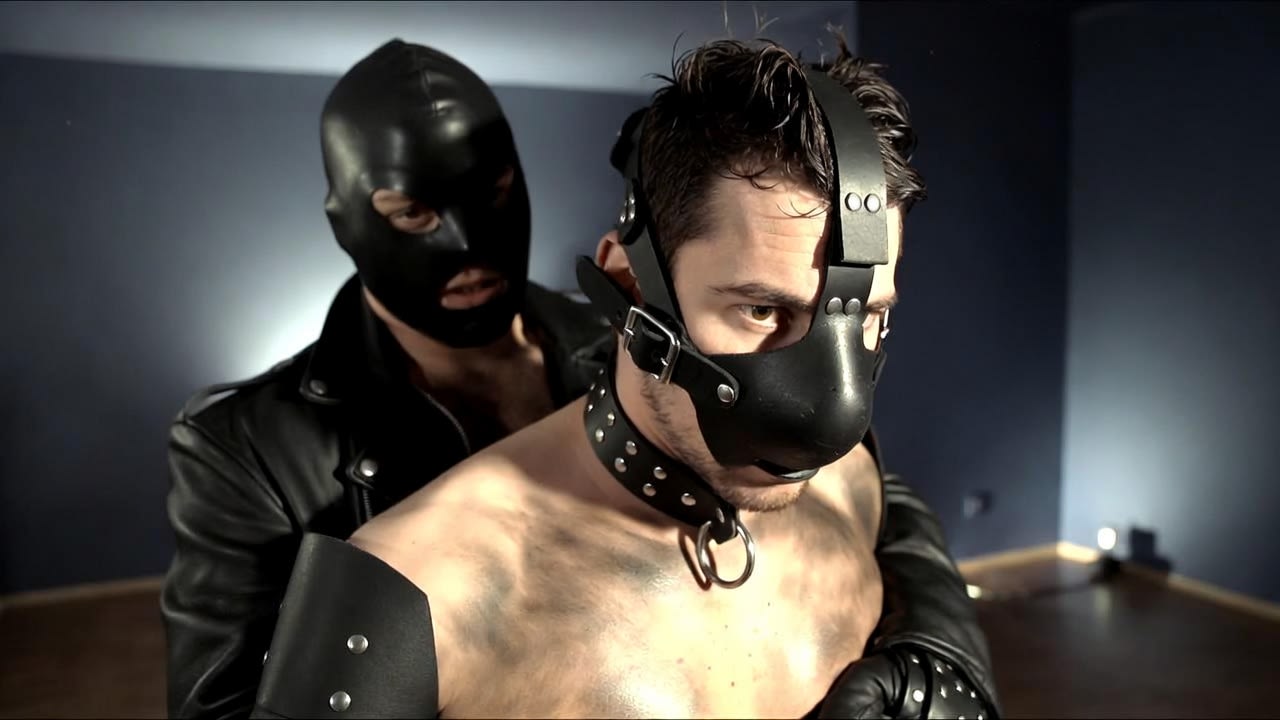
Look at him. Held from behind by a gloved hand, a hood at his shoulder, a muzzle of black leather strapped across the lower half of his face. The collar at his throat carries a single steel ring. His eyes are open. He is not fighting. He is somewhere most people never let themselves go — the place where there is nothing left to perform.
The muzzle is not a silencer. It is an invitation.
People who have never worn one assume the muzzle is about control taken by force. It rarely is. The straps do not make you quiet; they make a decision on your behalf that you have already agreed to. That distinction is everything.
When you can speak, you manage. You explain, you soften, you steer. You keep one hand on the wheel of the encounter at all times, even when you swear you have let go. The muzzle removes the wheel. It says: you will not talk your way through this one. You will be here, in your body, with your breath, and you will trust the hand that put it on you.
That is not less freedom. For the right person, it is the first real taste of it.
What the voice was doing all along
Consider what we use words for in the quiet hours. We narrate. We reassure ourselves. We perform composure for an audience of one. The running commentary of the mind spills out of the mouth as small talk, as jokes that defuse, as the constant low negotiation of is this okay, am I okay, are we okay.
Take the mouth out of service and the commentary has nowhere to go. At first it panics. It rattles against the leather. And then — if you are held well, if the hand at your chest is steady — it settles. The noise inside goes quiet because the noise outside has nowhere to escape. You stop describing the moment and you start living inside it.
This is why so many who try it feel something loosen in the chest — not distress, but relief. They have been talking their whole lives. No one ever told them they were allowed to stop.
The collar, the ring, the line that holds
Notice the ring at his throat. A collar with a single O-ring is a quiet promise. It is the place a lead clips to. It is the handhold. It says: you are reachable, you are claimed, you can be drawn closer or kept exactly where you are. Paired with the muzzle, the message is complete — your voice is mine to hold, and so is your distance.
None of this works without the thing the gear cannot supply on its own. Trust. The muzzle is only safe in the hands of someone who has earned the right to put it on you, and who will read you the entire time you wear it. Power exchange is not the absence of communication. It is communication moved into a different language — pressure, breath, the angle of a held body, the squeeze of a hand that means I have you.
Why leather, and why the weight matters
There is a reason this happens in leather and not in something lighter. Leather has weight. It warms to the body and holds that warmth. It creaks. It smells of itself. Every one of those details is a tether to the present moment — and the present moment is exactly where surrender lives.
A muzzle made of leather sits against the jaw with a steady, unmistakable presence. You cannot forget it is there. That is the gift: it keeps returning your attention to your own face, your own breath, the simple fact of being inside a body that someone else is tending. Lighter things let the mind wander. Leather insists you stay.
The gloved hand does the same work. A bare hand is intimate in one way; a gloved one is intimate in another — deliberate, composed, unhurried. It tells you the person holding you has prepared, has dressed for this, has made the encounter a ritual rather than an accident. Ritual is what turns sensation into meaning.
How to be held when you cannot speak
If the idea pulls at you, begin slowly. Surrender of the voice is not a beginner's first step; it is something you grow into once trust is already in the room.
Agree on the wordless signals before anything goes on. A hand that taps twice. An object held that, once dropped, ends everything instantly. Decide what slow down looks like and what stop looks like when the mouth cannot say either. The one who holds the power holds the greater responsibility: to watch, to check, to never mistake stillness for consent that has quietly run out.
Then, when the straps are buckled and the world narrows to breath and leather and the warmth of the body behind you — let go of the part of you that wants to manage. You have done the work. You are allowed to be carried now.
The silence is the point
We live in a culture that mistakes noise for presence. More words, more updates, more proof that we exist. The muzzle is a refusal of all that. For the length of a scene, you are not your opinions or your explanations or your endless self-narration. You are a body, held, breathing, trusted to feel rather than describe.
There is a word I keep returning to: deilig. Indulgent, yes. But intentional. The deepest pleasures are rarely loud. They are the ones you sink into with your whole weight, certain you will be held.
After the straps come off
When it ends — and it always ends — the voice comes back slowly, and it should. Do not rush it. The mouth that has been quiet for an hour does not snap straight into chatter. There is a tenderness in the return, a re-entry that deserves the same care as the descent.
This is aftercare, and it is not optional. Water. Warmth. A hand that stays. The one who took the voice is the one who returns it, gently, with words that put the person back together: you did beautifully, you were held the whole time, you are safe. Surrender given is a gift. It is answered with care, never with carelessness.
The muzzle, in the end, is not about taking something away. It is about clearing space. Remove the voice, and what remains is the truest thing — a person, present, trusting, finally quiet enough to feel everything they came here to feel.
That is the surrender worth learning. Not the loud kind. The kind you sink into, held, with nothing left to say.
— Mistress Krigar