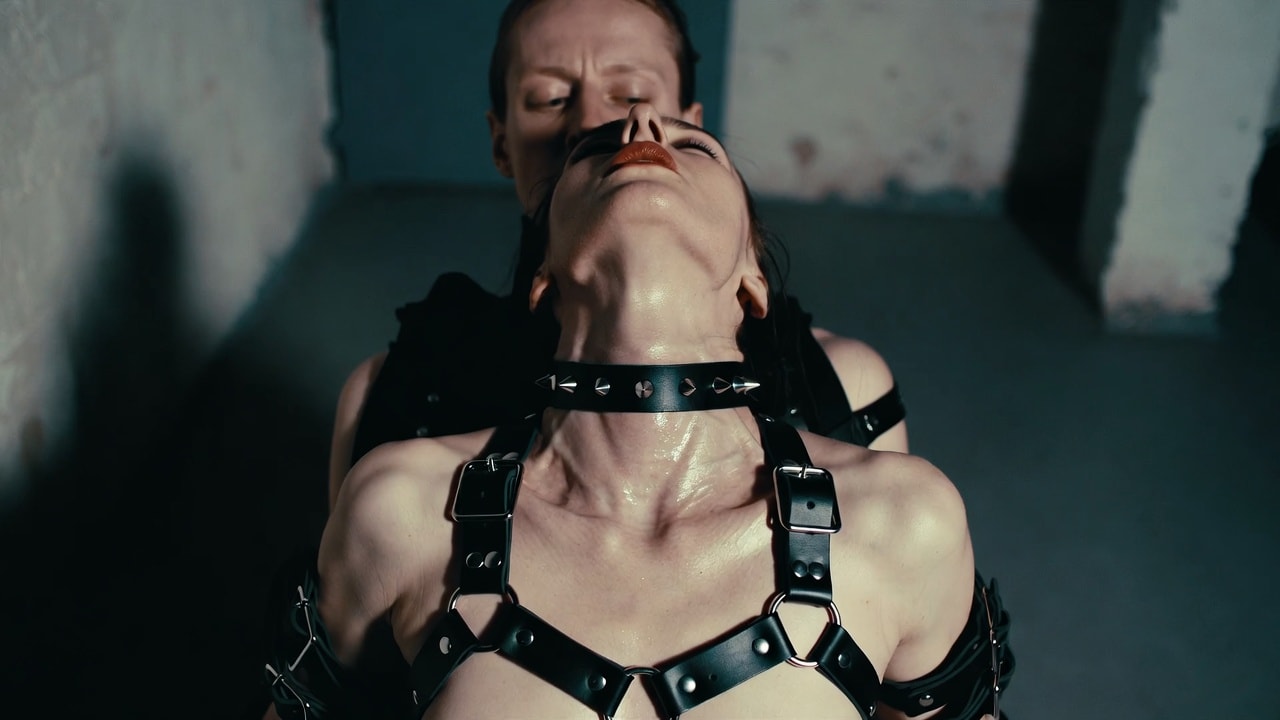
Everyone believes surrender happens on the way down. The bend of the knee. The bow of the head. The slow fold toward the floor. That is the surrender the world can picture, because it looks like what the word sounds like: descent.
But there is another surrender, and it moves in a different direction entirely. It happens when you lean back.
Picture the room. Bare walls, cold light, the kind of space that offers you nothing to hide behind. You are wearing leather — a harness buckled across your chest, a collar studded at your throat — and behind you, close enough that you feel her breath before you feel her hands, she stands. You cannot see her. You will not turn around. And then you do the one thing the body is built to refuse: you tip your head back, open your throat to the ceiling, and let your weight fall into a person you cannot watch.
That is the trust fall. That is the subject of tonight's lesson.
The Direction of Surrender
Kneeling is surrender you perform facing forward. You can see the floor coming. You choose each inch of the descent, and your body stays in negotiation with gravity the entire way down. It is beautiful, and I have written about it often, but it is — in the physics of trust — a controlled landing.
Leaning back is different. The body has no map for what is behind it. No eyes, no hands raised in guard, no way to break the fall. Every instinct you own was built to keep your spine vertical and your throat covered. To lean back into another person is to override a million years of caution with a single decision:
She is there. She will hold me.
This is why the backward lean undoes people who kneel easily. On your knees, you give your posture. Leaning back, you give your safety. There is no version of it that can be faked, because the moment your weight commits, the truth arrives: either you trust her, or you catch yourself. The body cannot lie in that direction.
What the Throat Says
Watch what happens to the throat in that moment. The head tips, the chin lifts, and the most guarded surface of the body — the one place every animal protects without being taught — rises into the light.
The bared throat is the oldest sentence in the language of surrender. It needs no words, no contract, no explanation. It says: I am not defending this. I am giving you the one thing instinct tells me to keep. A collar around that throat does not create the vulnerability; it frames it. The leather and the steel studs are punctuation around a sentence the body is already speaking.
And here is what I want you to understand, because it is the heart of everything we do on this platform: the bared throat is not weakness. It is the most expensive gift in the room. Anyone can guard themselves. Guarding is free; it is the default state of every stranger on every street. To un-guard — deliberately, for one chosen person — costs everything the guard was worth. That is why it means so much to the one who receives it.
The Harness Holds What She Holds
Now, the leather. A chest harness is a curious thing if you have never worn one. It restrains nothing. Your hands stay free. Your legs carry you anywhere you wish to go. By any practical measure, it does not bind you at all.
And yet everyone who buckles into one feels the change immediately. The straps cross the chest and shoulders like a diagram of intention. Each buckle closes with a small, decisive sound. The rings sit cold against the sternum, then warm to the skin, and the body begins to understand that it has been organized. Framed. Prepared for someone's attention.
The harness is structure, not restraint — and structure is its own kind of holding. When she takes hold of a strap, she is not grabbing your body; she is taking a handle that you buckled on for her. You dressed yourself in the means of your own surrender. Every strap says: I thought about this before you arrived. I made myself ready to be held.
This is why the harness belongs in the picture of the backward lean. When your weight tips into her, the leather is what her hands find. It carries the load your courage committed. The harness is the middle term between her strength and your trust — the physical proof that surrender, done well, is engineered rather than accidental.
Her Body Behind Yours
There is a particular presence a Dominant has when she stands behind you. In front of you, she is a person: a face, an expression, a gaze you can read and answer. Behind you, she becomes something larger and less negotiable — a warmth at your back, a breath at your ear, a gravity you orbit without seeing.
Submissives often tell me the moments that mark them deepest are not the intense ones. Not the strike, not the command. They are the moments of contact without observation. Her hand arriving on a shoulder from behind. Her breath on the back of the neck. The felt certainty of being attended to by someone you cannot check on.
Being held from behind concentrates all of this into one position. You are wrapped in her presence and given none of the usual instruments for verifying it. You cannot read her face. You cannot anticipate her hands. You have only the evidence of contact — and the decision, renewed each second, to keep leaning. Trust stops being an idea and becomes a continuous physical act, like breathing.
The Cold Room and the Warm Point of Contact
Notice, too, what the room is doing. Surrender photographs beautifully in bare, unfinished spaces, and this is not an accident of style. A cold room strips away the soft furnishings a mind can wander into. No cushions, no clutter, no comfort except one: her.
When the walls are bare and the light is cold, the single warm point of contact — her body against your back, her hands at the harness — becomes the entire world. Deprivation is not the point; focus is. The room empties so that she can fill it. The cold exists so that her warmth has a definition. Every serious dynamic understands this exchange: take away the ambient comforts, and the comfort that remains is the one that was chosen, offered, and earned.
Trust Is Built Before It Is Spent
Let me be precise now, because beauty without precision is how people get hurt.
The lean I am describing — the full weight, the closed eyes, the open throat — is not a beginning. It is a result. Nobody arrives at that moment by wanting it badly enough. You arrive by building it: conversations before leather, limits spoken out loud, safewords agreed and honored, small trusts extended and kept, one after another, until the body has enough evidence to override its own alarm.
Trust is a currency. Scenes spend it. Conversation, consistency, and aftercare earn it back with interest. A Dominant who lets you fall — physically or emotionally — has not proven your weakness; she has proven she had no business standing behind you. And a submissive who leans before the foundation is built is not brave, only unbanked. Build first. Spend later. The lean will be there when you have earned it together, and it will be worth more for the wait.
The Practice of Leaning Back
If you serve, or hope to, here is your homework — and you know I always give homework.
Find the small versions of the backward lean in your daily practice. They are everywhere once you look. Letting her make the decision you would normally argue. Wearing what was chosen for you without inspecting the mirror. Waiting without asking how long. Each of these is the same movement in miniature: weight committed to a person you cannot supervise. Do them deliberately. Notice the flicker of instinct that wants to catch itself, and choose — each time, freshly — not to.
Because that flicker is the whole practice. Surrender is not the absence of the instinct to guard yourself. It is the repeated, wholehearted decision to set the guard down for someone who has proven she deserves to stand behind you.
The Landing
Here is the ending they never put in the picture: the lean has a landing.
The head tips back. The throat opens. The weight commits past the point of return — and then her arms are there, exactly where the trust said they would be, and the fall becomes an embrace so smoothly that no one watching could say where one ended and the other began.
That is what all of it is for. The harness, the collar, the bare room, the built trust. Not the falling.
The being caught.
— Mistress Krigar