There is a particular quiet that only arrives when someone stops trying to fill it.
You have felt it, perhaps, in the second before a held breath releases. In the pause after a door closes. In the moment a kneeling body settles and the room, finally, goes still. That quiet is not empty. It is the most crowded silence there is — full of attention, anticipation, and a trust so complete it no longer needs words.
This is a piece about that silence. About leather and stillness and the slow art of surrender. About what happens when the mouth is asked to rest so that everything else can speak.
The Room Goes Quiet
Picture the scene without rushing it.
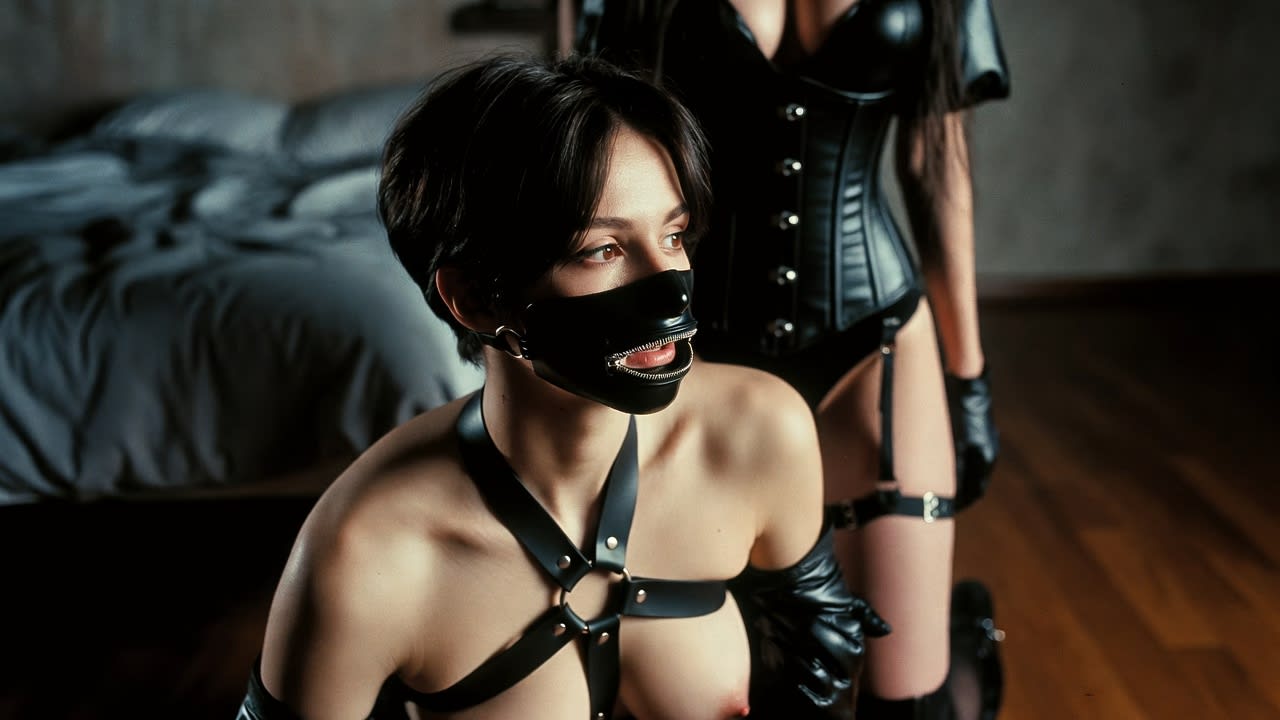
Low light. A bed left soft and unmade behind. Wooden floor cool beneath bare knees. One figure kneeling, dressed in nothing but fine leather worn close to the skin — straps that trace the body like punctuation, holding nothing in place except intention. Behind, standing, another figure in dark leather, unhurried, watching the way a person watches something they have chosen to be responsible for.
Nothing dramatic is happening. That is the point.
The drama of power exchange is not in the spectacle. It is in the restraint. In the deliberate slowness. In two people agreeing, without theatre, on who holds the thread and who lets it be held. The most charged rooms I have ever been in were also the most silent. Stillness is not the absence of intensity. Stillness is the intensity, distilled.
Leather as a Second Skin
Leather has always understood this.
It is a material that asks to be felt before it is seen — the weight of it, the warmth it takes from the body, the way it holds a shape and a scent and a memory. To wear leather in this context is not costume. It is commitment made tactile. A harness across the chest is not decoration; it is a sentence written on the skin that says I have decided to be here, exactly like this, for you.
There is a reason the aesthetic endures. Leather is honest. It does not pretend to be soft when it is not. It marks, it creaks, it remembers pressure. It rewards care and punishes neglect — which is, if you think about it, the whole grammar of devotion in a single hide.
When a submissive is dressed in straps that frame rather than conceal, something subtle happens. The body is offered, but it is also organised. Held. Given a structure to surrender inside of. That is the paradox at the centre of all of this: restraint is not the opposite of freedom. For some, it is the only door to it.
On the Quieted Mouth
And then there is the silence I promised you.
A quieted mouth — a soft gag, a mask, a simple agreement not to speak — is one of the most misunderstood pleasures in the whole vocabulary of power exchange. People imagine it is about taking something away. It is not. It is about giving something back.
Consider what the voice usually does. It explains. It hedges. It performs. It reaches for control of the moment by narrating it. Ask the voice to rest, and all of that falls away. What remains is purer: the eyes, the breath, the small movements of a body that can no longer hide behind chatter. A person who cannot speak must be read — and being read closely, being paid that kind of attention, is its own deep tenderness.
Silence, done with trust, is not a wall. It is a window.
For the one who submits, the quiet is a relief. No need to find the right words. No need to manage the encounter. The job becomes beautifully simple: be present, be honest, be here. For the one who leads, the quiet is a responsibility. You must watch more carefully. You must listen with your whole attention to a person who has handed you the task of understanding them without their telling you. That is not a small thing to be given. It should never be treated as one.
Trust Is the Whole Architecture
None of this — not the leather, not the kneeling, not the stillness — means anything without trust. Trust is not the decoration on top of power exchange. It is the entire structure holding it up.
Before a single strap is fastened, the real work has already happened. The conversation. The clear yes. The agreed signal that ends everything instantly, no questions, no disappointment. The slow building of confidence over time, so that surrender becomes possible precisely because safety is certain.
Consent as the Opening Move
I will say this plainly, because it matters more than anything else on this page: surrender is only beautiful when it is freely chosen, and it is only freely chosen when it can be freely withdrawn.
A quieted mouth must always keep a way to be heard. A signal in the hand. A dropped object. An agreed gesture. The silence is a gift offered on purpose — never a trap, never a removal of the right to stop. The whole edifice of power exchange rests on this: the one who appears to have no power, in truth, holds the most. They can end it with a breath. Everyone in the room knows it. That knowledge is what makes the surrender real instead of merely performed.
The Dominant's Quiet Burden
There is a romance to standing behind the kneeling figure, fully dressed, fully in control. There is also a weight to it that the romance rarely mentions.
To hold someone's surrender is to be trusted with their softest self. That is not a licence; it is a duty. The good dominant is not the loudest in the room. They are the most attentive. They notice the change in breathing, the shift of weight, the flicker behind the eyes. They lead not by force but by certainty — the calm, unhurried certainty that says I have you. You can let go. I am watching every second.
Control, properly held, is mostly care wearing better boots.
The Pleasure of Letting Go
So why do it at all? Why kneel, why quiet the mouth, why offer the body up in straps of leather on a cool wooden floor?
Because there is a specific, almost unspeakable relief in laying down the burden of being in charge of everything.
Most of us spend our days deciding. Managing. Performing competence for a world that demands it. To enter a room where, for an agreed hour, none of that is asked of you — where the only task is to trust, to feel, to be held inside a structure someone else maintains — is not weakness. It is a profound permission. The submissive does not lose themselves in surrender. They find a part of themselves that daylight rarely allows out.
And the one who leads finds something too. A focus that the rest of life fragments. A purpose narrowed to a single person and a single promise. There is a deep, deilig satisfaction in being wholly responsible and wholly present — in giving someone a stillness they could not have given themselves.
How to Begin, If You Are Curious
If any of this stirs something in you, begin the way everything here begins: slowly, and with words before silence.
Talk first. Name what you want and what you do not. Agree on the signal that stops everything. Start small — a held gaze, a chosen position, a single instruction followed and praised. Let trust be built, not assumed. The leather and the rituals can come later; they mean more when the foundation is already there.
And keep this close, whichever side of the dynamic calls to you: the goal is never to overpower. The goal is to meet. Power exchange at its finest is not one person winning. It is two people, by mutual design, arriving at a closeness that ordinary life keeps just out of reach.
The Last Word, Held Softly
The room is still quiet. The kneeling figure has not moved. Behind them, the one who leads has not looked away, not once.
Nothing dramatic is happening. Everything is happening.
That is the secret the silence keeps. Surrender is not given up — it is given to. And in that giving, held with leather and patience and an unbroken thread of trust, two people find a language older and truer than any words they might have spoken.
Let the mouth rest. Let the body settle. Let the quiet say what it came to say.
— Mistress Krigar
SubSurrender is an adults-only space for consensual power exchange. Everything here begins and ends with clear consent, clear limits, and the absolute right to stop.