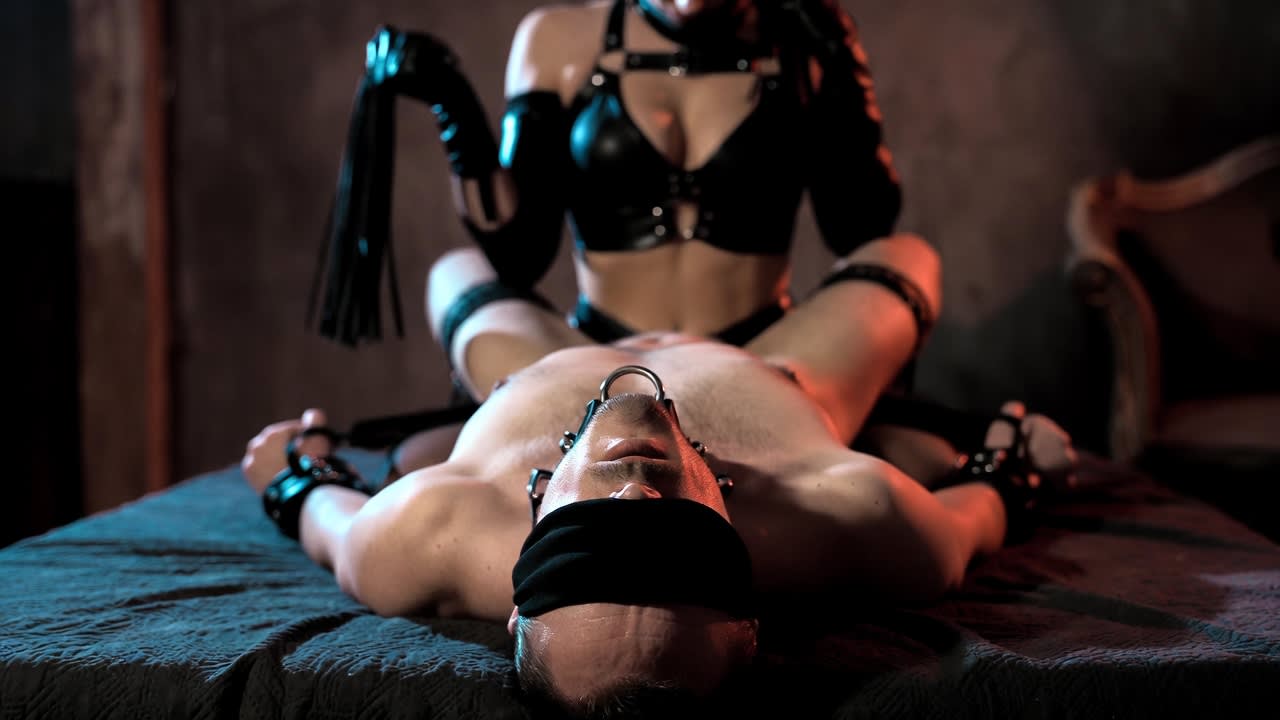
Laid Bare: The Surrender of Being Bound Open Beneath Her
There is a particular kind of quiet that only arrives when you have nothing left to do. No hands free to fidget. No way to turn from the room. No sight to busy yourself with. You are placed, and then you are kept there, and the keeping is the whole point.
Look at the position. Wrists drawn wide and held. Body opened along the bed, the long line of you exposed from throat to hip. Sight taken behind a blindfold. And above you, unhurried, the one who arranged you this way — gloved, composed, a flogger resting loose in her hand like a thought she has not yet decided to finish. This is not a scramble. This is a tableau. And you are its centre.
To be laid bare like this is not about nakedness. It is about availability. It is the difference between taking your clothes off and being opened.
Exposure Is Not the Same as Being Seen
Most people spend their days managing how they are perceived. We angle ourselves. We present the flattering side, the competent line, the version that holds. It is exhausting, and we rarely notice the cost until the managing stops.
When you are bound open beneath her, the management ends. You cannot turn your good side to the light because she has decided the light. You cannot cover the part of you that you usually guard, because your hands are not yours to use. The blindfold removes the last hiding place — the one behind your own eyes, where you watch yourself being watched and adjust accordingly.
What remains is plain exposure. Not performance. Not the curated self. Just the body and the breath and whatever is true underneath. And here is the thing that surprises the people who try it: that plainness is a relief. To stop curating is to put down a weight you had carried so long you stopped feeling it as weight.
The Vulnerability You Choose
There is exposure that happens to you, and there is exposure you hand over. They feel nothing alike. One is violation; the other is offering. The whole architecture of power exchange rests on this distinction.
You were not caught. You were not overpowered into this shape. You came to the bed and let your wrists be taken. You agreed to the blindfold, breath by breath. Every strap that holds you, you said yes to before it closed. That consent is not a footnote to the scene — it is the floor the scene stands on. Without it, there is no surrender, only force. With it, the same restraint becomes the safest place you have been in months.
Why the Restraint Sets You Free
It sounds like a contradiction, and it is the truest thing in this room. The cuffs do not take your freedom. They take your obligation.
As long as your hands are free, some quiet committee in your head keeps meeting. Should I move. Should I touch. Should I help. Am I doing this right. The freedom to act is also the burden of deciding, and for some of us that committee never adjourns — not at work, not at home, not in bed.
Bind the wrists and the committee has nothing to vote on. There is no decision left to make, because the decisions have been taken from you on purpose, by someone you chose to take them. What floods into that empty space is not panic. It is stillness. The body, finally relieved of its post, goes soft. The breath drops lower. You are not in charge here, and the not-being-in-charge is the gift you came for.
This is the paradox at the heart of submission: the one who is bound is often the one who finally exhales.
The Weight of Her Above You
Notice that she does not stand at a distance. She is close — astride, present, her weight a fact you can feel. This matters more than the implements ever will.
A blindfold could make a person feel abandoned, dropped into the dark and left. It does the opposite here, because the dark is not empty. You cannot see her, but you can feel where she is. The shift of her weight. The cool drag of latex. The pause in the air before the flogger moves. Sight is gone, and in its place every other sense leans forward and listens. Her nearness becomes the map you navigate by.
That is the deeper exchange. She has not taken your sight to isolate you. She has taken it so that you orient entirely around her — so that her presence becomes the only landmark left. The restraint and the blindfold are not walls between you. They are the means by which she fills the whole horizon.
Anticipation as Its Own Language
The flogger resting in her hand is not yet doing anything. And the not-yet is precisely the point.
When you cannot see, you cannot brace. You cannot read the wind-up and prepare your face. So you wait — and waiting, on the right side of a scene, is not dread. It is a held breath that goes on and on, sensation arriving not as shock but as answer. Anticipation stretches a single second into something long and golden. By the time anything lands, your whole skin has been listening for it. You have become, without noticing, all surface and attention.
She knows this. She is in no hurry, because the hurry would spend the very thing she is building. A patient hand is a dominant hand. The pause is not hesitation. The pause is her telling you, without a word, that she has all the time she likes and you have nowhere to be.
Trust Is the Thing Being Built
Strip away the leather and the latex and the staging, and what is actually happening on that bed is the construction of trust — slow, deliberate, load-bearing.
You cannot be laid open like this for someone who has not earned it. The position is too honest. Bound and blind, you are handing over not just your comfort but your safety, and the body knows the difference between a hand it can rely on and one it cannot. This is why surrender of this depth is not a beginner's first move. It is a destination you arrive at, after the smaller yeses have proven true, after she has shown — again and again — that the power you hand her is held with care and handed back intact.
That is the unglamorous engine beneath the beautiful image. Every scene that ends well makes the next descent easier. Trust compounds. The collar, the cuffs, the dark — they are only the visible shape of an agreement that was built in a hundred quieter moments, and is being honoured again now.
What It Asks of Her
It is easy to read a picture like this and see only the one who is bound. But the deeper demand sits with the one who is free.
To hold another person open is to be entrusted with their whole nervous system. The dominant who does this well is not careless and not cruel. She is attentive — reading the breath, the small sounds, the places the body tightens and the places it lets go. Her control is not the absence of care. It is care made precise. The flogger is never the point. The attention behind it is.
This is the part the cliché misses. Real dominance is not indifference dressed in leather. It is presence so complete that the person beneath can finally stop holding themselves together, because someone else is holding them now.
The Stillness on the Other Side
So we return to where we began — the quiet that arrives when there is nothing left to do.
Laid bare, bound open, sightless beneath her, you are reduced to something simple and whole. Not diminished. Distilled. The roles fall away, the managing falls away, the endless low hum of keeping it all together falls away. What is left is breath, and skin, and her — and the strange, deep peace of being completely available to one person who has earned the right to keep you there.
That is the surrender. Not the cuffs. Not the dark. The letting go itself — chosen, offered, and held. To be laid bare is to discover that the most exposed you have ever been is also, somehow, the safest. That is not weakness. It takes a particular strength to lie still and let yourself be opened.
Come to it slowly. Choose the hands you hand yourself to with care. And when you are ready — when the smaller yeses have all proven true — let yourself be laid bare, and learn how loud the quiet can be.
— Mistress Krigar
SubSurrender is an adults-only space. Everything here is consensual, negotiated, and adult. Surrender is built on trust, communication, and the freedom to stop at any time.