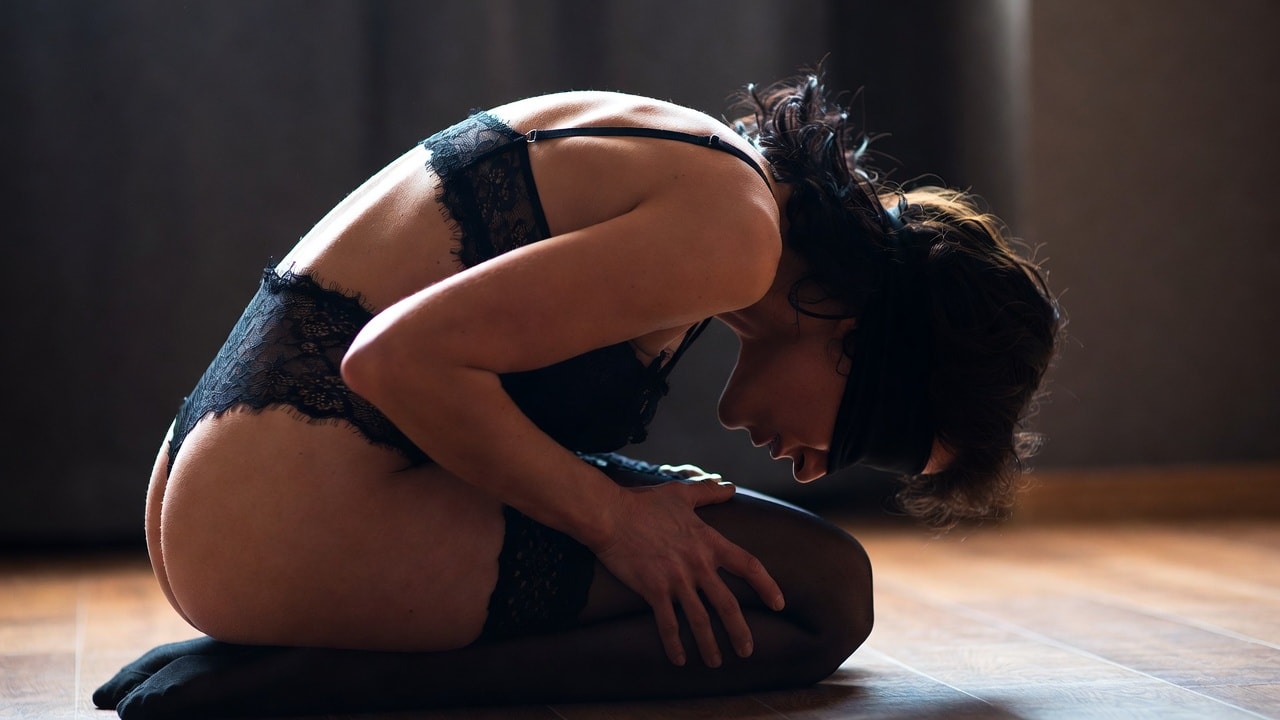
The light comes in low and patient, the way morning light does when no one is performing for it. A wooden floor. A blindfold tied without ceremony. And a woman folded all the way forward over her own knees, dressed in nothing sturdier than black lace.
Look at that picture long enough and you notice what is missing. No leather. No steel. No buckles counting down her spine. Nothing that could hold her there. The lace could tear like paper. The blindfold could slip with a shake of her head. She stays anyway.
That is the whole essay, really. Everything below is just me taking my time with it.
Leather announces. Lace admits.
We dress the lifestyle in hard materials, in our imaginations and on our book covers. Leather, latex, chain. Armor for people brave enough to want things out loud. And I love those materials — I have written about them often. They speak clearly. A corset laced to the spine says: I am held. A harness says: I am mapped and claimed.
Lace says something quieter and, I think, more difficult.
Lace hides nothing. It is a fabric made mostly of holes, a pattern of absence, decoration built around openness. It offers no protection, no compression, no structure. Wearing it is not a statement of strength. It is an admission: I have decided not to defend myself here.
Leather announces surrender to an audience. Lace admits it to one person. Sometimes only to yourself.
Softness is a decision, not a default
There is a lazy reading of submission that mistakes it for passivity — as if the submissive simply lacks the will to do anything else. Anyone who has actually knelt knows better. Holding still is work. Choosing openness, over and over, in a world that rewards armor, is work.
The same is true of softness. A woman does not drift accidentally into lace at seven in the morning on a bare wooden floor. She chose it from the drawer. She felt the decision in her fingers before she felt the fabric on her skin. Softness, worn deliberately, is one of the most assertive things a submissive can put on — because it costs something. It leaves her without excuses. Whatever happens next, she cannot pretend she was braced for it.
What the skin knows when the eyes are covered
Now add the blindfold, and the choice of fabric stops being aesthetic and becomes practical.
When sight goes, the skin gets promoted. Every submissive who has worn a blindfold knows this arithmetic: subtract one sense and the others do not merely compensate, they sharpen past usefulness into something almost unbearable. The room becomes texture. Air movement becomes information. Time becomes something you feel on the back of your neck.
Lace against blindfolded skin is a constant, low murmur. The scalloped edge at the hip. The slight bite of a stocking top. The place where pattern ends and bare skin begins — a border she can feel but not see, redrawn every time she breathes. She is wearing her own attention. The fabric keeps her present in her body at exactly the moment her body is all she has left.
This is why I tell those who serve me not to think of dressing as decoration. It is instrumentation. You are choosing what your skin will tell you later, when telling you things is your skin's entire job.
The bow that holds itself
Look at the posture again. This is not a kneel that displays. Her forehead reaches toward the floor. Her arms wrap her own legs. She has folded herself small, gathered herself into a shape with no openings and no view, a knot tied out of her own body.
There is a species of surrender that needs to be watched to exist — the presented pose, the lifted chin, the performance of obedience. It is beautiful and it has its place. But this bow is different. This bow would look exactly the same in an empty room.
And notice: nothing holds her except her. No rope does the work of her stillness. No hand rests on her back. She is both the offering and the altar. In rope we would call this self-suspension of a kind — all the tension is internal. The discipline is invisible because she has swallowed it.
I trust this shape more than almost any other. A submissive who can hold her own bow, blind, in soft clothes, on a hard floor, with no one applauding, has stopped negotiating with her surrender. She is not asking am I doing it right? She is simply doing it.
Dressing for a moment no one photographs
Let me make this practical, because ritual lives in the practical.
Most of the surrender in a real dynamic happens without witnesses. Not at parties, not in studios — in ordinary rooms, on weekday mornings, between the emails and the dishes. And the fastest way I know to move a body from the ordinary world into the other one is dressing done as ritual rather than routine.
It goes like this. The clothes are chosen the night before, or they are always the same ones — ritual loves repetition. They are put on slowly, in order, with attention. Not because anyone is watching. Because the order itself is a corridor, and walking it changes you. Stocking, then stocking. The lace settled at the hip with two thumbs. The blindfold last, always last, because the blindfold is the door closing.
By the time she kneels, she has already been kneeling for ten minutes. The bow is just the body catching up to a decision the hands made at the drawer.
For the one who receives this
If you are the one she kneels for: understand what the lace is telling you. Armor asks to be tested. Softness asks to be answered. A submissive who comes to you undefended is paying you the highest compliment in this entire lifestyle — she is telling you that your control is sufficient structure, that she does not need boning and buckles because she has you.
Answer that. Be exact. Be warm. Arrive on time to your own dominance. The undefended body keeps no armor between itself and your carelessness either — that is the weight you agreed to carry.
The quiet contract underneath
None of this works as decoration alone. The blindfold is only restful because she knows precisely who is in the room. The lace is only brave because she chose it freely and can choose otherwise tomorrow. Softness without safety is not surrender; it is just exposure.
So the unglamorous scaffolding stands under every image like this one: the conversations held in full daylight, the limits spoken and written, the word that stops everything, the aftercare that follows even the gentlest scene. Trust is not the mood of the picture. Trust is the load-bearing wall the picture hangs on. Consent is what makes the difference between a woman folded in lace on a wooden floor and a woman merely cold.
Build the wall first. Then hang whatever beauty you like on it.
Wear what tells the truth
Here is what I want you to take from her, bowed there in the morning light.
You do not need to look armored to be serious. You do not need hardware to be held — a held mind outranks a held wrist every time. And you do not need an audience for your surrender to count. The deepest bows happen on ordinary floors, in soft clothes, with no one watching but the one who matters — even when that is only the person you are becoming.
Choose the lace on purpose. Tie the blindfold last. Fold forward until you are small enough to be honest.
Softness, worn deliberately, is not the absence of strength. It is strength that no longer needs to be seen to be believed.
— Mistress Krigar