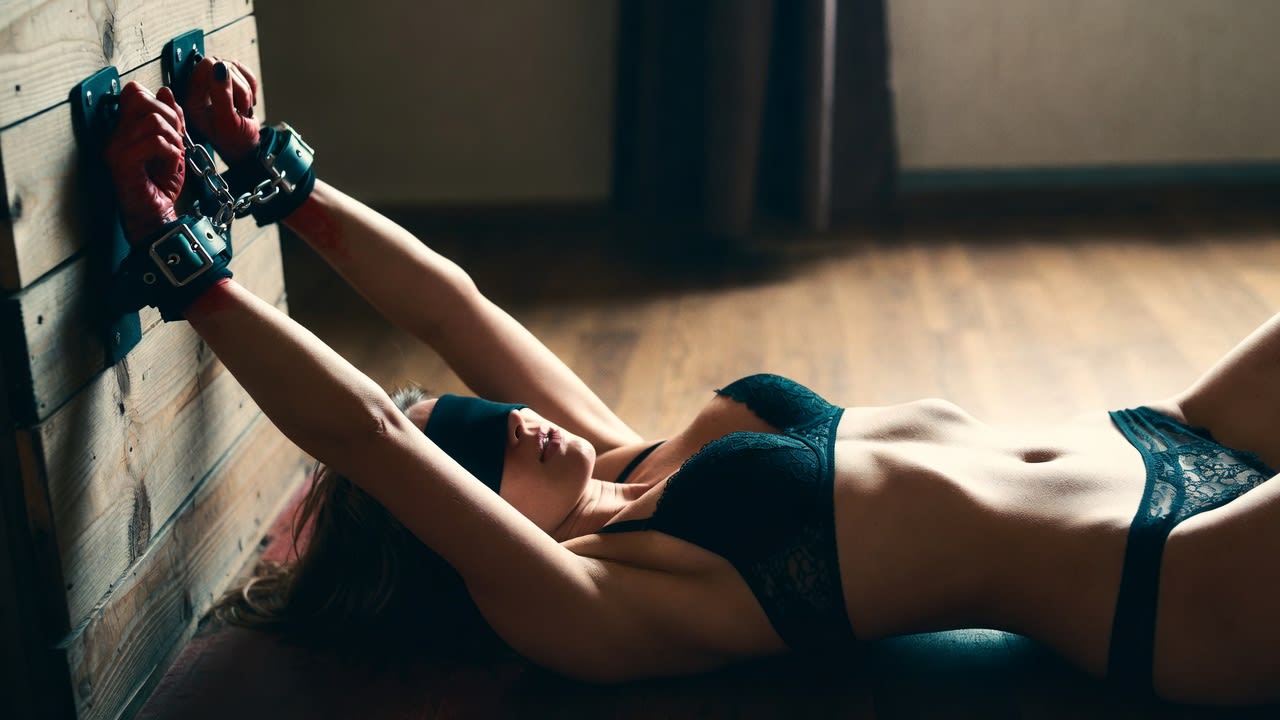
There is a particular quiet that arrives the moment the last cuff is buckled and the chain draws tight. Not fear. Not even excitement, exactly. Something older and lower than both — the body understanding, before the mind does, that the decision has already been made. You are held to the wall now. You are not going anywhere. And somewhere in that stillness, a knot you have carried all day begins, at last, to loosen.
This is a piece about that stillness. About leather cuffs and an anchor point. About the dark behind a blindfold, and the long, deliberate sweetness of being bound in place and made to wait.
The Anchor Point Changes Everything
Most people imagine restraint as a thing done to the wrists. It is not, really. Cuffs alone are jewelry. What transforms them is the anchor — the fixed point, the bolt in the wood, the place the chain runs to and does not give.
Wrists bound together still leave you mobile. You can roll, rise, wander. But wrists bound to something — to a wall, a ring, a frame that will not move no matter how you test it — that is a different sentence entirely. The anchor removes the last small lie we tell ourselves in surrender: the lie that we could still leave if we wanted to. Fastened in place, you cannot. And the strange gift of that is relief.
Feel it, the next time. The first pull is always a question. You lean, and the leather answers, and the chain answers behind it, and the wall behind that. Three refusals in a row. The body asks may I go? and the honest, immovable answer is no. Most of us spend our whole lives never once being told that cleanly. Here it is a kindness.
Why We Reach for the Blindfold
Take the eyes and you give everything else back doubled. This is the plain arithmetic of sensory deprivation, and it is why the blindfold is not an accessory but very nearly the centre of the scene.
Sight is the sense of control. We use it to measure distance, to read a face, to know what is coming so we can prepare our own reaction to it. Cover it, and all of that scaffolding falls away. You stop performing composure because you can no longer see whether it is working. You are left with only what touches you, and when it touches you, and the space between.
The Body Grows Ears in the Skin
In the dark, the world reorganizes. A footstep on wood becomes a whole event. The temperature of a breath tells you where a mouth is. The faint drag of a fingertip you did not see approaching lands with three times its weight, because you had no chance to brace. Restraint holds the body still; the blindfold holds the mind still, and between the two of them you are finally, gorgeously, unable to get ahead of the moment.
That is the whole point. To be caught inside now, unable to lean into the next thing, unable to manage. Blindfold play is not about being frightened of the dark. It is about being handed back your own skin.
The Long Sweetness of Waiting
Here is the part the pictures never quite explain. So much of surrender is not sensation at all. It is waiting.
Bound to the wall, blindfolded, you are placed into time the way one is placed into water — slowly, and then all at once. Nothing is happening. That is not a flaw in the scene; it is the scene. The one who holds you has walked to the other side of the room, or has simply gone quiet, and you are left to steep. To marinate in your own anticipation until the anticipation becomes a texture you can feel on the arms, the throat, the belly.
Impatience is the first thing to surface, and it is meant to. Let it. Let it rise and crest and find nothing to push against. Because the wall does not hurry, and the cuffs do not hurry, and the one who holds you does not hurry, and eventually — this is the deilig part, the part worth staying for — you stop hurrying too. The waiting stops being something done to you and becomes something you sink into. That is surrender proper. Not the moment you are bound. The moment you stop counting.
What You Are Actually Handing Over
People think submission is about handing over the body. The body is the easy part; it is right there, it can be tied in a minute. What you are really handing over is the timeline. The right to decide when the next thing happens. And there is a specific peace in that surrender that nothing else in ordinary life offers, because ordinary life asks you to hold the timeline every waking second.
For a little while, on the floor, in the dark, the timeline belongs to someone else. You may simply exist inside it. That is the luxury being sold here, and it is not a small one.
Trust Is the Thing Holding You, Not the Chain
None of this works on hardware. The chain is strong, but the chain is not what keeps you there. You could break a scene in a heartbeat with a single word, and both of you know it. What actually holds you is the agreement underneath the leather — that your no is real, your limits are law, and the one who bound you will honor the dark you have been placed in rather than exploit it.
Good power exchange is almost boringly rigorous about this. The conversation before the cuffs. The safeword that is never negotiated away. The eyes — the sighted eyes, the ones still watching you — reading the small language of your hands, your breathing, the set of your jaw, catching the moment "intense" tips toward "too much" often before you have found the word for it yourself.
That is what lets you go so far down. Not recklessness. The opposite of recklessness. You surrender that completely because the container is that solid. The restraint is theatre; the trust is structure. Confuse the two and you have missed the entire craft.
A Note on Aftercare
When the cuffs come off, the story is not over. Blood returns to the hands. The blindfold lifts and the light is suddenly enormous. Coming up out of that much surrender can leave a person raw in the best and most tender way, and it deserves the same care the descent did — warmth, water, a steady hand, quiet. The wall held you. Now something softer should.
Beginning, If You Are Curious
You do not need a dungeon or a wall of bolts to taste this. You need very little, and you need to move slowly.
Start with a single pair of well-made leather wrist cuffs and a soft blindfold. Start with the timeline, not the toy — practice being made to wait for one honest minute before anything else happens, and notice what that minute does to you. Agree on a word before anything is fastened, and mean it. Anchor to something forgiving before you anchor to anything fixed. And check in, out loud, more than you think you need to. The intensity does not come from severity. It comes from precision and patience, layered slowly, by two people who trust each other enough to take their time.
Restraint, blindfold, the waiting in the dark — none of it is really about the equipment. It is about being given permission to stop holding everything for a while. To be fastened in place and made to be still and, in that stillness, to be more present than you have let yourself be in months.
You worked out how to carry everything a long time ago. This is the opposite lesson. Be held to the wall. Let the dark come down. And wait — because the waiting, once you stop fighting it, is the sweetest part of all.
— Mistress Krigar