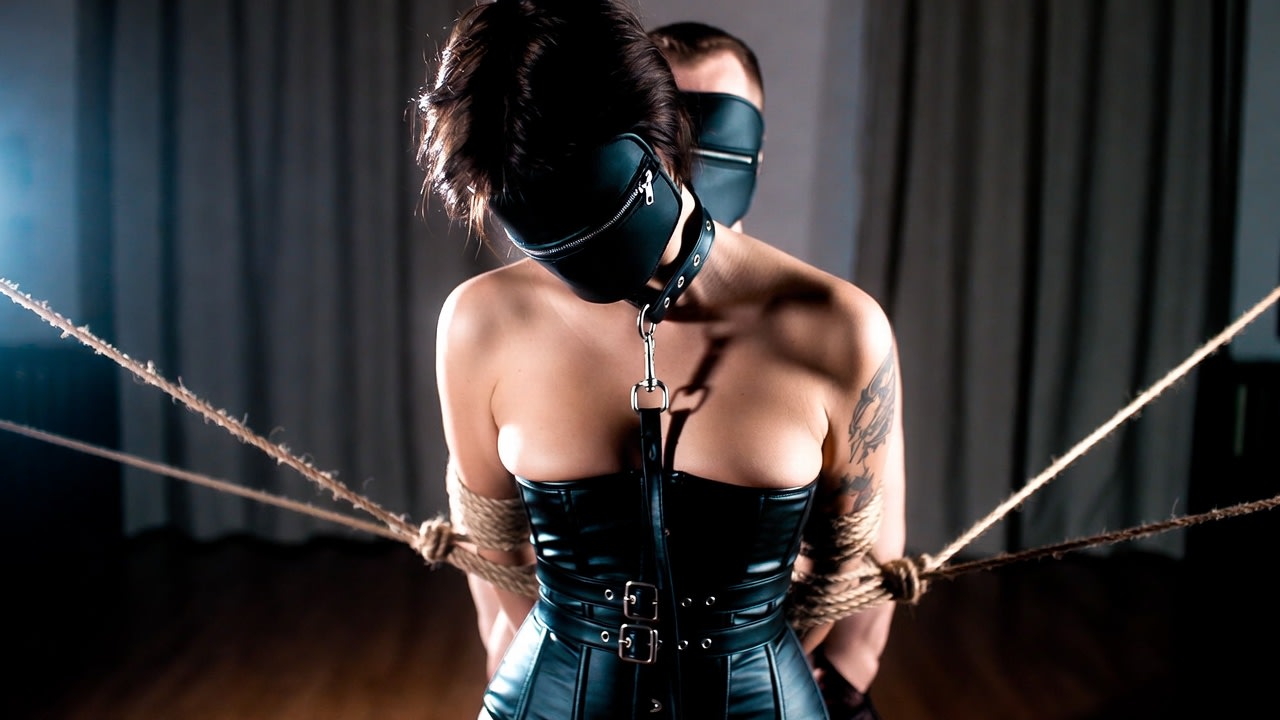
Look at her. Rope runs from her wrists to points she cannot see, pulled tight in four directions, and yet nothing about her is straining. The corset holds her spine. The blindfold holds her eyes. The leash hangs quiet at her collar. Someone stands behind her — close enough to feel, too far to lean on. She is caught in a web of tension, and she has never been more at rest.
That is the paradox I want to sit with today. Not the rope itself, though we will get to the rope. The stillness. The particular, bone-deep stillness that only arrives when every line is taut and there is nowhere left to go.
The Paradox of Tension
People who have never been tied imagine rope as confinement. Something done to you. Something you endure until it ends. They picture struggle, because in their world tension means conflict.
They have it backwards.
A body held from every direction is a body that no longer has to hold itself. Think about what you carry through an ordinary day: the posture you maintain, the face you compose, the decisions stacked one on top of another from the moment you wake. You are, every hour, the sole thing keeping yourself upright. Nobody tells you how exhausting that is because everybody is doing it, and we have agreed not to mention it.
Then the rope draws tight — one line, then another, then the opposing pull that balances the first — and something ancient in the body does the arithmetic before the mind catches up. I cannot fall. I cannot drift. I am held. The shoulders drop. The breath lengthens. The jaw, that little fist in your face that clenches through every meeting and every commute, finally opens.
Tension, applied with intention, is not conflict. It is architecture. A suspension bridge is nothing but opposing forces in perfect agreement, and it carries more weight than any slack thing ever could.
What the Blindfold Takes
Now cover the eyes.
Sight is the sense of vigilance. It is how you scan the room, read the faces, anticipate what comes next. Sight is the manager inside you that never clocks out. Take it away and the first response is always a flicker of protest — the mind casting about for its favourite instrument and finding nothing.
Then the dark settles, and the trade reveals itself.
What the blindfold takes is anticipation. What it returns is presence. You cannot see the hand approaching, so every touch arrives whole, unannounced, undiluted by the seeing of it. The creak of a floorboard becomes an event. Breath on the back of the neck becomes a sentence. The world, reduced, becomes vivid in a way the sighted world never manages — because you are no longer watching your life from one step ahead of it. You are in it. Exactly here. Exactly now.
The Listening Body
A blindfolded body listens with its whole surface. Skin becomes attentive. Hearing sharpens until you can track a person's weight across a room. This is not deprivation — it is redistribution. The attention you spent on watchfulness comes home to the body it abandoned, and the body, flooded with its own returned attention, wakes up.
This is why the blindfold belongs with the rope. The rope quiets the muscles; the blindfold quiets the mind. Together they empty the room of everything except what is actually happening in it.
The One Who Stands Behind
None of this works alone.
You cannot tie yourself into surrender any more than you can tickle yourself into laughter. The nervous system knows the difference between a knot you can undo and a knot you cannot, and it reserves its deepest release for the second kind. Stillness of this quality requires another person — one who stays.
Look at the image again. Behind her stands a figure she cannot see. She knows he is there the way you know the wall of a house is there: not by checking, but by the quality of the shelter. Every taut line in that room runs, eventually, back to a decision someone made about her wellbeing. The rope is only the visible part of the attention.
And this is the part outsiders miss entirely. The one who ties is not taking. The one who ties is keeping. Keeping watch, keeping count, keeping the circulation moving and the breathing easy and the whole fragile arrangement inside the borders that were agreed before the first line touched skin. Dominance of this kind is a form of vigilance so complete that the other person can finally stop being vigilant at all. That is the gift. Not the rope — the watching.
Rope Is a Language, and It Does Not Rush
Hemp rope has a smell — grass and dust and something faintly like bread — and a voice, a dry creak when it takes load. It marks the skin gently and briefly, a signature that fades by morning. It is an honest material. It does not stretch to flatter you and it does not lie about how much it holds.
Tying with it is slow by nature, and the slowness is the point. Each wrap laid flat, each tension checked against the last, fingers slid beneath the line to measure the space that must remain. A person who ties well is asking questions with their hands the whole time — how is this, and this, and here? — and a person who is tied well is answering with breath and small sounds and the settling of weight. It is a conversation conducted entirely in pressure. By the final knot, more has been said than most couples manage in an evening of talking.
This is why rope cannot be rushed and should never be casual. The lines in that photograph are taut because two people agreed, beforehand and in detail, about exactly what those lines would mean. The negotiation is not the boring part before the scene. The negotiation is the foundation the whole cathedral stands on.
The Stillness You Cannot Give Yourself
Here is what I know after years of watching people arrive at this place: the ones who need the rope most are the ones who hold the most.
The capable ones. The ones who run teams and households and never miss a deadline. The ones everyone else leans on. They come to the rope not because they are weak but because they are tired in a place sleep does not reach — tired of being the load-bearing wall of their own life.
Stillness, real stillness, is not something the strong can take. It has to be given to them, by someone they trust enough to receive it from, in a structure firm enough that the letting go is safe. The rope is that structure. The taut line is permission, written in fibre: you may stop now. I have you. Nothing is required of you but breath.
Watch a person like that in the moment the last line takes their weight. The face changes. Years come off it. What you are seeing is not pleasure, or not only pleasure. It is relief — the specific relief of a burden set down by someone who had forgotten they were carrying it.
Earning the Taut Line
If this image calls to you, let it call you slowly.
Trust of this depth is built the way rope itself is built — fibre by fibre, twisted together over time until the strands become one thing that holds. It begins with words: what you want, what you fear, where your edges are, what the signal is when a line must come off now. It grows through small experiments, honestly debriefed. It is maintained by aftercare, by warmth and water and the quiet talking-through, because the descent back from that deep stillness deserves as much attention as the climb into it.
There are no shortcuts, and you should be suspicious of anyone who offers one. The rope in that photograph is taut because it was earned. Every line of it.
Where the Ropes Cross
At the center of that web of tension kneels a woman doing, outwardly, nothing at all. No performance. No effort. Her hands are bound behind her; her eyes are elsewhere; her whole task in this world, for this hour, is to breathe and be held.
It looks like the least free position a body can occupy. It is the freest she will feel all week.
That is the secret the rope keeps, and tells only to those patient enough to learn its language: surrender is not the opposite of strength. It is what strength does when it finally trusts something enough to rest.
Be still. You are held.
— Mistress Krigar