There is a particular kind of silence that only arrives once you can no longer move.
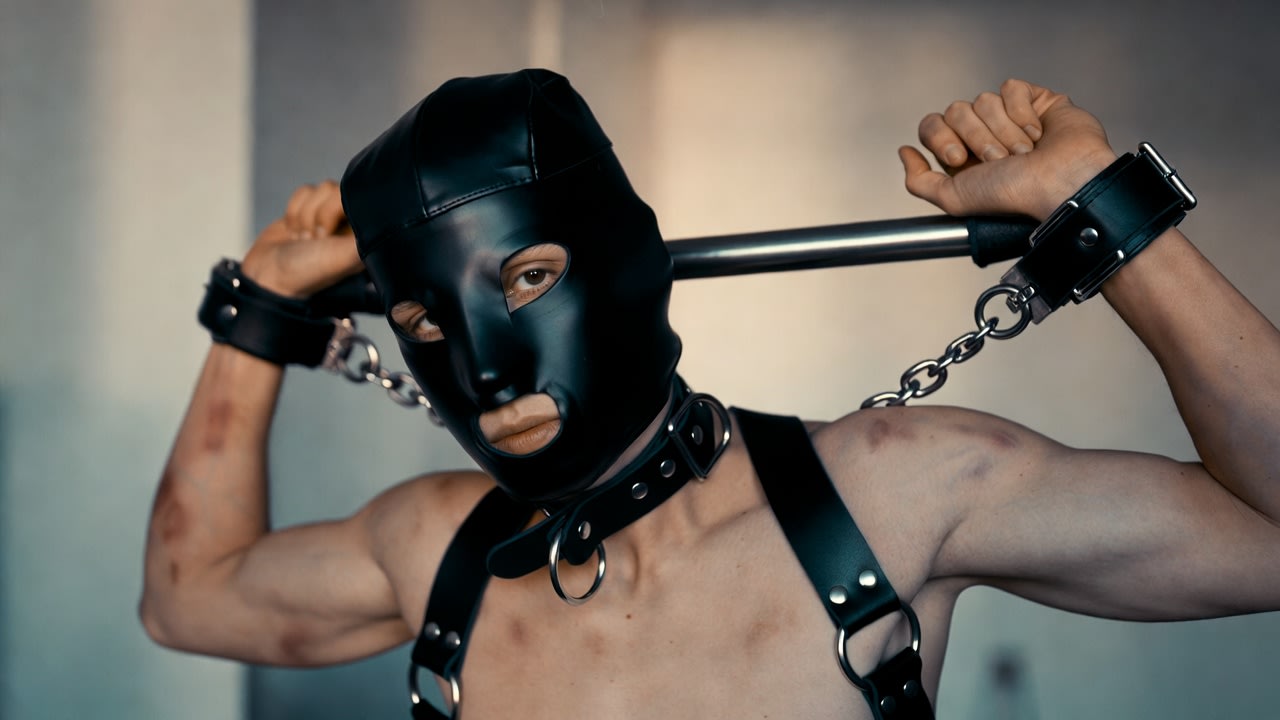
Look at the figure. The hood is on. The wrists are cuffed wide to the bar. The collar sits at the throat, and a chain runs from it like a sentence already decided. Nothing here is loud. Nothing is theatrical. And that is exactly the point. Restraint, done well, is not about spectacle. It is about stillness — the deep, deliberate stillness that lets a person finally stop performing and simply be held.
This is a meditation on that stillness. On the hood, the bar, the collar, and the surrender they make possible.
The Hood: Where the Self Quiets Down
The first thing the leather hood takes is the face. And the face, for most of us, is where the work lives — the expressions we manage, the reactions we curate, the small constant labour of being seen and seeming fine.
Put the hood on, and that labour ends.
Behind the leather, there is no one to perform for. The eyes still see, the mouth still breathes, but the social self — the one that smiles on cue and braces against judgment — goes quiet. What remains is sensation. Texture against the skin. The warmth of your own breath returning to you. The strange, welcome smallness of a world reduced to what you can feel.
People imagine the hood is about anonymity, about hiding. It is closer to the opposite. With the face gone, there is nowhere left to hide. You are returned to your body, exactly as it is, and asked only to stay there. That is not a disappearance. It is an arrival.
Sensation as a kind of honesty
When sight narrows and the familiar noise of self-image falls away, the smaller signals get louder. A shift in air. The cool line of a chain. The press of leather where a moment ago there was nothing. The body begins to tell the truth it usually mumbles under everything else.
This is why sensory restriction is so often described as grounding rather than frightening. Fewer inputs, more attention. The mind stops sprinting and starts listening.
The Bar: An Honest Geometry
A spreader bar does not negotiate. It holds the arms where it holds them, and it does not pretend otherwise. There is something almost kind in that honesty.
Look at how the wrists sit — cuffed, opened, suspended in a shape the body did not choose and cannot undo. The bar removes the option of fidgeting, of half-measures, of the thousand tiny adjustments we make to stay in control of how we are seen. It draws a clean line and says: here. Stay.
And in that fixed geometry, something loosens. When you cannot rearrange yourself, you stop trying. The shoulders drop. The breath lengthens. The mind, denied its usual escape routes, settles into the only place left to go — down, inward, into the present.
Restraint is not the absence of freedom. It is the freedom to stop holding yourself together.
That line matters. Because the great misunderstanding about bondage is that it is something done to a person. At its best, it is something done for them. The bar does the work of holding so the body underneath it can finally let go.
The Collar: A Word Made of Leather
And then there is the collar.
The hood quiets the self. The bar fixes the body. The collar answers the only question that remains: whose?
A collar is not jewellery, though it can be beautiful. It is a statement worn at the throat — the most vulnerable, most honest part of the body, where the pulse lives and the voice begins. To wear one is to say, plainly and without apology, that you have chosen to belong to this moment, to this exchange, to the hands that fastened it.
See the O-ring at the centre. The chain that finds it. Nothing about it is accidental. A line is drawn from the collar to the cuffs, and that line says: you are connected, you are claimed, you are not floating loose. You are held.
There is enormous relief in being claimed by something you trust. It is the difference between drifting and being anchored.
Surrender Is Not Weakness
Let me be clear, because the world is sloppy about this.
The person in restraints is not the powerless one. Surrender is a thing you give, and you cannot give what you do not own. It takes a particular kind of strength to lower your defences on purpose — to say I will stop steering, I will stop bracing, I will let myself be held — and to mean it.
That is not collapse. It is trust in motion.
The submissive in the hood and the bar has made a decision most people never dare to make in their daily lives: to stop being in charge of everything for a little while, and to discover that the sky does not fall. That the held body is safe. That letting go is not the same as losing.
Power, exchanged — not taken
This is why the language matters. We do not say power is taken in these moments. We say it is exchanged. One person offers stillness and obedience; the other offers attention, control, and care. It is a circuit, not a conquest. The one holding the leash is also holding a responsibility — to watch, to read the body, to honour the trust that made the whole thing possible.
Without that, restraint is just rope and metal. With it, restraint becomes a language two people speak together, fluent and quiet.
Why Stillness Feels So Good
There is a reason the held body so often exhales.
In ordinary life, the mind is a manager that never clocks out. It plans, it guards, it second-guesses, it keeps a hundred plates spinning. Restraint takes the plates away. It says: you cannot fix anything from here, so you may as well stop trying.
And the nervous system, offered permission to stop, often does something remarkable. It drops. The tight wire of vigilance goes slack. Some people describe a floating warmth, a softness behind the eyes, a quiet that they cannot find any other way. The body has been waiting, sometimes for years, to be told it is allowed to rest.
That is the deilig paradox at the centre of all of this: the tighter the hold, the deeper the release.
Doing It Well: Trust Is the Real Equipment
None of this works without one thing, and it is not the leather.
It is trust.
The hood, the bar, the collar — these are beautiful tools, but they are only as good as the agreement underneath them. Before the first cuff closes, there is a conversation. What is wanted. What is off the table. The word that ends everything instantly, no questions, no delay. The held body must know, in its bones, that the hands around it are paying attention.
This is the unglamorous truth that the photographs never show: the safest, most surrendered scenes are built on the least mysterious foundations. Clear words. Agreed limits. A way to stop. Two people who have decided, in plain daylight, what they are about to share in the dark.
Negotiate everything first. Restrain nothing you have not discussed. Keep a way out within reach — a release for the cuffs, a signal that needs no voice. Watch the body the whole way through. And afterwards, come back gently: warmth, water, quiet words, the slow return from that held place to the ordinary world. The surrender does not end when the bar comes off. It ends when the person is fully, softly back.
That care is not an afterthought. It is the whole point.
The Quiet After
So look one more time at the figure in the hood.
Not powerless. Chosen. Not trapped. Held. Not silenced. Finally quiet, in the way a person can only be quiet when they have decided, on purpose, to stop carrying themselves for a while.
This is what surrender offers — not a loss of self, but a rest from the exhausting work of defending it. The bar holds the arms. The collar holds the throat. The hood holds the noise. And underneath all of it, someone gets to set down a weight they did not even know they were carrying.
That is the deilig thing. That is the whole quiet point.
Come back when you are ready to be held.
— Mistress Krigar